When DIY Mold Removal Actually Works
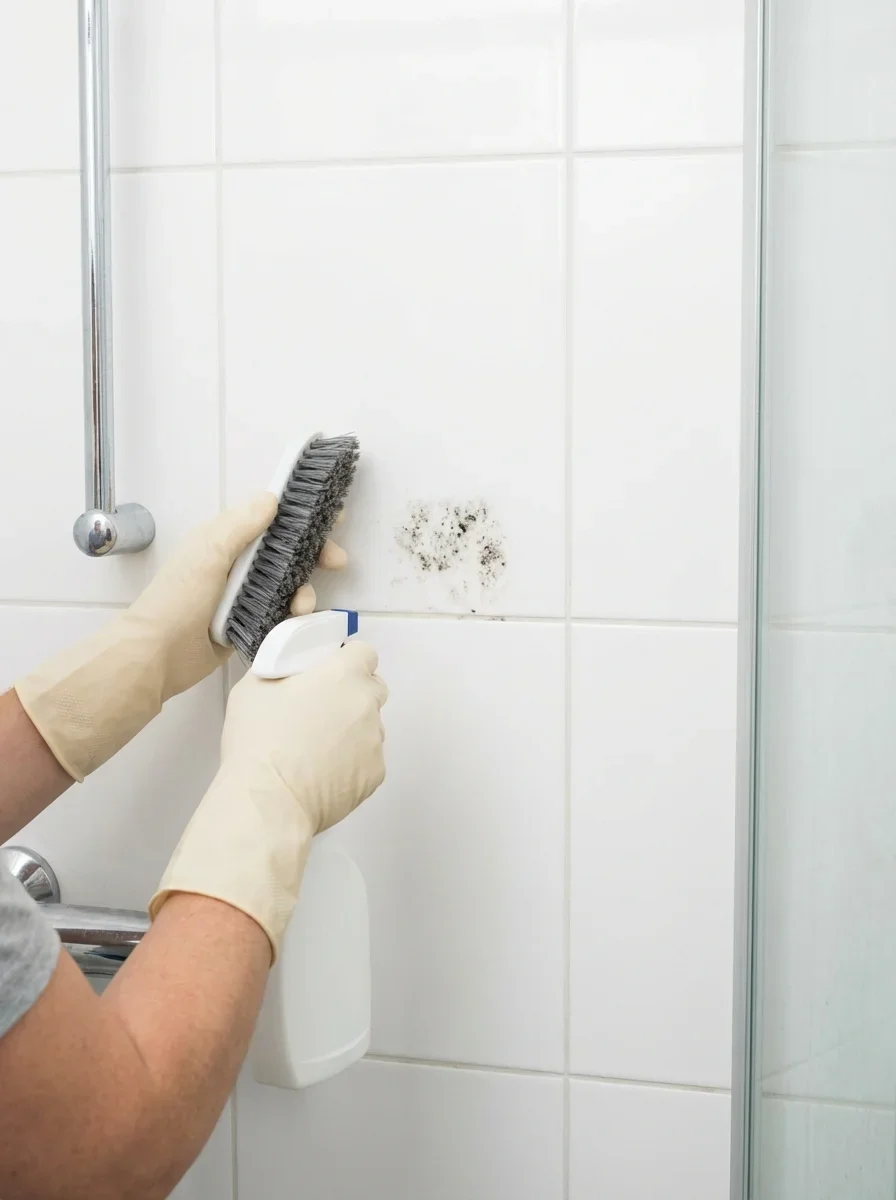
Small, surface-level mold on non-porous materials is the only scenario where DIY makes sense. We're talking about a patch smaller than 10 square feet on tile, glass, or sealed metal—places where mold can't penetrate.[1] A shower door with visible spots, a windowsill, or the edge of a bathroom vanity all qualify if you catch them early.
The EPA sets that 10-square-foot threshold for a reason: below it, you can usually handle cleanup with basic protective gear and household solutions like vinegar, hydrogen peroxide, or an EPA-registered antimicrobial cleaner.[1] Above it, you're dealing with enough spore load that disturbance without proper containment creates what one Houston homeowner described as a "spore explosion" that sent mold through every air vent in their 2,400-square-foot home.
The critical step most DIYers skip? Fixing the moisture source before cleaning.
Mold doesn't grow without water. In Texas homes, that means tracking down condensation on AC ducts (common in our 8-month cooling season), a toilet supply line weeping at the connection, or roof flashing that failed during the last thunderstorm. Clean the mold without addressing the leak, and you're back to square one in two weeks.
| Factor | DIY Mold Removal | Professional Remediation |
|---|---|---|
| Best For | <10 sq ft on non-porous surfaces | >10 sq ft, porous materials, hidden growth |
| Equipment | N95 mask, spray bottle, scrub brush | HEPA filtration, negative air machines, containment barriers |
| Cost | $50-$200 | $1,500-$30,000 depending on scope |
| Moisture Detection | Visual inspection only | Thermal cameras, moisture meters, borescopes |
| Documentation | None | Lab testing, clearance reports, insurance records |
| Recurrence Risk | High if source not fixed | Low with proper protocol |
The Equipment Gap Between You and a Pro
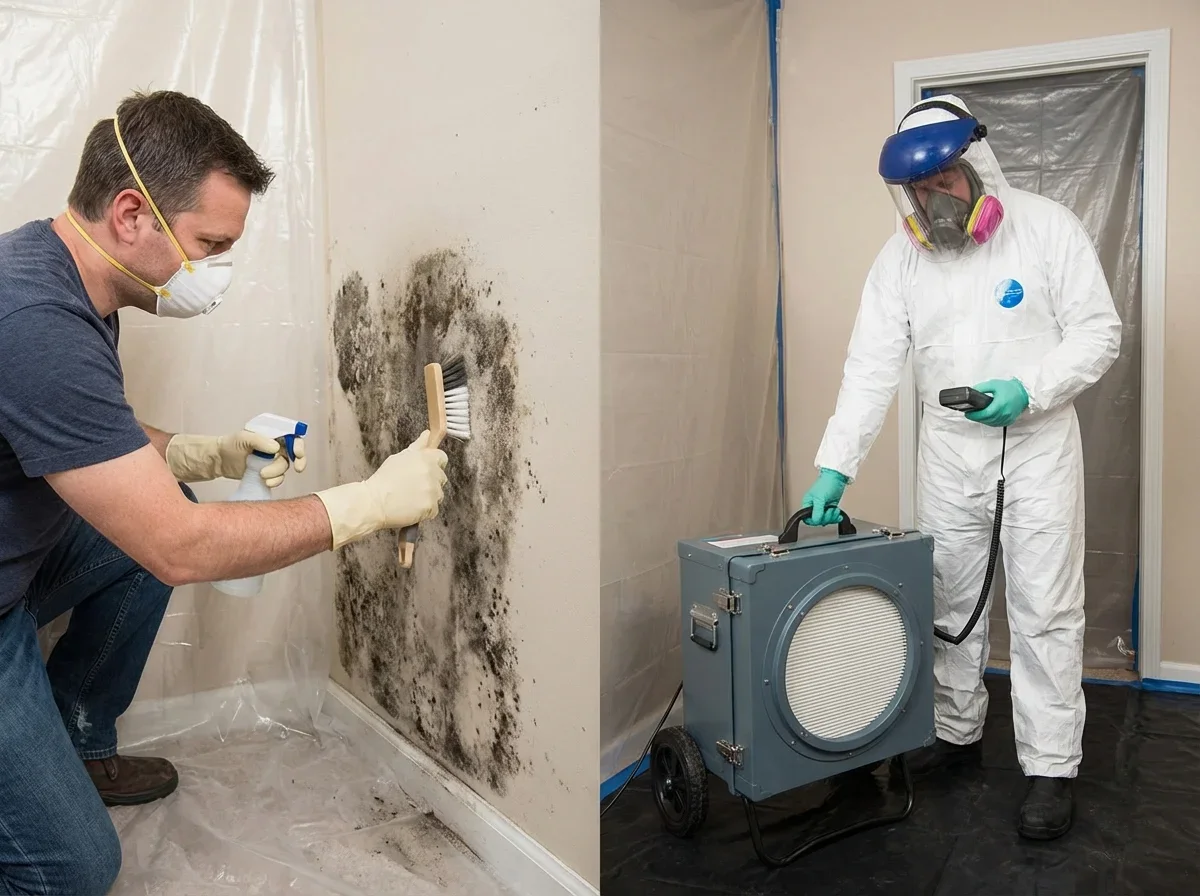
Professional mold remediation uses containment barriers, negative air machines with HEPA filtration, and air scrubbers that pull spores out of circulation during cleanup.[2] You're working with an N95 mask, safety goggles, rubber gloves, and maybe a spray bottle of Concrobium if you did your homework.
That equipment difference matters because disturbing mold releases spores into the air. A light scrubbing on bathroom tile can send millions of particles airborne. Without negative pressure containment (which pulls air toward the work area and filters it before exhaust), those spores drift into your HVAC return, settle in your ductwork, and colonize new surfaces days later.
One San Antonio homeowner tried DIY on attic mold and ended up with growth in every supply register—turns out their AC was running while they scraped, and the system distributed spores to 14 rooms.
Professionals also use moisture meters, infrared cameras, and borescopes to find hidden growth. Your eyes can't see through drywall. A thermal imaging camera shows a wet wall cavity behind your shower that's been feeding mold for six months. Those tools don't live in your garage, and the stakes in Texas are high: expansive clay soil shifts foundations constantly, cracking slab edges and plumbing lines underneath.
A visible patch on your dining room baseboard might trace back to a slab leak you'll only find with detection equipment.
What Texas Licensing Requirements Tell You About Risk
Texas mandates separate licenses for mold assessment and remediation through the Texas Department of Licensing and Regulation under TMARR (Texas Mold Assessment and Remediation Rules).[2] That's not bureaucratic overkill—it's recognition that mold work requires specialized training in containment protocols, personal protective equipment, and safe disposal. You can verify credentials at https://www.tdlr.texas.gov/mol/mol.htm before hiring anyone.
The rules also prohibit the same company from assessing and remediating your mold. An assessor inspects, tests, and writes a protocol; a different licensed remediator follows it. That separation exists because the incentive to upsell disappears when the inspector doesn't profit from the cleanup.
No similar checks exist when you're both assessor and remediator in your own home.
You might think you're looking at surface mold on drywall when an IICRC S520-trained technician would recognize it as the visible edge of category 3 growth extending four feet into the wall cavity. DIY doesn't require licensing, insurance, or following EPA's Mold Remediation in Schools and Commercial Buildings guidelines.[1] That's fine for wiping down a shower surround. It's catastrophic when you unknowingly disturb Stachybotrys in a water-damaged wall cavity without respiratory protection rated for mycotoxin exposure.
Hidden Mold Is the Real Problem in Texas Homes
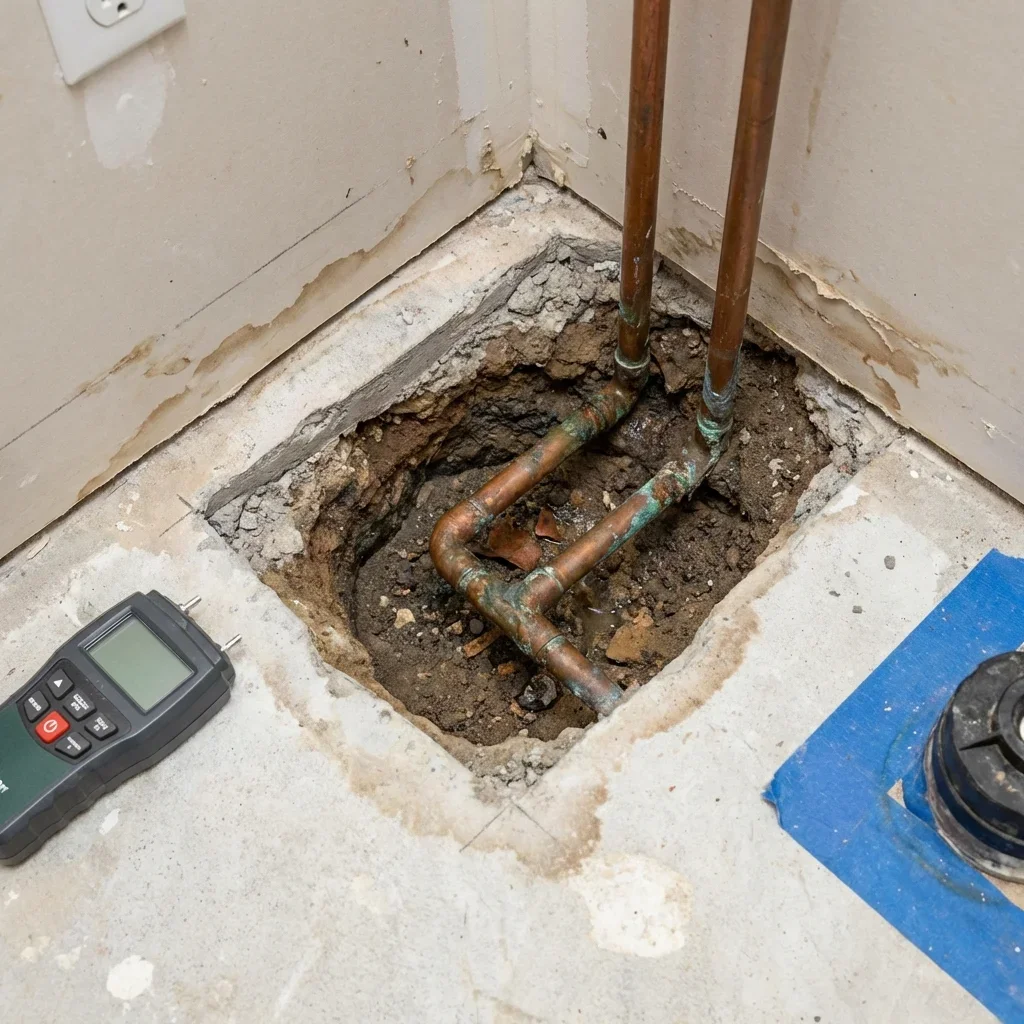
Slab-on-grade construction—the standard across Houston, Dallas-Fort Worth, Austin, and San Antonio—hides plumbing underneath concrete. When a copper supply line corrodes (accelerated by our hard water at 150-300+ ppm calcium), it leaks slowly under the slab for months. You'll notice warmer floors, higher water bills, or foundation cracks before you see mold.
By then, moisture has wicked up through the slab into wall cavities, insulation, and subfloor areas you can't access without cutting drywall.
Pier-and-beam homes in older neighborhoods face the opposite problem: crawl spaces that trap moisture year-round. Texas humidity averages 60-75% in summer across the eastern half of the state. Poor crawl space ventilation creates ideal conditions for mold on floor joists, subfloor plywood, and HVAC ductwork running through those spaces. You'll smell it through floor vents before you see it.
One Dallas homeowner scrubbed visible mold off their master bathroom ceiling, only to discover during a later whole house mold remediation that the attic had 300 square feet of growth on roof decking. The bathroom moisture had been venting into the attic through an improperly installed exhaust fan for two years.
DIY cleaned the symptom; it took professionals to find the source.
Pro Tip: The mold you can see is rarely the whole problem. In Texas homes, visible growth on walls or ceilings typically indicates hidden moisture issues in cavities, under flooring, or in attic spaces. If surface cleaning doesn't permanently solve the problem, you're dealing with structural moisture intrusion that requires professional diagnosis.
The Real Cost Math (And Why DIY Isn't Always Cheaper)
DIY mold removal costs $50-$200 in materials: cleaner, protective gear, disposal bags, maybe a replacement section of drywall if you're handy. Professional remediation in Texas runs $1,500-$6,000 for typical residential jobs, with whole-house projects after flooding reaching $15,000-$30,000 depending on square footage and materials affected.[2]
Those numbers make DIY look like an obvious win until you factor in what goes wrong.
Incomplete removal means regrowth within weeks—you've spent $150 and a weekend to end up back at square one. Spore dispersal through your HVAC means you've turned a bathroom problem into a ductwork contamination requiring HVAC mold removal at $2,000-$5,000. And if you miss hidden mold that later forces remediation during a real estate transaction, you're paying for both the professional job and the deal delay or buyer credit.
The cost advantage of DIY evaporates if the job takes three attempts, requires duct cleaning afterward, or causes health issues that send you to urgent care. One Houston homeowner spent $89 on supplies to clean attic mold themselves, inhaled spores without proper respiratory protection, and ended up with a sinus infection that required two rounds of antibiotics.
Their eventual professional remediation cost $3,200—$3,000 more than if they'd called a licensed contractor on day one.
Insurance adds another wrinkle. Most Texas homeowners policies exclude mold unless it results from a covered peril like sudden pipe burst. If you DIY and worsen the damage (or your attempt creates proof of "lack of maintenance"), you've just voided any potential coverage. A TDLR-licensed company documents everything for insurance claims and knows exactly what policies typically cover.
Health Risks You Can't See Coming
No federal exposure limits exist for airborne mold concentrations, which means OSHA and EPA rely on precautionary protocols rather than hard thresholds.[3] Professional remediators follow guidelines from the ACGIH, NYC Department of Health, and IICRC that assume any mold disturbance poses risk and require containment, filtration, and proper PPE.[2]
You're wearing an N95 from the hardware store—appropriate for sanding drywall, marginal for mold. Professionals use P100 or powered air-purifying respirators when dealing with more than minimal growth.
That difference matters with species like Stachybotrys chartarum (black mold), which produces mycotoxins that cause respiratory irritation, chronic fatigue, and immune response issues in sensitive individuals.
The real danger isn't dramatic—you won't collapse from a few spores. It's cumulative. Low-level exposure over weeks or months causes symptoms that creep up: persistent cough, sinus congestion, headaches, fatigue. You attribute it to cedar fever (reasonable in Central Texas) or summer allergies, never connecting it to the mold you "cleaned" that's still releasing spores from inside your wall cavity.
Children, elderly adults, and anyone with asthma or compromised immunity face higher risk. Texas ranks 47th nationally in air quality partly due to industrial emissions and ozone, but indoor air quality testing often reveals mold spore counts 10-100x outdoor levels in homes with active growth.
You can't know your exposure level without testing—something professionals do before, during, and after remediation.
When You Absolutely Need a Professional (Non-Negotiable Scenarios):
- Mold growth exceeding 10 square feet (roughly 3x3 feet)
- Any mold inside HVAC systems, ductwork, or on evaporator coils
- Growth following sewage backup, flooding, or Category 3 water damage
- Mold you can smell but cannot locate visually
- Recurring mold that returns despite repeated DIY cleaning
- Anyone in the household with respiratory issues, asthma, or compromised immunity
- Active real estate transactions (sale, purchase, or rental)
- Insurance claims requiring documentation and clearance testing
- Suspected mold behind walls, under flooring, or in attic spaces
When You Absolutely Need a Professional
Three scenarios require a licensed mold remediation company in Texas, no exceptions:
Growth exceeding 10 square feet. That's a 3x3-foot section of wall or ceiling—roughly the size of a café table. Beyond that threshold, containment and negative air are non-negotiable to prevent cross-contamination.[1]
Mold in HVAC systems. Your ductwork connects every room in your house. Disturb mold in a return plenum or on evaporator coils without containment, and you've just seeded spores everywhere conditioned air flows. HVAC mold removal requires shutting down the system, sealing registers, and cleaning with equipment you don't own.
Any growth after sewage backup or flooding. Category 3 water (sewage, storm surge, rising groundwater) carries bacteria and pathogens alongside mold. Post-Harvey Houston saw thousands of homes with combined contamination requiring biohazard protocols.
DIY puts you in contact with E. coli, Salmonella, and worse.
You should also call professionals if you smell mold but can't find it, if anyone in your household has respiratory issues, or if mold keeps returning despite repeated cleaning. That musty smell is often hidden mold in wall cavities, under flooring, or in attic spaces—places that require invasive inspection with moisture meters and thermal imaging.
Real estate transactions demand professional involvement. Most buyers request a mold inspection before closing, and any visible growth triggers deeper investigation. Trying to DIY-clean mold before listing your home is risky: if you miss hidden areas or don't address the moisture source, it reappears during the buyer's inspection, killing the deal or forcing a price concession.
The DIY Process (For Situations Where It Actually Applies)
If you're handling a small patch of surface mold on non-porous material, here's how to do it without making things worse:
Isolate the area. Close doors to the affected room. Turn off HVAC serving that zone if possible—at minimum, cover return vents with plastic sheeting and painter's tape to prevent spore circulation. Open a window for ventilation.
Gear up properly. N95 respirator (fitted, not gapped), safety goggles without vents, rubber gloves extending past your wrists, and old clothes you can bag and wash in hot water immediately after. Don't touch your face until you've decontaminated.
Clean with appropriate solution. Vinegar (5% acetic acid) kills about 82% of mold species. Hydrogen peroxide (3-10% solution) handles most others. Spray the area, let sit for 10-15 minutes, scrub with a disposable brush or rag, then wipe clean.
Don't mix cleaners—vinegar + hydrogen peroxide creates peracetic acid, which is corrosive.
Bag everything immediately. Dispose of rags, brushes, and any porous materials (drywall, insulation, cardboard) that contacted mold. Double-bag in 6-mil plastic and seal. Texas municipal codes allow mold waste in regular trash if bagged.
Dry the area completely. Use fans and dehumidifiers to bring humidity below 50%. Measure with a hygrometer. If you can't dry it within 48 hours, the problem is bigger than DIY can handle.
Monitor for recurrence. Check the spot weekly for a month.
If mold returns, you didn't fix the moisture source, and it's time to call a professional.
Why the Moisture Source Matters More Than the Mold
Mold is a symptom, not the disease. Every remediation pro will tell you the same thing: if you don't eliminate the water, you're just buying time until it comes back.
Texas homes face moisture intrusion from multiple vectors, and many aren't obvious.
Slab leaks under your foundation create rising damp that wicks through concrete into baseboards and lower walls. You'll notice warmer floors or spiking water bills before you see mold. Expansive clay soil in the Blackland Prairie (DFW, Austin, San Antonio) and Gulf Coast (Houston) swells with rain and shrinks during drought, shifting your foundation and cracking both slab and plumbing. One Richardson homeowner traced bathroom mold back to a pinhole leak in copper piping under their slab—the pipe had been rubbing against rebar for eight years as the foundation shifted.
AC condensate problems are constant in Texas. Your air handler produces gallons of water daily during summer. If the drain pan cracks, the condensate line clogs, or the drip tray overflows, that water floods the air handler closet or attic.
Mold follows within 48 hours.
A clogged condensate line is a $150 HVAC service call; attic mold removal after six months of overflow costs $4,000-$8,000.
Roof leaks are deceptive. Your roof can fail at the valley flashing during a thunderstorm, drip water into the attic for weeks, and create mold on decking before you notice a ceiling stain. Texas roofing takes a beating: hailstorms, 95°F surface temperatures in summer, and wind-driven rain during severe weather. A professional mold inspection uses moisture meters to find wet areas you can't see from inside your attic.
What Professional Remediation Actually Involves
Licensed mold remediation in Texas follows a structured protocol that starts long before anyone touches the mold. A TDLR-licensed assessor (separate from the remediation company) inspects your home, takes air and surface samples, and writes a detailed remediation protocol based on IICRC S520 standards.[2]
That document specifies containment requirements, cleaning methods, and clearance criteria.
The remediation company builds containment using 6-mil polyethylene sheeting and zipper doors, creating a sealed work area. They establish negative pressure with HEPA-filtered air scrubbers that pull air from the containment zone, filter it, and exhaust outside. This creates lower air pressure inside the work area so spores can't escape into clean spaces.
Removal methods depend on the material. Non-porous surfaces get HEPA-vacuumed and cleaned with antimicrobials. Porous materials (drywall, insulation, carpet) that absorbed mold get removed entirely and bagged for disposal. Structural elements like studs and joists get wire-brushed, HEPA-vacuumed, and treated with encapsulants.
The goal isn't to create a sterile environment—mold spores exist everywhere—but to return spore counts to normal background levels.
Post-remediation verification testing confirms the work succeeded. An independent assessor (often the same one who wrote the protocol) takes clearance samples. If spore counts remain elevated, the remediation company continues work at no additional cost. You get documentation proving the job's complete—critical if you're selling your home or filing an insurance claim.
The Texas-Specific Risks DIYers Underestimate
Texas construction and climate create failure modes you won't read about in generic mold guides. Our slab-on-grade dominance means you can't visually inspect plumbing until it fails catastrophically. Copper and PEX lines run through trenches cut in the slab, surrounded by sand and soil. A slow leak saturates the soil under your slab, creates hydrostatic pressure, and pushes moisture up through the concrete.
You'll see efflorescence (white mineral deposits), feel cold spots on flooring, or smell mustiness before you see mold. By then, subfloor damage and mold growth have been developing for months.
Post-2000 construction in rapid-growth metros like Austin, Frisco, and New Braunfels suffers from workmanship defects. Builders racing to meet demand sometimes skip critical moisture management: house wrap installed backward, window flashing omitted, vapor barriers torn during framing. These defects don't show up in a final walkthrough but create chronic moisture intrusion that feeds mold for years.
A DIY cleanup addresses surface growth without fixing the building envelope failure, and mold keeps coming back until the underlying construction defect gets repaired.
Hurricane and flood risk along the Gulf Coast creates mass mold events that overwhelm DIY capacity. Post-Harvey (2017) Houston saw 3x normal mold remediation search volume in April 2025 as homes that got "cleaned up" after the storm showed delayed mold emergence. Rising floodwater saturates wall cavities, insulation, and subfloor areas that look fine after surface drying.
Without professional structural drying using dehumidifiers and air movers to pull moisture from inside walls, those cavities stay damp and grow mold months later.
When "I'll Just Cut Out the Drywall" Backfires
Removing moldy drywall sounds straightforward until you understand the risks. Cutting releases massive spore loads—the saw action pulverizes mold into airborne particles.
Without containment and negative air, those spores circulate through your entire home.
The pros use HEPA-filtered vacuums with brush attachments to pre-clean the surface, mist the area with water to suppress airborne spores, then cut with oscillating tools that minimize dust. They bag material inside the containment zone and seal before moving it through your home. You're making plunge cuts with a utility knife or drywall saw, dumping spores into the air with every stroke, and carrying the pieces through your living room to the trash.
Worse, you might be cutting into a cavity that extends beyond the visible mold. That 2x3-foot patch on your wall could connect to a 10x3-foot area of hidden growth behind the drywall. A moisture meter reading or infrared camera scan would show wet areas extending to adjacent bays.
You cut out the visible section, leave the wet cavity intact, and mold reappears in the new drywall within weeks.
Texas homes built before 1980 add asbestos concerns. Drywall joint compound, texture coatings, and some insulation materials contained asbestos until the late 1970s. Disturbing those materials without testing creates inhalation risk regulated by EPA and TCEQ.
Professional remediators test suspicious materials before cutting—you probably won't.
The Insurance Claim Factor
Texas homeowners insurance typically excludes mold unless it results from a covered peril—a burst pipe qualifies, chronic roof leaks don't.[2] If you have a valid claim (sudden pipe failure, storm damage), how you handle the initial response affects coverage.
Most policies require "prompt action to mitigate damage." That means stopping active leaks and drying wet areas immediately. It doesn't mean grabbing a spray bottle and scrubbing.
If you attempt DIY remediation before the insurance adjuster documents the loss, you risk accusations of spoliation (destroying evidence). The adjuster can't assess the full extent of damage if you've already removed materials.
Professional companies document with photos, moisture readings, and air samples before touching anything. They work directly with adjusters and understand what Texas insurers typically cover. Insurance claim mold services include scope writing, estimate preparation, and dealing with disputes—worth the expense when you're fighting for a $15,000 payout.
Failed DIY also creates maintenance exclusions. If your initial cleanup was inadequate and mold recurs, the insurance company can argue you failed to maintain the property, voiding coverage for the subsequent damage.
A professional remediation with clearance testing documents that you handled it correctly the first time.
What Happens When You Call a Pro
The process starts with a TDLR-licensed mold assessment company (verify at https://www.tdlr.texas.gov/mol/mol.htm). They inspect visible areas, use moisture meters to check suspected zones, and may deploy infrared cameras to find hidden wet spots. If they find conditions suggesting mold, they'll take air samples (spore trap or culturable) and surface samples (tape lift or swab) for lab analysis.
Lab results take 24-72 hours. The report identifies mold species, quantifies spore concentrations, and compares indoor counts to outdoor baselines.
If remediation is needed, the assessor writes a protocol specifying containment level (limited, full, or complex), removal methods, and clearance criteria.
You then hire a separate TDLR-licensed remediation company to execute the protocol. They can't be affiliated with the assessment company—that's Texas law preventing conflicts of interest. The remediator gives you a detailed estimate based on the protocol, usually broken into containment, removal, disposal, and post-cleaning.
Work duration depends on scope. A bathroom with 20 square feet of wall mold might take 1-2 days. Whole-house remediation after a flood runs 5-10 days.
The crew works behind containment barriers, so you can often stay in the home if the affected area is isolated.
After completion, the original assessment company returns for clearance testing. They take post-remediation air samples to confirm spore counts dropped to normal levels. If results pass, you get a clearance letter documenting successful remediation—essential for real estate transactions, insurance claims, or tenant disputes.
The Real Decision Tree
Your decision comes down to three questions:
How much mold can you see, and where is it? Under 10 square feet on non-porous surfaces (tile, glass, sealed metal) in a well-ventilated area? DIY is defensible. Anything porous (drywall, wood, fabric), anything inside wall cavities or HVAC, or anything over 10 square feet?
Call a professional.
Do you know the moisture source, and can you fix it permanently? If it's obvious (leaking toilet supply line, missing caulk around a tub), and you can repair it yourself, fine. If you're guessing, or the fix requires cutting into walls or accessing plumbing under your slab, you need help.
Are there health, insurance, or real estate stakes? Anyone with asthma or immune issues in the home? An active insurance claim? Trying to sell your house in the next year?
All three scenarios demand professional involvement for documentation, liability, and proper handling.
Most Texas homeowners who try DIY on anything beyond minor surface mold end up calling professionals after the first attempt fails. You've spent money on supplies, wasted a weekend, and possibly worsened the problem by spreading spores. The second attempt costs more than hiring the right people on day one.
Where to Find Qualified Help in Texas
Texas requires separate licenses for assessment and remediation, which means you'll work with at least two companies: one to inspect and test, another to do the work. Verify all credentials at https://www.tdlr.texas.gov/mol/mol.htm before signing anything. Look for Mold Assessment Consultant license for inspectors and Mold Remediation Contractor license for the cleanup crew.
Beyond state licensing, seek IICRC-certified firms. The Institute of Inspection, Cleaning and Restoration Certification sets industry standards through the S520 mold remediation protocol.
Technicians with AMRT (Applied Microbial Remediation Technician) or FSRT (Fire and Smoke Restoration Technician) certification understand containment, airflow management, and proper PPE.
Ask about insurance before hiring. Texas doesn't require workers comp for contractors (one of few states), but reputable mold companies carry general liability, pollution liability, and professional liability coverage. Request certificates of insurance and verify they're current.
References matter. A Houston-area company with experience in post-Harvey remediation understands flood-related mold differently than one that mostly handles bathroom cleanups. DFW contractors familiar with expansive clay foundation issues know where to look for slab leaks.
Local expertise translates to faster diagnosis and fewer surprises.
Get three quotes, but compare scope, not just price. The lowest bid often excludes containment, HEPA filtration, or clearance testing. A thorough estimate breaks out each phase—assessment, containment, removal, cleaning, disposal, testing—so you can see exactly what you're paying for.
- US Environmental Protection Agency (EPA). "A Brief Guide to Mold, Moisture and Your Home." https://www.epa.gov/mold/brief-guide-mold-moisture-and-your-home. Accessed April 02, 2026.
- Florida Department of Health. "Mold." https://www.floridahealth.gov/community-environmental-public-health/environmental-public-health/air-quality/mold/. Accessed April 02, 2026.
- Occupational Safety and Health Administration (OSHA). "SHIB 03-10-10 A Brief Guide to Mold in the Workplace." http://www.osha.gov/publications/shib101003. Accessed April 02, 2026.