When Mold Testing Actually Matters (and When It Doesn't)
The uncomfortable truth: most mold testing is ordered because someone feels like they should, not because it will produce actionable information. If you see a black patch spreading across drywall or catch a whiff of mildew every time the AC kicks on, you don't need a lab report to confirm mold is present.
You need remediation.[1]
But there are real scenarios where testing earns its cost. You smell mold but can't locate the source after checking obvious spots — that's when air sampling or a thorough mold inspection with targeted surface sampling can pinpoint hidden growth in wall cavities, under flooring, or inside ductwork. You're buying a home in Houston and the seller claims that water stain in the master closet is old and inactive — surface sampling tells you whether spores are still viable. You've just completed remediation on a slab leak that soaked insulation under your foundation, and you want third-party confirmation the job is done right — post-remediation verification sampling is standard practice and often required by Texas Department of Licensing and Regulation (TDLR) protocols for licensed remediators.
In Texas, where slab-on-grade construction dominates and plumbing leaks under concrete slabs create moisture problems you can't see until drywall starts bubbling, testing becomes particularly useful for locating mold rather than simply confirming it exists. A musty smell in a 1995 tract home in Plano could be coming from a pinhole leak in copper piping that's been dripping onto subfloor insulation for six months. Air sampling won't fix the leak, but it can tell you which room has the highest spore concentration so you know where to start looking.
The bottom line: if testing changes your decision or narrows your search, it's worth doing. If it just confirms what you already know, save the $300–$800 and put it toward actual remediation.
Air Sampling: What It Measures and What It Misses
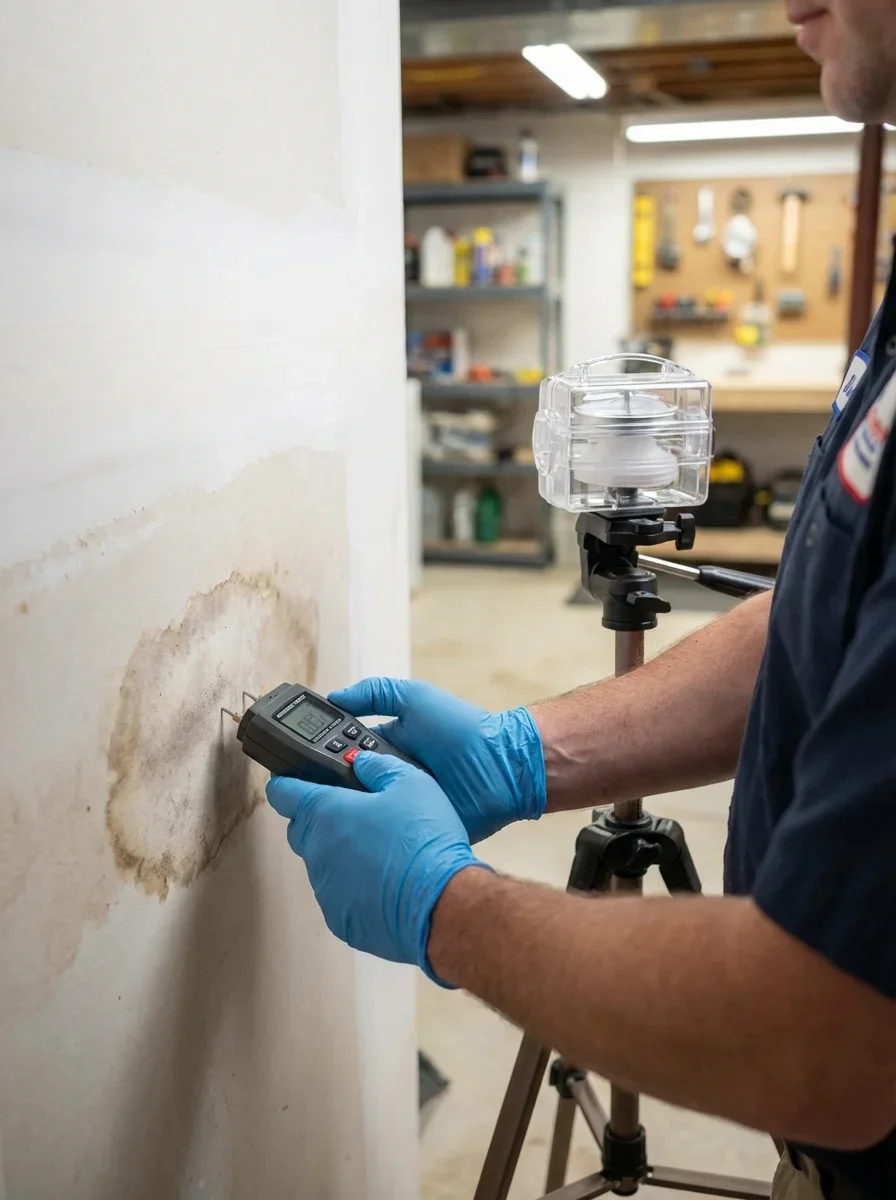
Air sampling is the most common mold test, and it's often the least useful.
Here's how it works: a pump pulls a measured volume of indoor air through a collection device — usually a spore trap or an agar plate — capturing airborne mold spores. The sample goes to a lab, which counts and identifies the types of mold present. You get a report listing spore concentrations (typically in spores per cubic meter) and genus-level identification.
Sounds comprehensive. In practice, air sampling is a snapshot of one moment in one location. Mold doesn't release spores constantly. If the HVAC system hasn't run in hours, spore counts drop. If you sampled right after opening a window on a breezy April afternoon in Austin, outdoor spores flood the reading.
Air sample results can vary by 50% or more depending on time of day, weather, and whether someone just walked through the room stirring up dust.[3]
Non-viable air sampling (spore traps) counts total spores — dead or alive. It's faster and cheaper, but it won't tell you if the mold is actively growing or leftover from a leak you fixed two years ago. Viable sampling (culture plates) only captures living spores that land and grow on the agar, which means it undercounts many mold types that don't grow well in lab conditions. Either way, you're missing mold that's embedded in surfaces, hidden inside wall cavities, or simply not releasing spores at the moment the pump is running.
The CDC and NIOSH explicitly state there are no federal health-based standards for mold in indoor air, and they don't recommend routine air sampling.[2]
That doesn't mean air samples are useless — they're just not the smoking gun most people expect. They work best as a comparison tool: an outdoor control sample taken at the same time tells you if indoor levels are elevated. A post-remediation air sample compared to baseline readings verifies that spore counts dropped after cleanup.
In Texas, where AC systems run eight months a year and ductwork is a notorious mold reservoir, air sampling is frequently used to investigate mold in air ducts or HVAC-related odors. If spore counts are highest near return vents, that's a red flag pointing to growth inside the system. But the test won't show you where in the ducts the mold is growing — you still need a visual inspection with a camera scope and potentially targeted surface sampling inside the plenum.
When Air Sampling Makes Sense:
- You smell mold but can't locate the source after visual inspection
- Comparing spore counts room-by-room to identify problem areas
- Post-remediation verification to confirm cleanup success
- HVAC system investigation when odors suggest duct contamination
- Insurance claims requiring documented baseline and clearance readings
- Real estate transactions where buyers need objective data before closing
Surface Sampling: Direct Evidence of What's Growing Where
Surface sampling is more targeted. Instead of pulling air, you're collecting mold directly from a material: a swab rubbed across a suspect area, a piece of tape pressed onto a moldy surface (tape lift), or a small chunk of material sent to the lab (bulk sampling, covered separately). The sample gets analyzed under a microscope or cultured to identify species and estimate contamination levels.
This is the method that answers the question most homeowners actually care about: Is this stuff on my bathroom ceiling active mold, or just dirt?
A swab sample from that dark patch around the shower exhaust fan will confirm whether it's Stachybotrys (black mold), Aspergillus, soap scum, or mineral deposits. Surface sampling also works when you suspect a cleaned area wasn't properly treated — a tape lift from a wall that was bleached but not sealed can show whether spores are still present.
The Minnesota Department of Health notes that surface sampling has its own limitations: it only tells you what's at the specific spot you sampled.[3] Miss the worst contamination by six inches, and your sample comes back clean even though mold is thriving two feet away. Surface sampling also won't detect airborne spores unless they happen to have landed on the area you swabbed.
In practice, surface sampling shines in a few scenarios. First, verifying remediation success — TDLR-licensed Mold Assessment Technicians in Texas routinely use surface sampling during post-remediation verification to confirm cleaned surfaces meet acceptable standards. Second, identifying species when health concerns are in play — if someone in your household has a compromised immune system and you need to know whether the mold in your crawl space is Aspergillus fumigatus or a less hazardous type, surface sampling gives you that specificity.
Third, settling disputes. A buyer's inspector flags a stain in the attic of a pre-1980 pier-and-beam home in Dallas, the seller insists it's inactive, a surface sample provides objective evidence one way or the other.
Tape lifts are cheap (often $30–$50 per sample) and fast. Swabs cost slightly more. Both give you genus and sometimes species-level ID. Culture-based surface sampling takes longer (3–7 days for growth) but can isolate viable organisms for more detailed analysis.
Bulk Sampling: When You Need to Know What's Inside a Material
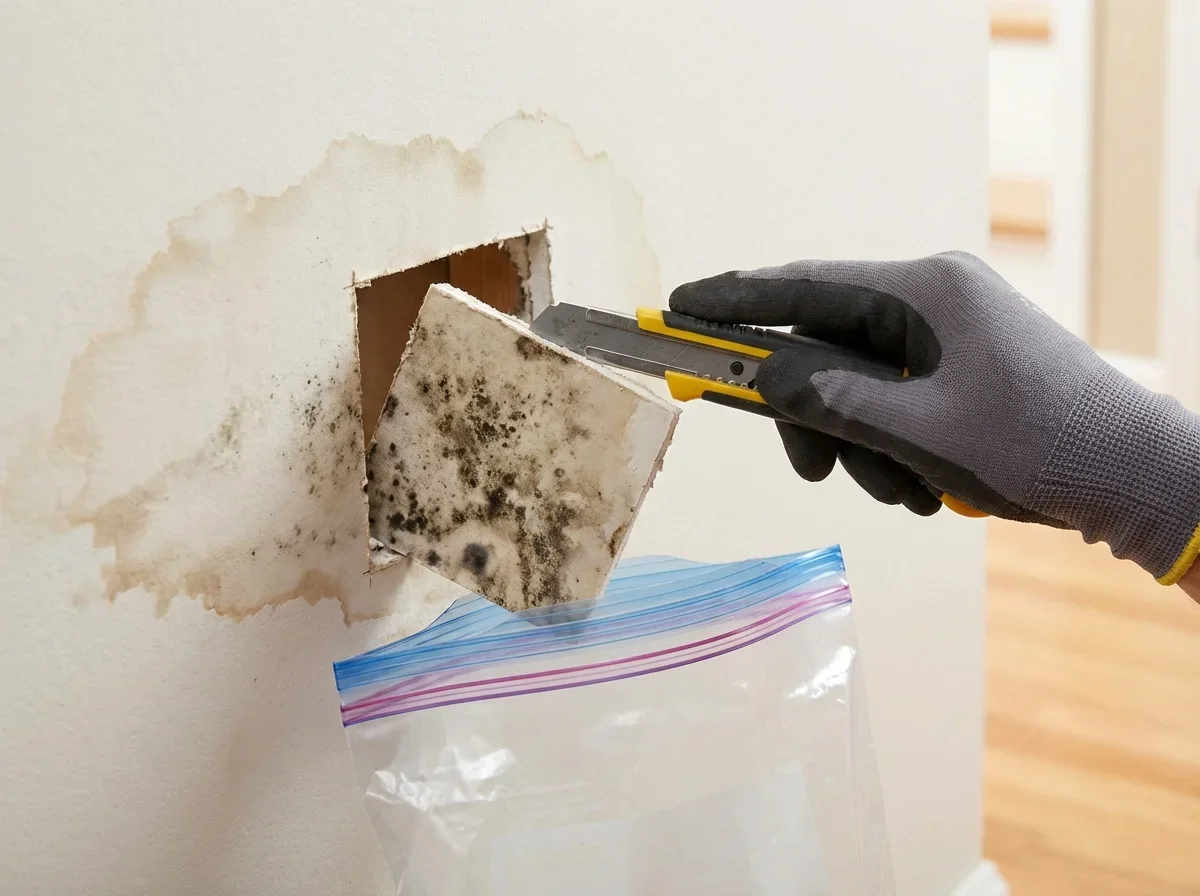
Bulk sampling means cutting out a piece of the contaminated material — a chunk of drywall, a section of insulation, a fragment of carpet padding — and sending it to a lab. The lab examines the sample under a microscope or processes it to identify mold types and estimate contamination severity.
This is the gold standard when you need to know what's growing inside something, not just on the surface.
You typically see bulk sampling in two situations. First, pre-demolition assessment: you're about to rip out water-damaged drywall from a slab leak in a San Antonio tract home, and you want to know whether the insulation behind it is salvageable or needs full replacement. A bulk sample of the insulation tells you how deep contamination goes. Second, hidden contamination: you smell mold but can't see it, and surface sampling from accessible areas comes back negative. Cutting a small access hole and taking a bulk sample of the wall cavity insulation or subfloor material can confirm or rule out hidden growth.
Bulk sampling is destructive by nature — you're cutting holes in your home. That makes it less common than air or surface sampling, but when you're already planning to tear out materials, the added cost and effort are minimal. The information you get is highly specific: exact mold species, contamination density, and a direct answer to whether the material is salvageable or must go.
In Texas, where expansive clay soil causes foundation movement and slab cracks that let moisture seep into wall cavities, bulk sampling is sometimes the only way to confirm mold is growing inside the wall rather than just on the surface. A TDLR-licensed assessor might take a bulk sample of drywall and a separate sample of the insulation behind it to determine the full extent of remediation needed.
This is especially common in post-storm scenarios. After major flooding events like Houston's Tax Day Flood or Hurricane Harvey, bulk sampling helped homeowners and adjusters determine whether wall assemblies could be dried and treated or needed full replacement.
The downside: bulk sampling is slow (results take several days) and requires repair afterward. You're also limited by access — you can't easily take bulk samples from inside sealed ductwork or below a concrete slab without significant demolition.
Comparing Methods: Which Test Answers Your Actual Question
The choice between air, surface, and bulk sampling isn't about which one is "best" — it's about which one answers the question you're actually asking.
- "Is there mold in my home?" — You probably don't need testing. Visual inspection and odor detection are more reliable than any lab result.[2]
- "Where is the mold?" — Air sampling can point you to problem areas by comparing spore counts room-by-room. Surface sampling confirms suspected spots.
- "What type of mold is this?" — Surface sampling or bulk sampling give you species-level identification. Air sampling gives you genus-level at best.
- "Is the mold still active after cleaning?" — Surface sampling or air sampling post-remediation, compared to baseline readings.
- "Is this material salvageable or does it need replacement?" — Bulk sampling of the material itself.
- "Is the air safe to breathe?" — There's no standard for "safe" mold levels in air, so this question doesn't have a yes/no answer. Air sampling can show whether indoor spore counts are higher than outdoor controls, but interpretation is subjective.
Texas-specific note: if you're working with a TDLR-licensed mold assessment company (verify at https://www.tdlr.texas.gov/mol/mol.htm), they'll typically recommend a combination approach for any significant contamination. Initial visual inspection, targeted air sampling to establish baselines, surface sampling of suspected areas, and post-remediation air sampling to verify clearance. This multi-method protocol is standard practice under IICRC S520 guidelines and required by many insurance policies for claims documentation.
One pattern emerges from homeowner experiences: people who paid for extensive air sampling before locating the source often felt the money was wasted.
Testing won't fix anything. It just tells you what's there. If you already know mold is present, skip straight to finding the moisture source and addressing it — or hire a qualified professional for a mold inspection that combines visual assessment with strategic sampling.
| Testing Method | Best Used For | Cost Range | Turnaround Time | What It Reveals |
|---|---|---|---|---|
| Air Sampling | Finding hidden sources, post-remediation verification, HVAC investigations | $75–$150 per sample | 24–48 hours | Airborne spore counts, genus-level ID, indoor vs. outdoor comparison |
| Surface Sampling | Confirming visible growth, species identification, verifying cleanup success | $30–$75 per sample | 24 hours (non-culture) 3–7 days (culture) |
Specific contamination at sampled spot, species-level ID, viability status |
| Bulk Sampling | Assessing hidden contamination, determining material salvageability | $50–$100 per sample | 3–7 days | Contamination depth, exact species, whether material requires replacement |
Lab Analysis Methods: Culture vs. Non-Culture
Once you've collected a sample, how the lab processes it determines what you learn.
Non-culture (direct microscopic examination) is faster and cheaper. The lab mounts the sample on a slide, stains it, and counts spores under a microscope. You get total spore counts and genus-level identification within 24–48 hours. This works for spore traps (air samples) and tape lifts (surface samples). The limitation: you're counting everything, dead or alive, and identification is based on spore morphology, which can't always differentiate closely related species.
Culture-based analysis means growing the sample on agar plates in controlled conditions. Only viable (living) mold grows. After 3–7 days, the lab identifies colonies by appearance, growth patterns, and microscopic characteristics. This method gives you more precise species-level identification and confirms active growth, but it misses any mold that doesn't grow well on the specific media used.
Some mold types are notoriously difficult to culture, so a negative culture doesn't guarantee absence.
PCR (polymerase chain reaction) and ERMI (Environmental Relative Moldiness Index) testing are newer molecular methods that detect mold DNA. These are extremely sensitive — they'll pick up trace amounts that culture or microscopy might miss — but they're also more expensive and harder to interpret. ERMI scores compare your home's mold profile to a database of "moldy" vs. "non-moldy" homes, but critics argue the scoring system doesn't account for regional climate differences or normal background mold. In humid Texas, where airborne mold is ubiquitous year-round, an ERMI score might flag "elevated" levels that are actually typical for the Gulf Coast climate.
Most Texas homeowners stick with non-culture air sampling (spore traps) and culture-based surface sampling (swabs or tape lifts) because they're affordable, well-understood, and accepted by insurance adjusters and real estate professionals.
Molecular methods are useful in litigation, health investigations, or when dealing with rare species, but they're overkill for routine residential work.
What Test Results Actually Mean (and Don't Mean)
You get the lab report back. It lists Aspergillus, Penicillium, Cladosporium, maybe Stachybotrys. Spore counts in the thousands.
Now what?
First: there are no federal exposure limits for mold. The EPA doesn't set thresholds. OSHA doesn't have permissible exposure limits for residential settings. The CDC doesn't define "safe" levels.[2] Anyone who tells you "anything above X spores per cubic meter requires remediation" is making it up or citing a guideline from a private organization, not a regulatory standard.
What results can tell you is whether indoor levels are elevated compared to outdoor controls. If your outdoor sample shows 500 spores/m³ of Cladosporium (common outdoor mold) and your indoor sample shows 5,000, that's a meaningful difference suggesting an indoor source. If indoor and outdoor counts are similar and the species match, you're likely just seeing normal background mold that drifts in from outside.
Species matter more than raw counts.
Stachybotrys chartarum (black mold) grows on cellulose materials (drywall, paper) in persistently wet conditions — finding it indoors is a red flag pointing to chronic water intrusion. Aspergillus and Penicillium are everywhere, but high indoor concentrations suggest water damage or poor ventilation. Chaetomium is another moisture-indicator species common in Texas homes with ongoing leaks.
One frustration homeowners report: getting a report full of Latin names and spore counts with no context about what to do with the information. A reputable TDLR-licensed assessor will interpret results in the context of your home's history, construction, and visual findings.
Numbers without narrative are nearly useless.
Also worth knowing: spore counts fluctuate wildly. A sample taken at 9 a.m. before the AC runs will show different counts than one taken at 3 p.m. after the system has been cycling for hours. Some labs provide confidence intervals or recommend multiple samples taken over time to account for variability. Single-point samples are snapshots, not definitive diagnoses.
Reality Check: A mold test report doesn't tell you whether remediation is needed — it tells you what's present at one point in time. The decision to remediate should be based on visible growth, moisture problems, and occupant health concerns, not arbitrary spore count thresholds that don't exist in federal regulations.
Texas-Specific Testing Considerations: TDLR Rules and Real-World Constraints
Texas is one of the few states that regulates mold assessment and remediation through licensing. Under Texas Mold Assessment and Remediation Rules (TMARR), any mold project affecting more than 25 contiguous square feet requires a TDLR-licensed Mold Assessment Technician to perform the initial inspection and a separate TDLR-licensed Mold Remediation Contractor to do the work.
The assessor and remediator must be different companies — no self-dealing.
This creates a built-in system for third-party testing and verification. If you're dealing with significant contamination — say, whole house mold from a burst pipe in a post-2000 two-story home in Frisco — the licensed assessor will document findings, perform baseline sampling (usually a mix of air and surface), write a remediation protocol, and return for post-remediation verification sampling after the work is done. All of this is documented, and the reports become part of your home's record (important for resale and insurance claims).
For smaller projects under 25 square feet, licensing isn't required, but many Texas homeowners still hire licensed professionals because insurance companies often won't process mold claims without TDLR-compliant documentation.
If you're filing a claim for water damage mold removal after a storm or plumbing failure, expect the adjuster to ask for assessment reports from a licensed technician.
Regional quirks: Houston's high humidity and history of catastrophic flooding means assessment firms there routinely use more conservative sampling protocols — multiple air samples per floor, surface samples from all wet materials, bulk samples of insulation to assess salvageability. In drier West Texas (El Paso, Midland), mold problems are less common, and testing is often limited to targeted surface sampling of specific trouble spots like evaporative cooler pads or bathroom exhaust areas.
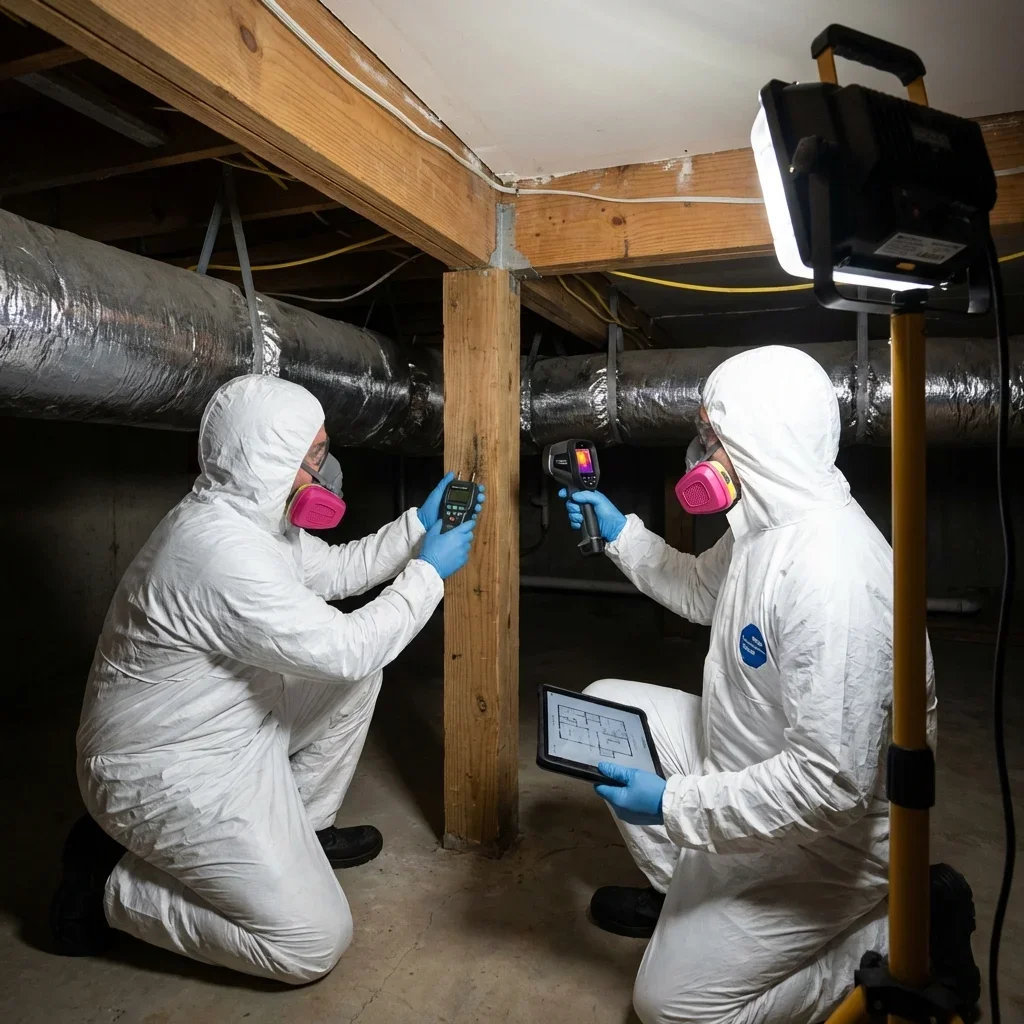
Another Texas-specific issue: slab-on-grade construction. When mold is suspected under a slab or inside a sealed wall cavity, non-invasive testing (air sampling near the affected area) often provides only indirect evidence. TDLR assessors will sometimes use thermal imaging or moisture meters to locate hidden moisture, then recommend limited demolition to expose and directly sample the affected materials.
This is where bulk sampling becomes essential — you can't remediate what you can't see, and you can't assess what you can't sample.
Verify any mold professional's license status at https://www.tdlr.texas.gov/mol/mol.htm before hiring. The state takes enforcement seriously, and unlicensed operators can't provide the documentation you'll need for insurance, real estate transactions, or legal purposes.
When to Skip Testing and Just Fix the Problem
Here's the advice most testing companies won't give you: if you can see mold or confirm moisture intrusion, testing is often a delay tactic that costs money without changing your next step.
You've got visible growth on drywall from a leaking toilet supply line in your Dallas home. You don't need a lab to tell you it's mold — you need to fix the leak, remove the wet drywall, dry the framing, and replace the damaged materials. Testing adds a week and $500 but doesn't alter the remediation protocol.
Same story for bathroom mold around a chronically leaking shower pan, attic mold from a roof leak you've already identified, or HVAC mold in a condensate drain pan that's been overflowing for months.
The EPA's guidance is blunt: if you see mold, assume it's a problem and remediate it.[1] The species doesn't change the cleanup approach for small to moderate contamination. You're still removing affected materials, fixing the moisture source, and drying everything thoroughly.
Testing makes sense in three scenarios: you can't find the source, you need documentation for a third party (insurance, real estate, legal), or you're verifying that remediation was successful.
Outside those cases, you're better off spending money on actual fixes rather than lab reports.
One homeowner pattern: people who tested first, then paid again for remediation, wish they'd just hired a good mold remediation company from the start. A qualified contractor can usually identify the problem, scope the work, and provide a flat-rate bid faster and cheaper than the testing-assessment-bidding-remediation sequence.
That said, if you're in a real estate transaction or dealing with a contentious insurance claim, testing becomes a necessary evil. A pre-purchase real estate mold inspection with sampling can uncover hidden issues before you close. A TDLR-compliant assessment with before-and-after testing can make the difference between a paid claim and a denial.
Combining Methods for Complete Assessment
The most thorough mold investigations use multiple testing methods strategically.
Start with a visual inspection to locate obvious growth and moisture sources. Use air sampling to establish baseline spore counts and identify which rooms or zones have elevated levels. Follow up with surface sampling on suspect areas to confirm species and viability. If contamination is hidden or extensive, add bulk sampling of building materials to determine the scope of necessary demolition.
This layered approach is standard for licensed assessors working on commercial mold remediation projects, post-storm damage assessments, or complex residential cases with multiple moisture sources. For a typical single-issue residential job — say, mold from a pinhole leak in a copper pipe under a kitchen sink — you might only need surface sampling of the affected cabinet and drywall, plus a post-remediation air sample to verify clearance.
In Texas, where homes routinely deal with foundation movement, plumbing failures under slabs, and high humidity that keeps materials damp for extended periods, a combination approach catches problems that single-method testing misses.
Air sampling might show elevated Stachybotrys in a bedroom, surface sampling confirms it's growing on the baseboard, and bulk sampling of the wall cavity reveals it's also colonized the insulation — that's the full picture you need to write an accurate remediation protocol.
Some TDLR-licensed firms include multi-method sampling in their standard assessment packages. Others charge per sample type. Expect to pay $300–$500 for a basic assessment with 2–3 air samples and 2–3 surface samples. Complex assessments with bulk sampling, multiple rooms, and detailed lab analysis can run $1,000–$2,000+. Compare that to the cost of remediating the wrong area because you didn't sample thoroughly enough, and it's often money well spent.
The key is knowing which methods answer your specific questions. Don't pay for testing that won't change your decision. Do invest in testing that narrows down hidden sources, confirms remediation success, or provides the documentation you need for insurance, resale, or legal purposes.
Interpreting Results and Next Steps
You've paid for testing. The report arrives. Now you're staring at a table of spore counts, a list of genera, and maybe some photos of agar plates with fuzzy colonies.
Here's how to make sense of it.
Compare indoor to outdoor samples. If your outdoor control shows 1,200 spores/m³ and your living room shows 1,150 spores/m³ with similar species distribution, that's normal background. If the living room shows 8,000 spores/m³ with species you didn't see outdoors, you've got an indoor source.
Look at species diversity. A sample dominated by one or two species (especially water-damage indicators like Stachybotrys or Chaetomium) suggests localized active growth. A sample with ten different species at low counts often reflects dust accumulation or normal indoor air.
Note sample locations. High spore counts near an HVAC return vent point to duct contamination. High counts in one room but not adjacent spaces suggest a localized moisture source. Consistent elevation across all samples means either widespread contamination or sampling during a high-spore event (like cleaning out a moldy closet right before testing).
Post-remediation results should show spore counts comparable to outdoor controls and no dominance by water-damage species.
If counts are still elevated or the same problem species persist, remediation wasn't complete. Many Texas insurance policies require post-remediation testing before they close a mold claim, and TDLR-licensed remediators routinely offer post-remediation verification as part of their contract.
If results are ambiguous or don't match what you're seeing (or smelling), don't be afraid to re-test or hire a second assessor for a competing opinion. Mold assessment is part science, part detective work, and one snapshot doesn't always capture the full picture.
Finally: results don't fix anything. They're a diagnostic tool. The value comes from using that information to target moisture sources, guide remediation scope, and verify success.
A report sitting in a drawer while mold keeps growing is worthless. Act on what the testing reveals, or don't bother testing in the first place.
- US Environmental Protection Agency (EPA). "Is Sampling/Testing for Mold Necessary?." https://www.epa.gov/mold/samplingtesting-mold-necessary. Accessed April 02, 2026.
- Centers for Disease Control and Prevention (CDC) / National Institute for Occupational Safety and Health (NIOSH). "Mold, Testing, and Remediation." https://www.cdc.gov/niosh/mold/testing-remediation/index.html. Accessed April 02, 2026.
- Minnesota Department of Health. "Testing For Mold." https://www.health.state.mn.us/communities/environment/air/mold/moldtest.html. Accessed April 02, 2026.