What Affects Attic Mold Removal Cost in Texas
Square footage matters, but it's not the only driver. Remediation companies in Houston, Dallas, Austin, and San Antonio charge $3.50 to $7.50 per square foot for straightforward attic mold jobs — think surface growth on exposed rafters with easy access and minimal insulation disruption.
That price jumps to $10 to $20 per square foot when contractors hit complications: low clearance that forces techs to crawl on their stomachs, blown cellulose insulation that's saturated and needs full removal, or extensive wood rot that requires structural repairs before you can even start the mold cleanup.
Accessibility is a silent cost multiplier. A walk-up attic with a pull-down ladder and standing headroom costs less to remediate than a scuttle-hole entry in a two-story home where techs haul equipment through a tight opening and work in a 4-foot crawl space. If your attic has HVAC ductwork snaking through it — common in post-2000 Texas tract homes — contractors may need to clean or replace flex ducts that are coated in mold, adding $500 to $2,000 to the bill.
Pier-and-beam homes in older neighborhoods often have better attic access, but slab-on-grade construction dominates Texas, and those homes tend to have tighter, hotter attics with limited ventilation.
The moisture source drives repeat costs if you don't fix it first. Texas's expansive clay soil — the black gumbo under Houston, the heavy clay across the Blackland Prairie from Dallas to San Antonio — swells and shrinks with moisture changes, shifting foundations and stressing roof structures. That movement cracks ridge vents, loosens shingles, and opens gaps where rain sneaks in.
Contractors won't guarantee their work if the roof still leaks or if condensation from an undersized AC drip pan keeps saturating the same spot. Expect to add $300 to $1,500 for plumbing or roof repairs before remediation begins, and factor in $1,200 to $3,000 for insulation replacement if the existing batts or blown-in material are compromised.
Key Cost Factors for Texas Attic Mold Removal:
- Base rate: $3.50-$7.50/sq ft for simple jobs; $10-$20/sq ft with complications
- Access difficulty: Scuttle holes and low-clearance attics add 30-50% to labor costs
- Pre-remediation repairs: $300-$1,500 for roof/plumbing fixes before mold work begins
- Insulation replacement: $1,200-$3,000 typical for contaminated materials
- HVAC duct cleaning/replacement: $500-$2,000 if ducts are affected
- Moisture source: Must be fixed first or mold returns within months
Average Attic Mold Removal Costs Across Texas Metros
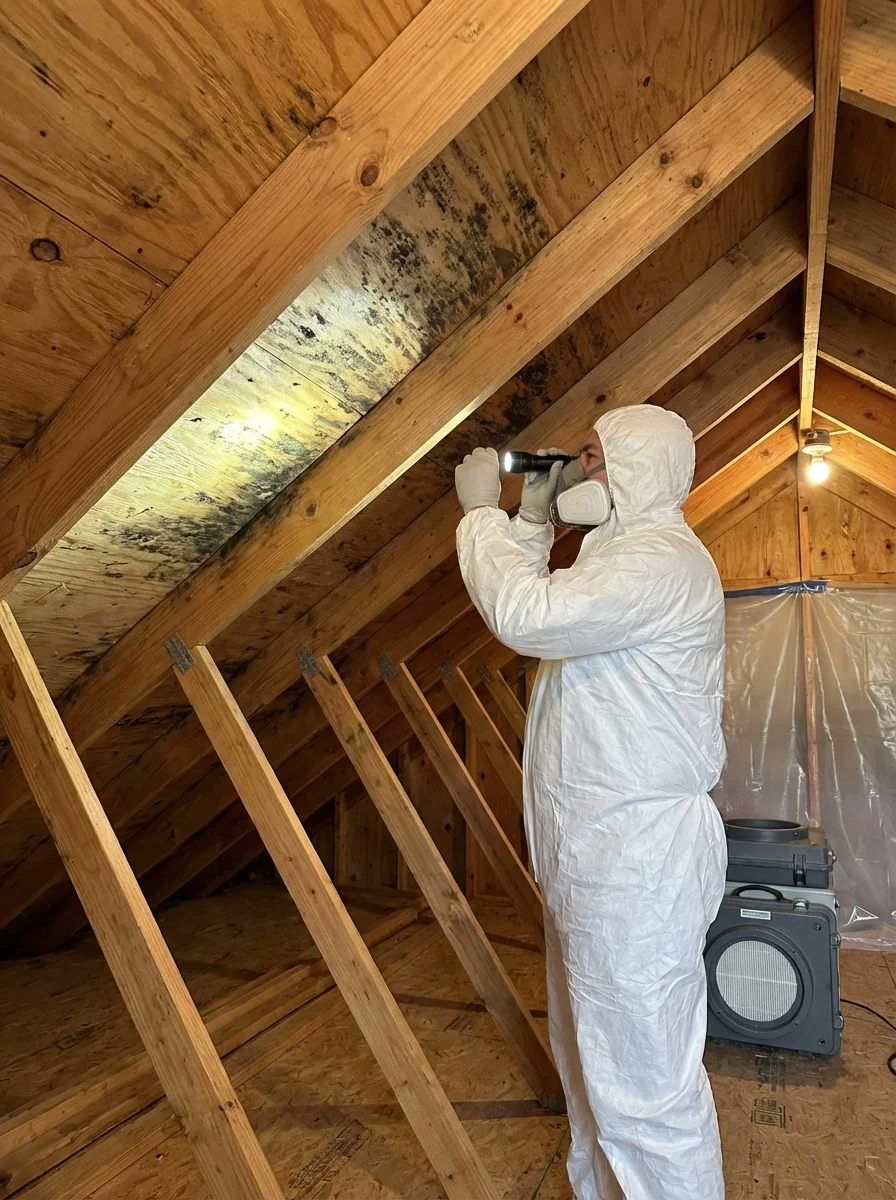
Houston homeowners report quotes ranging from $2,200 to $5,500 for moderate attic mold jobs — 400 to 800 square feet of affected area, surface growth on sheathing and rafters, some insulation removal. The Gulf Coast humidity (average 75% in summer) and frequent tropical storms make Houston attics especially vulnerable. Post-Harvey awareness remains high, and licensed mold remediation companies often bundle structural drying and moisture control into their bids to prevent recurrence after flood events.
Dallas-Fort Worth quotes cluster around $1,800 to $4,200 for similar-sized jobs, with prices trending higher in newer suburbs (Frisco, McKinney, Prosper) where two-story homes have complex rooflines and spray foam insulation that's harder to remove. North Texas sees severe storm damage from hail and high winds March through June, and insurance claims for roof-related mold spike each spring.
San Antonio and Austin fall into a similar range — $1,600 to $4,000 — but Hill Country properties with metal roofs and better natural ventilation sometimes come in lower, while older homes with asbestos-containing insulation require specialized abatement that can push costs past $10,000.
Small jobs under 100 square feet of visible mold sometimes get flat-rate pricing around $800 to $1,200, especially if the contractor can address it without full containment setup. The EPA notes that homeowners can clean small areas (less than 10 square feet) themselves using detergent and water, but larger infestations require professional assessment to ensure proper containment and removal[2].
In practice, most Texas homeowners hire pros once they see more than a few patches, because attic mold often extends beyond what's visible — it hides under insulation, inside wall cavities at eave edges, and along roof decking seams.
What's Included in a Professional Attic Mold Remediation
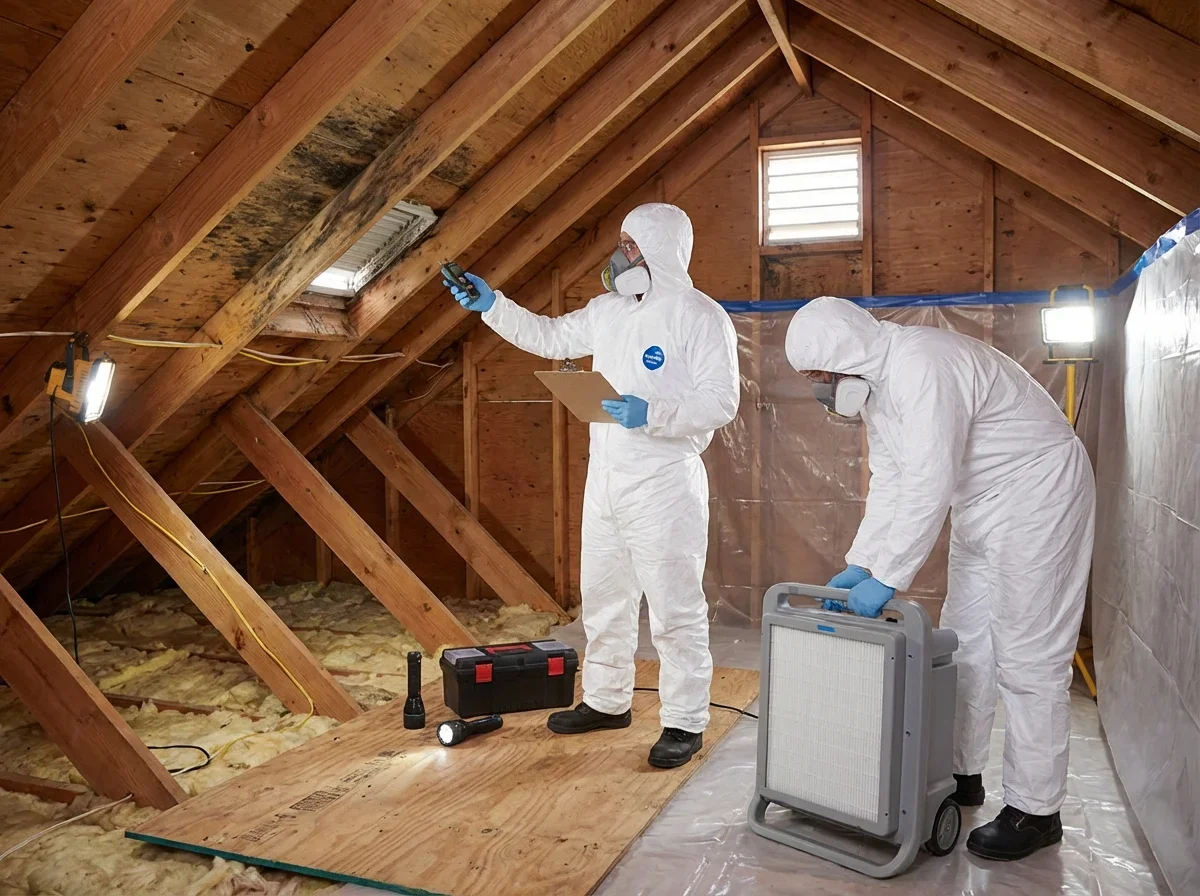
TDLR-licensed mold remediation contractors in Texas follow a structured protocol. They start with containment — sealing off the attic from the rest of your home using plastic sheeting and negative air pressure machines to prevent spores from drifting into living areas or ductwork. That setup alone costs $400 to $800 depending on attic size and access points.
Next comes removal: HEPA vacuuming, wire-brushing contaminated surfaces, cutting out and bagging affected materials like insulation or rotted sheathing. Techs wear respirators and full protective gear, not just dust masks.
After physical removal, contractors apply antimicrobial treatments or encapsulants to wood surfaces — foggers or sprayers that coat rafters and decking to inhibit future growth. This step costs $150 to $400 and is standard in humid Texas climates where residual spores can reactivate with the next moisture event.
The final stage is verification: either a post-remediation air quality test by a separate TDLR-licensed mold assessment company (required by law in Texas — your remediator can't test their own work) or a visual clearance inspection. Post-remediation testing runs $300 to $600 and gives you documentation for insurance claims or real estate transactions.
Some contractors include insulation replacement in their base bid; others quote it separately. Blown-in fiberglass or cellulose costs $1.50 to $3.00 per square foot installed, while spray foam (common in newer Texas homes) runs $3.50 to $7.00 per square foot. If your attic insulation was compromised by mold or moisture, you'll need to replace it to restore energy efficiency and prevent recurrence.
Don't skip this step — Texas summers are brutal, and an under-insulated attic drives up cooling costs and creates temperature differentials that promote condensation.
| Remediation Step | What's Involved | Typical Cost Range |
|---|---|---|
| Containment Setup | Plastic barriers, negative air machines, sealing access points | $400 - $800 |
| Physical Removal | HEPA vacuuming, brushing, cutting out contaminated materials | Included in per-sq-ft rate |
| Antimicrobial Treatment | Foggers/sprayers on wood surfaces to prevent regrowth | $150 - $400 |
| Post-Remediation Testing | Independent TDLR air quality verification (required by law) | $300 - $600 |
| Insulation Replacement | Blown-in fiberglass/cellulose or spray foam installation | $1.50 - $7.00/sq ft |
Why Attic Mold Costs More Than Other Mold Jobs
Attic environments are hostile. Summer temperatures in Texas attics routinely hit 130°F to 150°F, making remediation work physically demanding and slower. Techs need frequent breaks, hydration, and rest cycles, which adds labor hours.
Poor ventilation means respirators and Tyvek suits become unbearable fast, so crews rotate out every 20-30 minutes in peak summer. Winter work is easier, but attic jobs don't wait for convenient weather — most get triggered by a ceiling stain or musty smell that demands immediate attention.
Material removal is messier in attics than in bathrooms or crawl spaces. Blown insulation — the fluffy pink or white stuff common in post-1990 Texas homes — gets everywhere when disturbed. It coats ductwork, settles into wall cavities, and requires extensive HEPA vacuuming and bagging. Contractors charge more for jobs involving blown insulation because cleanup takes longer and disposal costs add up.
A heavily contaminated attic can generate 10 to 20 contractor bags of debris, and mold-contaminated materials often require special disposal fees at landfills.
Structural surprises inflate costs mid-job. Once contractors pull back insulation, they frequently find rotted roof decking, compromised trusses, or outdated wiring that needs attention before remediation can proceed. Texas building codes (IRC with state amendments) require proper ventilation ratios (1 square foot of vent per 150 square feet of attic space, or 1:300 if you have a vapor barrier), and older homes often fall short.
Upgrading ventilation — adding ridge vents, soffit vents, or powered attic fans — can add $800 to $2,500 but prevents future mold by reducing humidity and heat buildup.
How Texas Licensing and Regulations Impact Pricing
Texas is one of the few states with mandatory mold licensing under the Texas Department of Licensing and Regulation (TDLR). Mold remediation companies must hold separate licenses from mold assessment companies, and TDLR requires proof of general liability, pollution liability, and professional liability insurance.
These requirements raise overhead costs, which get passed to homeowners, but they also ensure you're working with trained professionals who follow Texas Mold Assessment and Remediation Rules (TMARR).
Verify your contractor's license at tdlr.texas.gov/mol/mol.htm before signing a contract. Licensed remediation workers must complete 24 hours of initial training and 6 hours of continuing education annually. The separate-assessor rule means you'll often pay for two companies on one job — the assessment company that identifies the scope and writes the protocol, and the remediation company that does the physical work.
Total costs for assessment plus remediation typically run $2,000 to $6,000 for a standard attic job, with the assessment fee ($300 to $600) covering inspection, air sampling, and a detailed written protocol.
Unlicensed contractors undercut these prices by $500 to $1,500, but you're gambling. If the work fails inspection or mold returns, you've wasted money. Worse, unlicensed remediation can void your homeowner's insurance coverage or tank a real estate sale if disclosed.
Texas real estate law requires sellers to disclose known mold issues, and a botched DIY or unlicensed job becomes a liability. Stick with TDLR-licensed professionals, especially if you're remediating before selling or filing an insurance claim.
Pro Tip: Texas law requires separate companies for mold assessment and remediation — if a contractor offers both services under one license, they're operating illegally. This separation protects you from conflicts of interest and ensures independent verification of completed work.
What Drives Costs Higher: Black Mold, Insulation, and Ductwork
Stachybotrys chartarum — the infamous "black mold" — doesn't inherently cost more to remove than other species, but it signals a serious moisture problem that often requires deeper intervention. Black mold thrives in persistently wet conditions (48+ hours of saturation), so if you've got it in your attic, your contractor will look for chronic leaks, condensation issues, or ventilation failures that need fixing before remediation.
The mold itself scrapes off like any other species, but the underlying repairs drive costs up.
Insulation removal and replacement are the biggest cost add-ons. If your attic has 12 inches of blown cellulose or fiberglass that's moldy or wet, full removal costs $1.00 to $2.00 per square foot just for labor and disposal. A 1,200-square-foot attic could add $1,200 to $2,400 to your bill before you even reinstall new insulation.
Contractors vacuum out the old material, bag it, haul it to a landfill, then blow or roll in fresh insulation rated to R-30 or R-38 (standard for Texas climate zones). If you're replacing with spray foam for better moisture control and air sealing, budget $4,000 to $8,000 for a typical attic.
HVAC ductwork cleaning or replacement adds another layer. Flex ducts in Texas attics often run through unconditioned space, and when mold spores settle inside or on the outer insulation jacket, the ducts become a contamination source. Cleaning ductwork costs $500 to $1,200 for a whole-house system, but heavily contaminated flex ducts sometimes need replacement ($1,500 to $3,500) because cleaning doesn't fully remove embedded spores.
If your AC drip pan overflowed and soaked ducts, contractors may recommend HVAC mold removal as part of the attic remediation to prevent recirculation.
Hidden Costs and Budget Surprises Homeowners Report
Roof repairs are the most common budget surprise. Contractors won't remediate mold until the moisture source is fixed, and roof leaks in Texas — from missing shingles after a hailstorm, cracked flashing around chimneys, or failed valley seals on complex rooflines — can add $500 to $3,000 before mold work begins.
Some remediation companies bundle minor roof patching into their bids; others require you to hire a roofer first. Verify what's included upfront to avoid a project that stalls mid-job.
Structural repairs escalate costs fast. If roof decking is rotted (common where leaks went unnoticed for months), you're looking at $800 to $2,000 to replace plywood sheathing before mold removal even starts. Truss damage from long-term moisture exposure can push costs into the $5,000 to $10,000 range if you need a structural engineer's report and reinforcement.
Texas building codes require permits for structural modifications, adding time and inspection fees ($150 to $400) to the timeline.
Post-remediation testing sometimes reveals elevated spore counts that require a second round of cleaning. This happens when contractors miss hidden mold under insulation or inside wall cavities at eave edges. A failed clearance test means additional labor ($400 to $1,200) and a second verification test ($300 to $500).
To minimize this risk, hire contractors who use thermal imaging cameras during initial assessments to map moisture intrusion and identify all affected areas before starting containment.
DIY Attic Mold Removal vs. Hiring a Pro in Texas
The EPA allows homeowners to clean small mold areas (less than 10 square feet) using detergent and water, but emphasizes fixing the moisture source first[1]. If you've got a few moldy rafters near a known roof leak you've already patched, you can scrub them with a stiff brush, detergent, and water, then let them dry completely. Wear an N95 mask, gloves, and eye protection, and ventilate the attic with fans blowing outward.
This approach works for surface mold on accessible wood — think a 2x4 rafter you can reach from a ladder.
It doesn't work for extensive growth, hidden mold under insulation, or contamination across hundreds of square feet. Professional containment prevents spores from spreading to living areas and ductwork during cleanup, something DIY efforts can't replicate. Texas attics also present safety risks — extreme heat, cramped spaces, exposed nails, unstable footing on ceiling joists — that make prolonged DIY work dangerous.
If you're not comfortable working in a 140°F space while wearing a respirator, hire a pro.
TDLR licensing exists for a reason. Licensed contractors know how to assess extent of contamination, choose appropriate removal methods, and verify clearance using spore count testing[3]. They carry insurance that protects you if something goes wrong — a DIY job that spreads spores into your HVAC system or living areas creates a bigger mess than you started with.
For jobs over 100 square feet or any situation involving black mold, water damage, or unknown moisture sources, professional remediation pays for itself in done-right-the-first-time results.
How to Get Accurate Quotes and Avoid Low-Ball Bids
Request in-person inspections from at least three TDLR-licensed remediation companies. Phone estimates or "ballpark" quotes based on square footage alone miss critical details — attic height, insulation type, ductwork location, access limitations — that define the real scope of work.
A thorough inspection takes 30 to 60 minutes and includes moisture readings, thermal imaging if available, and a written protocol detailing containment setup, removal methods, and disposal procedures.
Compare itemized bids, not just bottom-line numbers. One contractor might quote $3,200 for the same job another prices at $4,800, but the cheaper bid excludes insulation replacement, post-remediation testing, and antimicrobial treatment that are included in the higher bid. Ask what's covered: containment, HEPA filtration, debris removal, surface treatment, insulation disposal, duct cleaning if needed, and verification testing.
Low-ball bids often leave out these steps or use unlicensed subcontractors to cut costs.
Red flags include contractors who:
- Offer mold assessment and remediation under one license (illegal in Texas)
- Quote without inspecting the attic in person
- Lack TDLR license numbers on their website and contracts
- Refuse to provide proof of pollution liability insurance
- Pressure you to sign same-day contracts with time-limited discounts
Legitimate contractors welcome questions and provide references. Ask how they handle moisture source repairs, whether they subcontract any work, and what their post-remediation clearance process looks like. If they're evasive or can't explain their protocol in plain terms, keep shopping.
When Insurance Covers Attic Mold and When It Doesn't
Most Texas homeowners policies exclude mold damage caused by long-term neglect, poor maintenance, or gradual leaks. If your attic mold grew over months from a slow roof leak you ignored, insurance won't pay.
But if mold resulted from a sudden covered event — burst pipe, storm damage, AC overflow from a power outage — you may have coverage, especially if your policy includes a mold endorsement (typically $5,000 to $25,000 in additional coverage).
File claims fast. Texas insurance law requires policyholders to report damage promptly, and delays give insurers grounds to deny claims. Document everything: photos of the mold, the moisture source, and any visible damage to roof decking or insulation. Get a TDLR-licensed mold assessment company to write a protocol and estimate costs before remediation starts — this documentation supports your claim and prevents disputes over scope.
Some contractors offer insurance claim mold services that include working directly with adjusters and providing detailed invoicing for reimbursement.
Even with coverage, expect to pay your deductible ($1,000 to $2,500 for most Texas policies) plus any costs that exceed your mold endorsement cap. If remediation costs $6,000 and your endorsement covers $5,000, you're out of pocket $1,000 plus the deductible.
Review your policy's mold language now, before you need it, and consider adding endorsement coverage if you live in a high-risk area (Gulf Coast, older homes, pier-and-beam construction).
Preventing Future Attic Mold and Long-Term Cost Savings
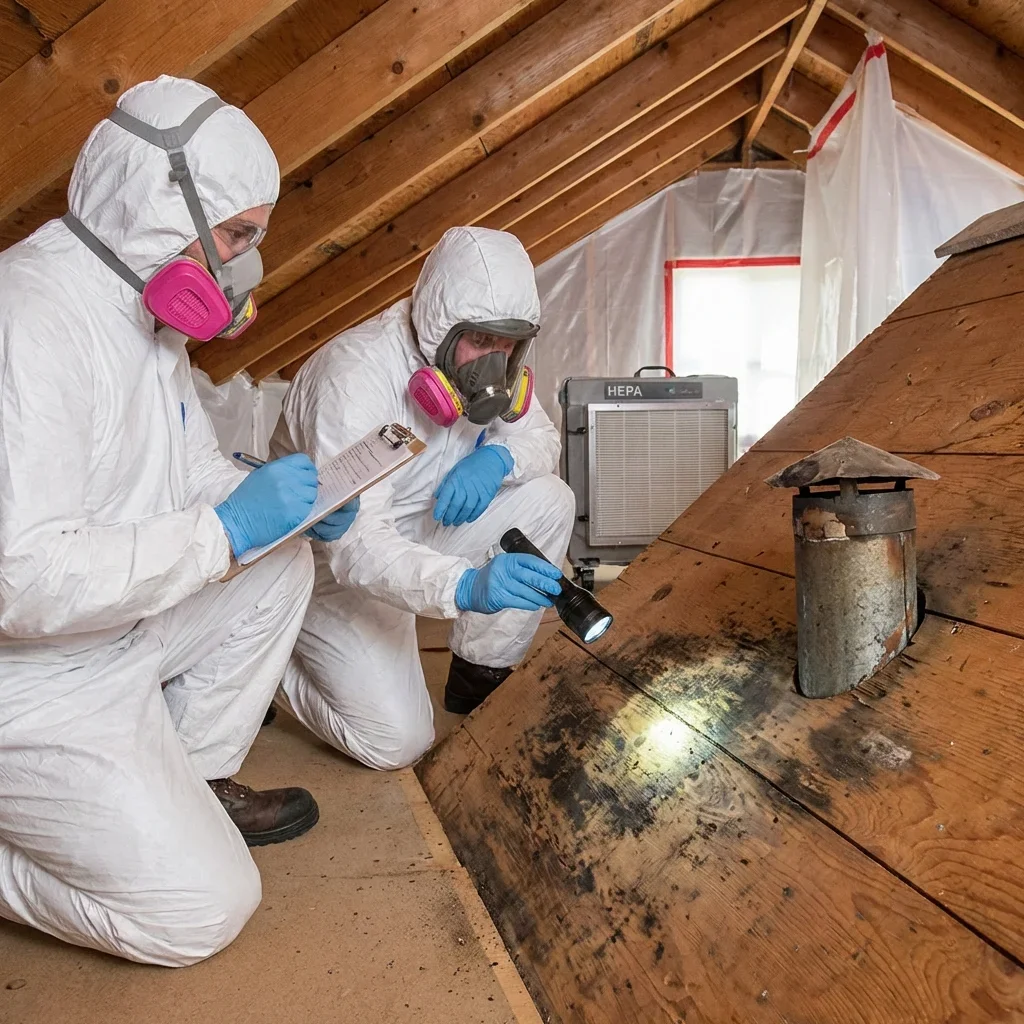
Fix the moisture source or mold returns — it's that simple. Texas's humid climate means attic ventilation is non-negotiable. Ridge vents paired with soffit vents create passive airflow that exhausts heat and humidity, reducing condensation on roof decking.
Powered attic fans ($300 to $800 installed) work well in two-story homes where passive ventilation falls short, but only if you've sealed air leaks in the attic floor first. Otherwise, you're just pulling conditioned air from living spaces into the attic, wasting energy and creating negative pressure that can backdraft combustion appliances.
Inspect and maintain your roof annually. Texas weather — hail in Dallas, hurricanes on the Gulf Coast, severe thunderstorms statewide — beats up roofs faster than in milder climates. Missing shingles, cracked flashing, and clogged gutters (common in tree-heavy neighborhoods across Houston and Austin) all funnel water into attics.
A $200 to $400 annual roof inspection catches problems before they become $3,000 mold jobs. Check your AC drip pan and condensate drain line twice a year — a clogged drain costs $10 to clear but causes thousands in damage if it overflows into attic insulation.
Control indoor humidity with whole-house dehumidification if you live in coastal areas where summer humidity stays above 70%. Standalone attic dehumidifiers ($200 to $500) help in extreme cases, but they're Band-Aids if you haven't addressed ventilation and air sealing first.
The real long-term savings come from proper construction — vapor barriers in attic floors, sealed ductwork, correctly sized HVAC systems that remove humidity, not just cool air. Newer Texas homes built to Energy Star standards incorporate these features, but older homes need retrofits to match.
Regional Cost Variations Within Texas
Gulf Coast properties (Houston, Galveston, Beaumont) trend 10% to 20% higher than state averages due to chronic humidity and flood risk. Contractors in these markets often bundle post-flood mold prevention measures into attic remediation — vapor barriers, upgraded ventilation, moisture monitoring — because repeat events are common.
Hurricane season drives demand spikes, and availability tightens after major storms, which pushes emergency pricing up.
West Texas (El Paso, Midland, Lubbock) sees lower costs — $1,200 to $3,200 for typical attic jobs — because dry climate (30% to 40% relative humidity) makes mold less frequent. When it does occur, it's usually tied to isolated plumbing leaks or AC malfunctions rather than systemic humidity issues.
Remediation is simpler in arid zones, with less insulation saturation and faster drying times.
Hill Country and Central Texas (Austin, San Antonio, Fredericksburg) fall in the middle — $1,600 to $4,000 — with costs influenced by home age and construction type. Older limestone or pier-and-beam homes in historic neighborhoods require careful handling, while sprawling new subdivisions with spray foam and complex rooflines cost more to access and remediate.
San Antonio's exceptionally hard water (300+ ppm calcium in some areas) accelerates plumbing corrosion, creating slow leaks under slab foundations that eventually migrate upward through wall cavities into attics, complicating moisture source repairs.
Questions to Ask Before Signing a Contract
What's your TDLR license number, and can I verify it online? Any hesitation is a deal-breaker. Legitimate companies provide this immediately.
How do you handle containment to protect my living areas and HVAC system? You want to hear "negative air machines, sealed plastic barriers, HEPA filtration." Anything less risks cross-contamination.
What happens if post-remediation testing fails clearance? Get this in writing. Some contractors include re-cleaning in their base bid; others charge extra.
Do you carry pollution liability insurance, and can I see proof? General liability alone doesn't cover mold claims — pollution liability is specific to contamination work.
Who handles the moisture source repair — your crew or a separate contractor? Clarify coordination and timelines so the project doesn't stall.
What's included in your bid: insulation removal, disposal, antimicrobial treatment, duct cleaning, testing? Itemized breakdowns prevent surprise charges.
Timeline: How Long Does Attic Mold Remediation Take?
Small jobs (under 200 square feet, minimal insulation disruption) take 1 to 2 days — one day for containment and removal, a second for cleanup and verification if needed. Moderate jobs (400 to 800 square feet, full insulation removal) run 3 to 5 days once you factor in containment setup, material removal, surface treatment, debris disposal, and post-remediation testing with a 24-hour lab turnaround.
Large projects (whole-attic contamination, structural repairs, duct replacement) stretch to 1 to 2 weeks, especially if you need permits for roof or framing work.
Texas weather impacts scheduling. Summer heat makes attic work brutal, so crews start early (6 AM to avoid peak temperatures) and work shorter days. Spring and fall are ideal for scheduling, but hurricane season and severe storm damage create demand surges that push timelines out.
If you're remediating before a real estate closing, build in 2 to 3 weeks minimum from inspection to final clearance report to avoid delays.
- US Environmental Protection Agency (EPA). "A Brief Guide to Mold, Moisture, and Your Home." https://www.epa.gov/mold/brief-guide-mold-moisture-and-your-home. Accessed April 02, 2026.
- US Environmental Protection Agency (EPA). "Mold Cleanup in Your Home." https://www.epa.gov/mold/mold-cleanup-your-home. Accessed April 02, 2026.
- US Environmental Protection Agency (EPA). "Mold Course Chapter 2: Assessment." https://www.epa.gov/mold/mold-course-chapter-2. Accessed April 02, 2026.