What's Included in a Mold Inspection
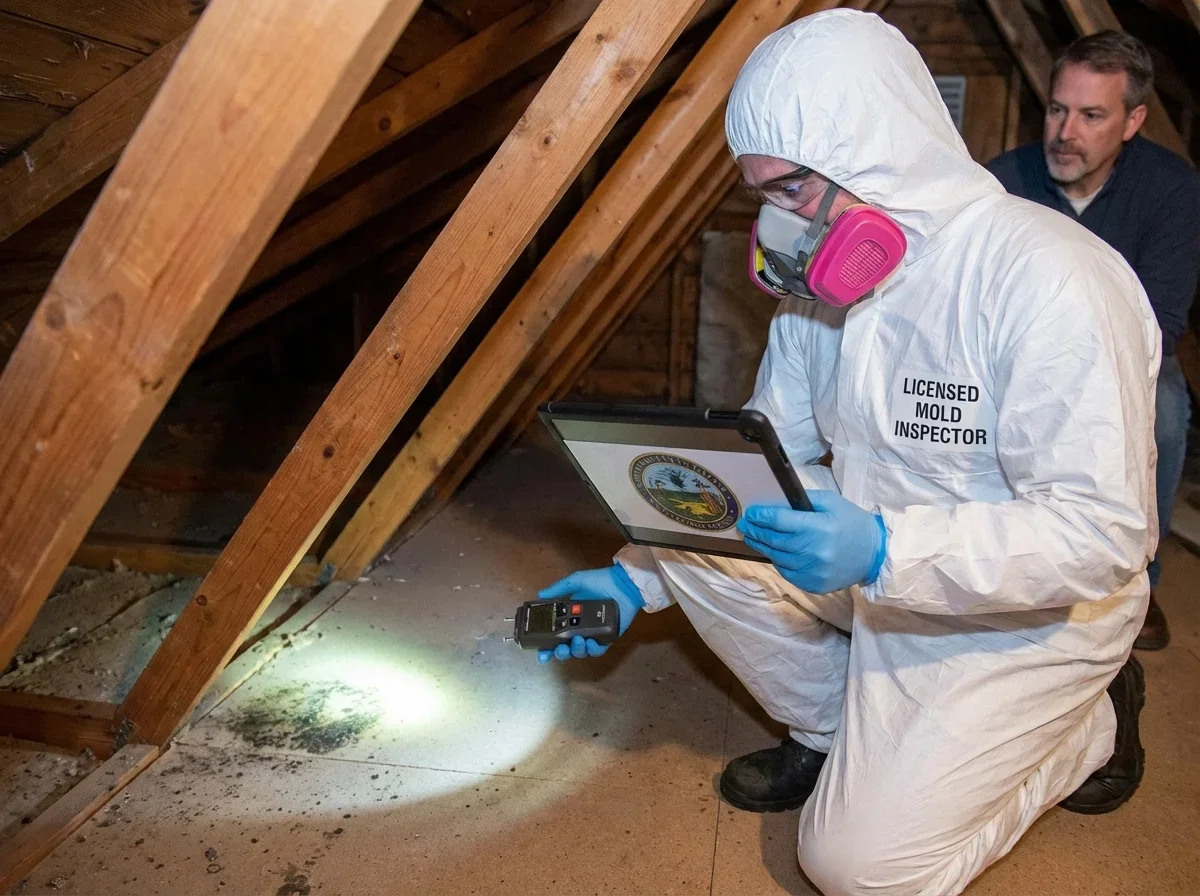
A mold inspection in Texas covers more than someone walking through your house with a flashlight. You're paying for a TDLR-licensed Mold Assessment Technician who knows where mold hides in Texas homes — under slab foundations, inside HVAC plenums, behind brick veneer where condensation accumulates during our eight-month AC season.
The inspector uses moisture meters to measure water content in walls, floors, and ceilings. They check humidity levels, examine your HVAC system for condensation issues, and inspect crawl spaces (in older pier-and-beam homes) or slab perimeters for moisture intrusion. Most important, they identify the source — whether it's a slow leak from corroded cast iron plumbing in a pre-1980 home or a cracked slab from shifting clay soil.
You'll receive a written report documenting findings, moisture readings, photos, and recommendations. If the inspector finds visible mold, they'll note the location and extent. If conditions suggest hidden mold but nothing's visible, they may recommend air quality testing to confirm spore levels.
Texas law requires that the company performing your inspection cannot perform the remediation.[TDLR]
That separation keeps assessments objective — your inspector isn't trying to sell you cleanup services.
Average Mold Inspection Costs in Texas
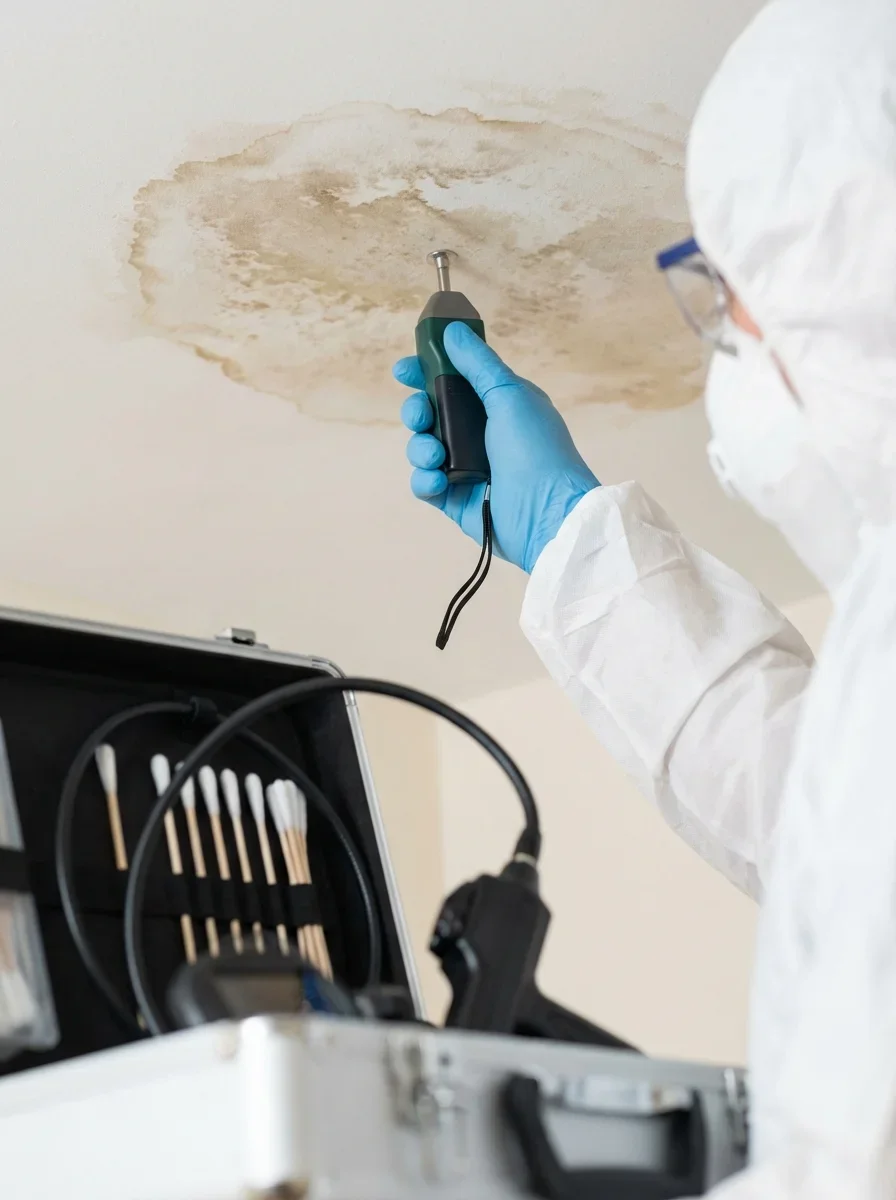
A standard visual inspection for a home under 2,000 square feet typically runs $300-$400. That includes the walkthrough, moisture mapping, and a written report. Homes between 2,000-4,000 square feet usually cost $400-$600, while larger properties or those requiring attic, crawl space, and HVAC system access can reach $700-$900.
These figures assume a straightforward inspection. If you need laboratory analysis — air samples, surface swabs, or bulk material testing — add $75-$150 per sample. Most inspectors recommend 2-3 air samples for a typical investigation: one from the affected area, one from an unaffected area as a control, and one outdoor sample for baseline comparison.
Post-remediation verification runs $250-$450 for most homes. That's the clearance test performed after mold remediation to confirm spore counts have returned to normal levels. Texas doesn't legally require clearance testing, but most reputable remediation companies won't consider a job complete without it — and your insurance company will likely demand documentation.
In Houston, San Antonio, and DFW, expect prices at the higher end of these ranges. Austin's booming construction market has pushed inspection costs slightly higher, while smaller markets like Corpus Christi or Waco tend toward the lower end.
Post-hurricane demand spikes prices temporarily — Houston saw inspection costs jump 30-40% in the months following Harvey as homeowners scrambled for assessments.
| Home Size | Standard Visual Inspection | With Air Sampling (2-3 samples) | Post-Remediation Verification |
|---|---|---|---|
| Under 2,000 sq ft | $300-$400 | $450-$700 | $250-$350 |
| 2,000-4,000 sq ft | $400-$600 | $625-$900 | $350-$450 |
| Over 4,000 sq ft | $700-$900 | $925-$1,350 | $450-$600 |
What Affects Your Inspection Cost
Your home's size matters, but so does complexity. A single-story ranch on a slab is straightforward. A two-story home with a complex roofline, multiple HVAC systems, and a pier-and-beam section underneath requires more time and access points.
Accessibility drives costs more than you'd expect. If the suspected mold is in a finished attic with limited headroom, inside wall cavities that require fiber optic camera inspection, or under a slab where moisture meters can only hint at the problem, your inspector needs more equipment and time. Commercial-grade thermal imaging cameras that detect temperature differentials from hidden moisture can add $100-$200 to the inspection fee.
The type of testing you need changes the equation entirely. A visual inspection with moisture readings gives you immediate answers about what's visible. Air sampling tells you what's floating around but requires 3-5 business days for lab results. Surface sampling (tape lifts or swabs) identifies specific mold species on visible growth. Bulk sampling — cutting out a piece of drywall or insulation for analysis — costs more because it's invasive and requires a small repair afterward.
If you're dealing with a real estate transaction, expect to pay for a more thorough inspection. Buyers typically request documentation that meets industry standards (IICRC S520), which means more sampling points and a detailed protocol-driven report.
That thoroughness costs $500-$800 for most single-family homes.
Emergency inspections after flooding or storm damage command premium pricing — often 50% above standard rates. When half your neighborhood is calling for inspections after a hurricane, supply and demand takes over.
Visual Inspection vs. Air Sampling
You don't automatically need air sampling. If your inspector finds visible mold — black spots on drywall, fuzzy growth on attic sheathing, colonies behind a leaking toilet — you already know you have a problem that needs remediation. Sampling to identify the species rarely changes the remediation approach, because all mold gets removed the same way.
Federal agencies including OSHA and EPA don't establish safe airborne mold concentration thresholds.[2] That means air sample results are compared to outdoor baselines or unaffected areas of your home, not to a regulatory limit. If your indoor spore count is significantly higher than outdoors, or if you're detecting species that shouldn't be present indoors, you have evidence of a problem.
Air sampling makes sense in specific situations.
When you smell mold but can't find visible growth, spore counts can confirm whether the odor is actually mold or something else. If someone in your household has persistent respiratory symptoms and you suspect hidden mold in wall cavities or ductwork, testing provides objective data. And when you're verifying that remediation actually worked, air sampling is the only reliable proof.
Surface sampling identifies mold species on visible growth. That's useful when you need to know if the black spots in your shower are toxic Stachybotrys or common Cladosporium. Most of the time, though, visible mold means you need cleanup regardless of species.
Bulk sampling — sending pieces of drywall, insulation, or carpet to a lab — costs more and creates minor damage. Inspectors use it when growth is extensive and species identification matters for insurance claims or litigation.
When You Actually Need Air Sampling:
- Persistent musty odor with no visible mold source
- Unexplained respiratory symptoms or allergic reactions
- Post-remediation clearance verification
- Insurance claim documentation requirements
- Hidden mold suspected in wall cavities or ductwork
- Real estate transaction requiring documented baseline conditions
When You Actually Need a Mold Inspection
Texas real estate contracts increasingly include mold inspection contingencies, especially in Houston and other flood-prone markets where buyers have learned hard lessons. If you're purchasing a home built before 1980 with original cast iron plumbing, or any home with a history of foundation work (a red flag in our clay soil regions), an inspection protects you from inheriting someone else's moisture problem.
Your insurance company may require an inspection before paying a claim. If you've filed for water damage and the adjuster suspects mold was present before the covered event, they'll want documentation of pre-existing conditions versus new growth.
That distinction determines whether remediation falls under your policy or becomes your out-of-pocket expense.
You definitely need an inspection if you've had water intrusion and it wasn't addressed within 48-72 hours. Slab leaks are notorious in Texas because they go undetected — you might notice higher water bills or warm spots on the floor before you see any visible damage. By the time symptoms appear, mold has often been growing for weeks or months under flooring or inside wall cavities.
After remediation, verification testing confirms the job was done right. TDLR-licensed companies follow IICRC S520 standards that require containment, HEPA filtration, and thorough cleaning, but only post-remediation air sampling proves spore counts returned to normal.
Without that clearance test, you're trusting the remediation company's word — and if symptoms return or you try to sell the home later, you'll have no documentation that the problem was properly resolved.
Texas-Specific Mold Inspection Rules
Texas is one of the few states with comprehensive mold licensing administered by the Texas Department of Licensing and Regulation. Under the Texas Mold Assessment and Remediation Rules (TMARR), anyone performing mold inspections for compensation must hold a Mold Assessment Technician license or work for a licensed Mold Assessment Company.
That licensing matters because it establishes minimum training and insurance requirements. Your inspector must complete TDLR-approved coursework and carry liability coverage. You can verify credentials at the TDLR Mold Program website (https://www.tdlr.texas.gov/mol/mol.htm) — just search by company name or individual license number.
The separation requirement is crucial: the same company cannot inspect and remediate.
This prevents conflicts of interest where an inspector inflates the scope of work to sell you expensive cleanup services. Your assessment company identifies the problem and writes a remediation protocol. A separate TDLR-licensed Mold Remediation Company performs the actual work.
Texas rules only apply when the total cost of inspection and remediation exceeds $200.[2] That's a low threshold — basically any professional service triggers licensing requirements. Homeowners can still handle minor cleanup themselves without hiring licensed contractors, but once you bring in professionals, TDLR rules apply.
If you're dealing with a rental property dispute, Texas law requires landlords to remediate mold within a reasonable timeframe once notified. A licensed inspector's report gives you documentation for enforcement. Our rental property mold inspection guide covers tenant rights and landlord obligations in detail.
How Texas Climate and Construction Affect Mold Risk
You can't discuss mold in Texas without talking about our foundation issues. Expansive clay soil across the Blackland Prairie (DFW, Austin, San Antonio) and Gulf Coast regions swells when wet and shrinks when dry.
That constant movement cracks slab foundations and the plumbing running underneath.
A slow slab leak delivers moisture directly to your foundation, flooring, and lower walls — often for months before you notice higher water bills or unexplained warm spots. Inspectors in Texas specifically check for foundation movement, cracked tiles, separating baseboards, and moisture readings at slab perimeters. These symptoms suggest hidden water damage that's creating ideal mold conditions.
Our AC systems run March through October, sometimes longer. That means 8+ months of condensation in ductwork, drip pans, and air handlers. Improperly insulated ducts in attics — where summer temperatures hit 140°F — create condensation on the exterior when cold air flows through. That moisture drips onto insulation and ceiling joists. Inspectors trained in Texas construction know to check HVAC systems even when the visible problem is elsewhere, because mold in air ducts often spreads spores throughout the house.
Brick veneer construction dominates Texas housing stock from the 1980s onward. When the vapor barrier behind brick fails or weep holes get blocked, condensation accumulates in the air gap between brick and sheathing. That's a hidden mold factory that requires specific inspection techniques — moisture meters inserted through weep holes or thermal imaging to detect temperature differences.
Pier-and-beam homes in older neighborhoods (Montrose in Houston, Hyde Park in Austin, Oak Lawn in Dallas) have crawl spaces that accumulate moisture from ground vapor and poor ventilation. Inspectors need to physically access these spaces, check for standing water, measure humidity levels, and look for mold on floor joists and insulation.
If your home has a crawl space, expect inspection costs toward the higher end of the range.
Texas Climate Reality: With AC systems running 8+ months annually and expansive clay soil causing chronic foundation movement, Texas homes face year-round mold risk that northern climates never experience. What qualifies as "preventive maintenance" elsewhere is essential survival here.
Getting the Most Value From Your Inspection
Ask for a detailed protocol if mold is found. A good inspector doesn't just tell you "you have mold" — they specify the affected areas, estimate the square footage requiring remediation, identify the moisture source, and outline the steps needed to fix it.
That protocol becomes your roadmap for remediation and helps you get accurate bids from cleanup companies.
Request moisture mapping documentation. Moisture meters measure water content as percentages — wood should be below 16%, drywall below 12%. Your inspector should note elevated readings and mark their locations. If readings are high but no mold is visible, you've caught a problem early before it becomes expensive. Those readings also serve as a baseline for verification after repairs.
If testing is recommended, understand what each sample tells you. Air samples measure spore concentrations and identify dominant species. Surface samples confirm whether visible growth is mold or something else (like dirt or mineral deposits). Bulk samples are invasive and should only be used when necessary for insurance claims or species identification.
Don't pay for more testing than your situation requires.
Get a second opinion if the findings seem inconsistent with what you're experiencing. If you have severe respiratory symptoms but air samples come back normal, something's wrong — either the sampling locations were poorly chosen, or the problem isn't mold. Conversely, if an inspector finds minor surface mold but recommends extensive demolition, get another assessment before proceeding.
Document everything. Take your own photos before and after the inspection. Keep copies of all reports, moisture readings, and lab results. If you need to file an insurance claim, pursue a real estate dispute, or verify that remediation solved the problem, you'll need that paper trail.
What Happens After the Inspection
If the inspection finds mold, you'll receive a remediation protocol that outlines the scope of work. That protocol should specify containment requirements, affected materials, removal methods, and verification procedures.
TDLR-licensed remediation contractors use this protocol to develop accurate bids.
Don't rush to the cheapest bid. Proper mold remediation requires containment (physical barriers and negative air pressure to prevent spreading spores), HEPA filtration, protective equipment, and thorough cleaning. Companies that lowball estimates often skip critical steps. Get 2-3 quotes from TDLR-licensed contractors and compare their proposed approaches against the protocol.
If the moisture source is a plumbing leak, foundation issue, or roof damage, that needs fixing before or during remediation. Otherwise mold returns. Your inspector should identify the source, but you'll need a separate licensed plumber, foundation specialist, or roofing contractor to make the actual repair.
The remediation company handles mold cleanup but not the underlying moisture problem.
After remediation, schedule post-remediation verification with the same inspection company (or another licensed assessment firm if you want additional objectivity). Verification testing uses the same methods as the initial inspection — usually air sampling — to confirm spore counts have returned to baseline levels. That clearance report is your proof the job was done right.
Many homeowners skip verification testing to save money.
That's a mistake. Without documentation that the problem was properly resolved, you'll face disclosure issues when selling, potential insurance complications if symptoms return, and no recourse if the remediation was incomplete.
Inspection Costs vs. Remediation Costs
An inspection runs $300-$700 for most homes. Remediation costs start around $1,500 for minor bathroom mold and can easily reach $10,000-$25,000 for extensive problems involving whole house mold or significant structural damage.
That price difference explains why some homeowners try to skip the inspection and go straight to remediation. But TDLR-licensed remediation companies won't start work without an assessment protocol. They need documentation of the scope, moisture source, and affected materials to do the job right and protect themselves from liability.
Insurance coverage is murky in Texas. Most homeowners policies exclude mold unless it results from a covered peril (like a burst pipe). If you're filing a claim, the insurance company will want a licensed inspector's report documenting that the mold resulted from a sudden event, not long-term maintenance neglect.
Our insurance claim mold services page covers how to navigate that process.
The inspection cost is a small investment compared to the risk of proceeding blindly. Knowing the scope before you start lets you budget accurately, get competitive bids, and make informed decisions about whether to file an insurance claim. It also prevents over-remediation — companies can't sell you unnecessary services if an independent assessment already defined the work required.
Finding a Qualified Inspector in Texas
Start with TDLR license verification. Don't hire anyone who can't provide a current Mold Assessment Technician license number. The TDLR website lets you search by name and view license status, issue dates, and any disciplinary actions.
Ask about their typical inspection process. A thorough inspector explains what they'll examine, what equipment they use (moisture meters, thermal imaging, air sampling pumps), and how long the inspection typically takes.
If someone promises a comprehensive inspection in 30 minutes, they're not doing it right.
Request sample reports. A professional assessment report should include photos, moisture readings, lab results (if applicable), and a detailed remediation protocol. Generic form reports with checkboxes and minimal detail suggest the inspector isn't providing much value.
Check if they carry professional liability insurance beyond the TDLR minimum. Errors and omissions coverage protects you if the inspector misses a major problem or provides faulty recommendations. Most qualified inspectors carry $1 million in general liability and professional liability coverage.
Understand their lab relationships. If air or surface sampling is needed, the inspector should use an accredited laboratory (AIHA-LAP or EMLAP certified). Ask which lab they use and whether you'll receive raw lab data along with the inspector's interpretation. Some inspectors mark up lab fees significantly — you shouldn't pay $150 for a $75 analysis.
Be wary of inspectors who push testing you don't need. If there's extensive visible mold, you don't need five air samples to confirm you have a problem.
If they recommend unnecessary testing to inflate the bill, find someone else.
Regional Cost Variations Across Texas

Houston's post-Harvey mold awareness and higher flood risk translate to more inspectors competing for business, which keeps prices relatively stable. Expect $350-$500 for a standard single-family home inspection in Houston, Sugar Land, or Pearland. The coastal humidity and frequency of water intrusion events mean most inspectors here are busy year-round.
DFW pricing runs slightly higher — $400-$600 for equivalent homes — partly because the market is fragmented across dozens of municipalities and partly because rapid suburban growth has increased demand. Foundation issues from shifting clay soil are so common in Plano, Frisco, and McKinney that many inspectors specialize in slab leak investigations.
Austin's booming real estate market and high home values push inspection costs toward the premium end. New construction defects in rapidly built developments have created demand for pre-closing inspections, and buyers are willing to pay $500-$700 for thorough assessments that protect six-figure down payments.
San Antonio's slightly lower home values and cost of living translate to more affordable inspections — $300-$450 for most homes. But the city has some of the worst water quality in Texas (300+ ppm hardness in many areas), which accelerates pipe corrosion and creates persistent slab leak problems.
Smaller markets like El Paso, Corpus Christi, and Waco generally run $250-$400 for standard inspections. Less competition means fewer pricing options, but lower overhead keeps costs down.
Rural areas and smaller towns may have limited access to TDLR-licensed inspectors. You might pay travel fees if the nearest qualified professional is 30-50 miles away.
For complex problems requiring air sampling and lab analysis, expect to bring in inspectors from the nearest metro area.
DIY Mold Detection Kits vs. Professional Inspection
Home test kits sold at hardware stores for $10-$40 are nearly worthless. They detect whether mold spores are present — which they always are, because mold spores exist everywhere.
A positive result tells you nothing about whether you have a problem requiring remediation.
Professional inspection identifies the source of moisture, the extent of growth, and the specific conditions creating mold risk. A $15 petri dish test doesn't measure moisture levels, doesn't detect temperature differentials from hidden leaks, and certainly doesn't produce a remediation protocol that contractors can work from.
If you're trying to save money, start with a careful visual inspection yourself. Check for water stains, musty odors, peeling paint, warped flooring, and condensation on windows or pipes. Use a flashlight to examine dark areas like crawl spaces, attic corners, and the backs of closets. Look for discoloration on walls near plumbing fixtures.
A $30-$50 moisture meter from a hardware store can help you identify elevated moisture in walls, ceilings, and floors. Normal readings are below 16% for wood and 12% for drywall. Anything higher suggests active moisture intrusion worth investigating further.
But if you find visible mold, detect persistent musty odors, or discover elevated moisture readings in multiple areas, you've exceeded DIY territory. A professional inspection costs $300-$500 and provides documentation you can't create yourself — including legal protection if you're dealing with a real estate transaction or insurance claim.
Mold Testing and Lab Analysis Costs
Laboratory analysis costs are separate from inspection fees. Air-o-cell cassette samples (the industry standard for air sampling) run $40-$75 per sample at most accredited labs. Your inspector will charge $75-$150 per sample collected to cover their time, equipment, and markup.
A typical air quality investigation requires 2-3 samples: one from the problem area, one from an unaffected area as a control, and one outdoor sample for baseline comparison.
That's $225-$450 in total sampling costs on top of the base inspection fee.
Surface samples (tape lifts or swabs) cost slightly less — $30-$60 per sample at the lab, marked up to $50-$100 by inspectors. These identify mold species on visible growth but don't tell you about airborne concentrations.
Bulk samples (cutting out pieces of material for analysis) cost $75-$150 per sample because they're invasive and require additional handling. Inspectors use bulk sampling when extensive growth makes species identification important for insurance or litigation, or when growth is embedded in materials like insulation where surface sampling won't work.
Results take 3-5 business days from most labs. If you need rush processing (24-48 hours), expect to pay 50-100% more. That's rarely necessary except in real estate transactions with tight closing deadlines.
Lab reports identify mold species, spore counts, and relative concentrations. Your inspector should interpret these results in the context of your home's conditions and compare them to outdoor baselines.
Raw spore counts without context mean nothing — you need someone who understands what the numbers indicate about your specific situation.
Pre-Purchase vs. Post-Problem Inspections
Real estate mold inspections before closing on a home are investigative — you're looking for hidden problems that might derail the purchase or require remediation credits from the seller. These inspections tend to be more thorough because you want to catch issues before you own them.
Expect to pay $500-$700 for a pre-purchase inspection on a typical single-family home in Texas. That includes visual assessment of all accessible areas, moisture readings, HVAC system check, and usually 2-3 air samples for baseline documentation.
If the inspection finds problems, you'll have leverage to negotiate repairs or pricing adjustments.
In older homes (pre-1980), budget for additional investigation of plumbing, foundation, and moisture barriers. Cast iron plumbing deteriorates over time and often has pinhole leaks. Original insulation and vapor barriers may be compromised. The inspector should examine these systems even if there's no visible mold, because latent moisture issues will become your problem after closing.
Post-problem inspections happen after you've discovered water damage, detected odors, or noticed symptoms. These are diagnostic — you know something's wrong and need to identify the source and extent. The scope is often narrower (focused on the problem area) but may require more invasive techniques like thermal imaging or cutting exploratory holes to see inside wall cavities.
After flooding or storm damage, emergency inspections prioritize identifying immediate risks — active water intrusion, structural safety, and areas requiring rapid drying to prevent mold establishment. These aren't comprehensive assessments; they're triage.
Follow-up testing after structural drying confirms whether mold established before materials were dried and whether remediation is needed.
- City of Baton Rouge, LA (BRLA.gov). "Permit & Inspection Fees." https://www.brla.gov/2694/Permit-Inspection-Fees. Accessed April 02, 2026.
- Louisiana Department of Health (LDH). "The Task Force on Mold in Louisiana." https://ldh.la.gov/assets/oph/Center-EH/envepi/Indoor_Air/MoldTaskForce/TMTF_MAY2021.pdf. Accessed April 02, 2026.
- Occupational Safety and Health Administration (OSHA). "SHIB 03-10-10 A Brief Guide to Mold in the Workplace." http://www.osha.gov/publications/shib101003. Accessed April 02, 2026.