Why Burst Pipes Lead to Mold in Texas Homes
Many Texas homes carry supply lines in attics, exterior walls and unheated garages. Those homes were built for summer, not for a hard freeze. A deep cold snap like Winter Storm Uri in 2021 can split lines in more than one spot at once.
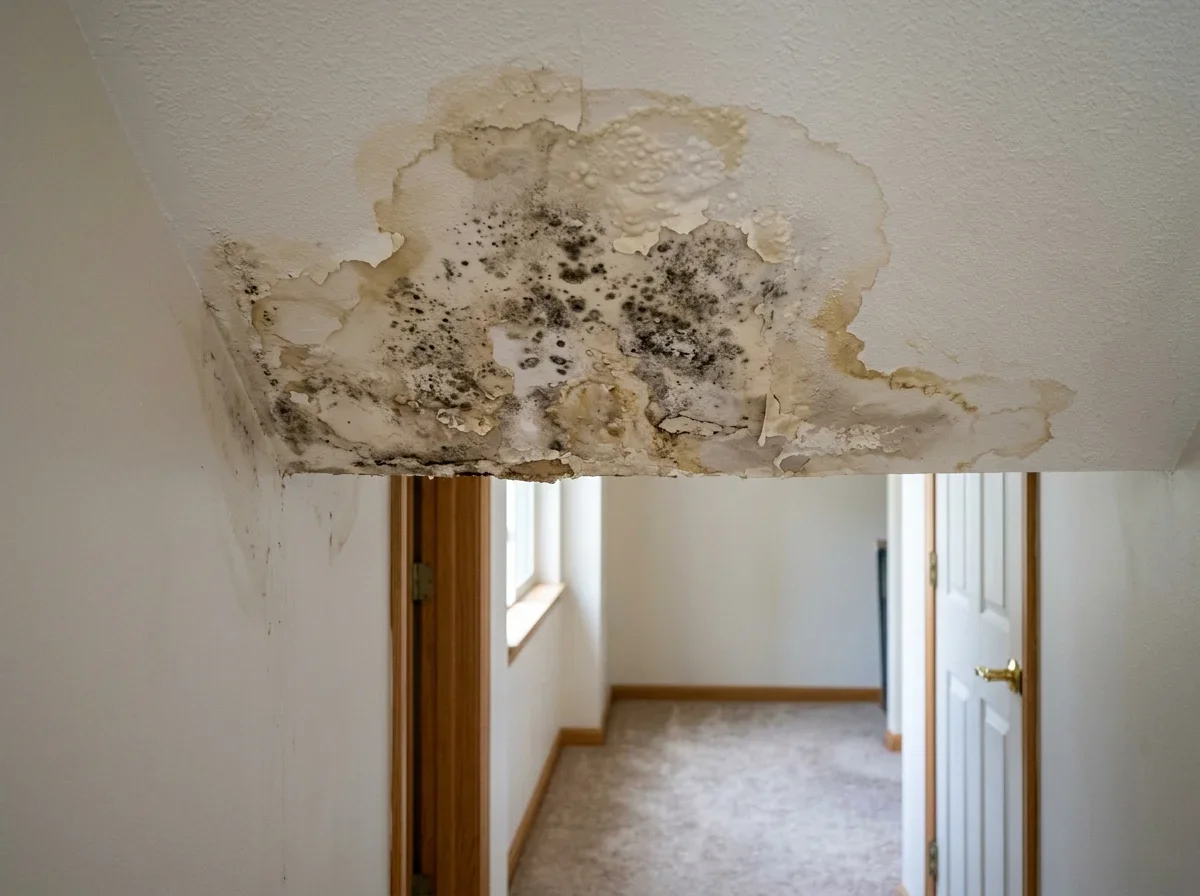
Mold needs three things: moisture, a food source and time. Drywall paper, insulation and framing lumber supply the food. Mild Texas weather after a thaw supplies the warmth.
How it works
What mold needs to grow
Step 1: Moisture
From a leaking or burst pipe
Step 2: Food source
Drywall paper, insulation and framing lumber
Step 3: Time
Growth can begin within a day
The Texas Department of Licensing and Regulation (TDLR) lists pipe leaks among the common moisture problems behind mold. Remediation requires fixing the moisture source first.[1]
How Quickly Mold Can Start After a Leak
Mold can begin growing within a day after a leak, according to the Texas Department of Insurance (TDI).[2] Treat the first few hours as the window that matters most.
You don't need to see mold for the clock to count. A musty odor or damp materials mean conditions are already favorable.
Where Water Hides After a Freeze and Thaw
Pipes often split while frozen and only leak once the thaw arrives. If the house is empty or the power is out, water can run for hours or days before anyone notices.
Watch your water meter with every fixture off, since any movement means a leak. Then look for ceiling stains or sagging, listen for running water, and check the attic insulation.
Attic and ceiling leaks
Attic lines drip into insulation, which soaks up water and holds it long after the surface looks fine. From there, water follows framing down into ceiling drywall and wall cavities.
Wall cavities and slab-home plumbing
Water travels along the path of least resistance. Check walls and ceilings along its entire route, not just near the failed pipe.
Slab homes behave differently. Plumbing runs beneath the floor, so a leak may show up as damp flooring, a warm spot or swelling baseboards rather than standing water.
| Home type | Where to look first |
|---|---|
| Two-story tract home | Attic, ceilings below supply lines, wall cavities between floors |
| Slab-on-grade (1980 onward) | Damp or warm flooring, swollen baseboards, musty closets |
| Pier-and-beam | Crawl space, subfloor underside, floor sag |
| Garage or exterior wall plumbing | Wall base, adjoining rooms, insulation |
For more on where growth concentrates, see where hidden mold tends to grow.
What to Do Right Away
Work in order. Each step below protects your home and your claim.
Stop the water and make it safe
- Shut off the main water valve.
- Turn off power to affected areas if water is near outlets or ceiling fixtures.
- Move valuables and furniture off wet floors.
TDI notes that failing to limit further damage can affect an insurance claim.[3]
Document before you clean up
- Photograph and video the source pipe, standing water, stained materials and damaged contents.
- Write down the timeline: when you found the leak, when you shut off the water, and when drying started.
- Keep the failed pipe section and save receipts for emergency work and equipment.
Start removing water and moisture
- Remove standing water.
- Pull soaked carpet padding and wet insulation.
- Run fans and dehumidifiers, and open the house to airflow when the weather allows.
Fans and air conditioning can make a room feel dry without drying the wall cavity, subfloor or framing behind it.
Pro tip
Ask for written moisture readings from drywall, framing and subfloor so you know the structure is dry, not just the surface.
Drying Out: What Works and When to Call a Pro
Drying is the main defense against mold, and it works best when it reaches the structure, not just the surface. If you want help, see our page on professional structural drying.
Dry versus damaged materials
Solid, non-porous materials can often be dried and cleaned. Soaked drywall, insulation and carpet padding often can't be saved.
Killing mold does not replace removing wet materials and drying the structure. For larger jobs, treatment decisions belong in an assessor's protocol, not in a spray bottle.
Side by side
Dry and clean versus remove
Often can be dried
- Solid, non-porous materials
- Cleaned once dry
Often can't be saved
- Soaked drywall
- Wet insulation
- Carpet padding
When professional structural drying makes sense
Pros use moisture meters and thermal imaging to confirm walls and ceilings are actually dry. Ask for written moisture readings from drywall, framing and subfloor.
Bring in an assessor if you notice any of these:
- Musty odor with no visible source
- Staining or bubbling paint that returns after drying
- Wet drywall or insulation left sitting for long periods
- Concealed spaces involved or an uncertain source
Large tear-outs can trigger city permit rules. These are drywall-repair lines, not mold rules, so confirm with your city's permit office.
| City | Drywall repair permit line |
|---|---|
| Houston | Up to 100 sq ft exempt |
| Austin | Up to 128 sq ft exempt (not fire-rated or shear-wall assemblies) |
| Fort Worth | Permit required at 16 sq ft or more |
| Dallas | Exempts nonstructural interior remodeling of 1- and 2-family homes |
If your home was built before 1978, disturbing paint may require a lead-safe certified firm under the EPA's Renovation, Repair and Painting (RRP) rule.
Signs Mold Has Already Started
Look for a musty smell, discoloration, bubbling paint, or staining that comes back after the area dries. Our guide to signs of mold in your home has the full checklist.
Measure any patch. If it is under 25 contiguous square feet, the Texas rules below give you more room to act, though you still need to dry and fix the cause.
If anyone in the home has symptoms you suspect are linked to mold, see a doctor.
Texas Rules for Mold Cleanup After Water Damage
Texas is one of the few states that licenses mold work, and the rules shape who you can hire.
The 25 square foot threshold
Under 25 contiguous square feet, a license is generally not required, and owners may do their own work on property they own or lease.[1][4] Above that, TDLR licensing applies.
The catch is paperwork. Unlicensed small-job work can't produce a certificate of mold remediation, which can matter for insurance and resale.
| Situation | Path |
|---|---|
| Small area, under 25 sq ft, source fixed | You can clean it yourself, or hire help |
| Visible growth near 25 sq ft, source uncertain, or wet materials remain | Independent assessor |
| 25 contiguous sq ft or more | Licensed remediator, after an assessor's protocol |
Hiring and verifying a licensed company
Ask for the TDLR license number and type, and check it through TDLR's Mold Assessors and Remediators program or at 800-803-9202. Our overview of Texas TDLR mold licensing rules explains the license types.
One company cannot both assess and remediate the same project. A contractor offering bundled "testing and removal" is a red flag.
The usual sequence looks like this:
- The assessor writes a protocol, delivered at least one day before work starts.
- The licensed remediator provides the Consumer Mold Information Sheet before starting.
- The remediator notifies TDLR before beginning, with exceptions for small projects.[4]
- A certificate of mold remediation is due within 10 days of completion.
When you're ready to hire, read how to choose a mold remediation company or review our water damage mold removal options.
Step by step
How a licensed mold job runs
Protocol
The assessor writes a protocol, delivered at least one day before work starts.
Information sheet
The licensed remediator provides the Consumer Mold Information Sheet before starting.
Notification
The remediator notifies TDLR before beginning, with exceptions for small projects.
Certificate
A certificate of mold remediation is due within 10 days of completion.
Insurance and Burst Pipe Mold Claims
TDI says most home policies cover sudden and accidental water damage, including a burst pipe, but usually exclude gradual leaks, seepage and flooding.[2] Mold coverage may be limited or require added coverage.
Usually covered
- Sudden and accidental water damage
- A burst pipe
Usually not covered
- Gradual leaks
- Seepage
- Flooding
A pipe that burst during a freeze is a sudden event. A slow thaw leak that ran unnoticed, or one left unrepaired, can be argued as gradual. Your timeline, photos and plumber's diagnosis make the sudden case easier to prove.
Notify your insurer promptly, ask whether emergency mitigation is authorized, and request written scopes. See whether homeowners insurance covers mold in Texas.
FAQ
How long does it take for mold to start after a water leak?
TDI says mold can begin growing within a day.[2] Act as soon as possible.
Does insurance cover mold from a burst pipe in Texas?
Often the sudden water damage is covered, while mold may be limited or excluded. Check your policy's sudden-versus-gradual wording and mold sublimits.[2]
What are the first signs of mold sickness?
Symptoms vary and can have other causes. Talk to a doctor about any health concerns instead of self-diagnosing.
Do lungs heal after mold exposure?
That depends on the person and the exposure. A doctor can evaluate your situation.
Can I clean up mold after a burst pipe myself?
Under 25 contiguous square feet, owners may generally do their own work on property they own or lease.[1] Fix the leak and dry the structure first.
What should I spray to prevent mold after water damage?
Spraying doesn't replace removing wet materials and drying. For larger jobs, follow an assessor's protocol.
- Texas Department of Licensing and Regulation. "Mold Assessors and Remediators FAQs." https://www.tdlr.texas.gov/mld/mldfaq.htm. Accessed October 17, 2026.
- Texas Department of Insurance. "When are water damage and mold covered by insurance?." https://www.tdi.texas.gov/tips/when-are-water-damage-and-mold-covered-by-insurance.html. Accessed October 17, 2026.
- Texas Department of Insurance. "Unexpected indoor waterfall? Home or renters insurance might help.." https://www.tdi.texas.gov/blog/water-damage.html. Accessed October 17, 2026.
- Texas Department of Licensing and Regulation. "Mold Assessors & Remediators At A Glance." https://www.tdlr.texas.gov/media/pdf/mold-assessors-and-remediators-at-a-glance.pdf. Accessed October 17, 2026.