What a Dehumidifier Does and Does Not Do About Mold
Does having a dehumidifier help with mold? Yes for prevention, no for cure.
Mold needs moisture to grow, and EPA lists dehumidification among the ways to reduce indoor humidity and speed drying after a water problem.[2] EPA also notes that a dehumidifier can help prevent growth in an overly humid room.[3]
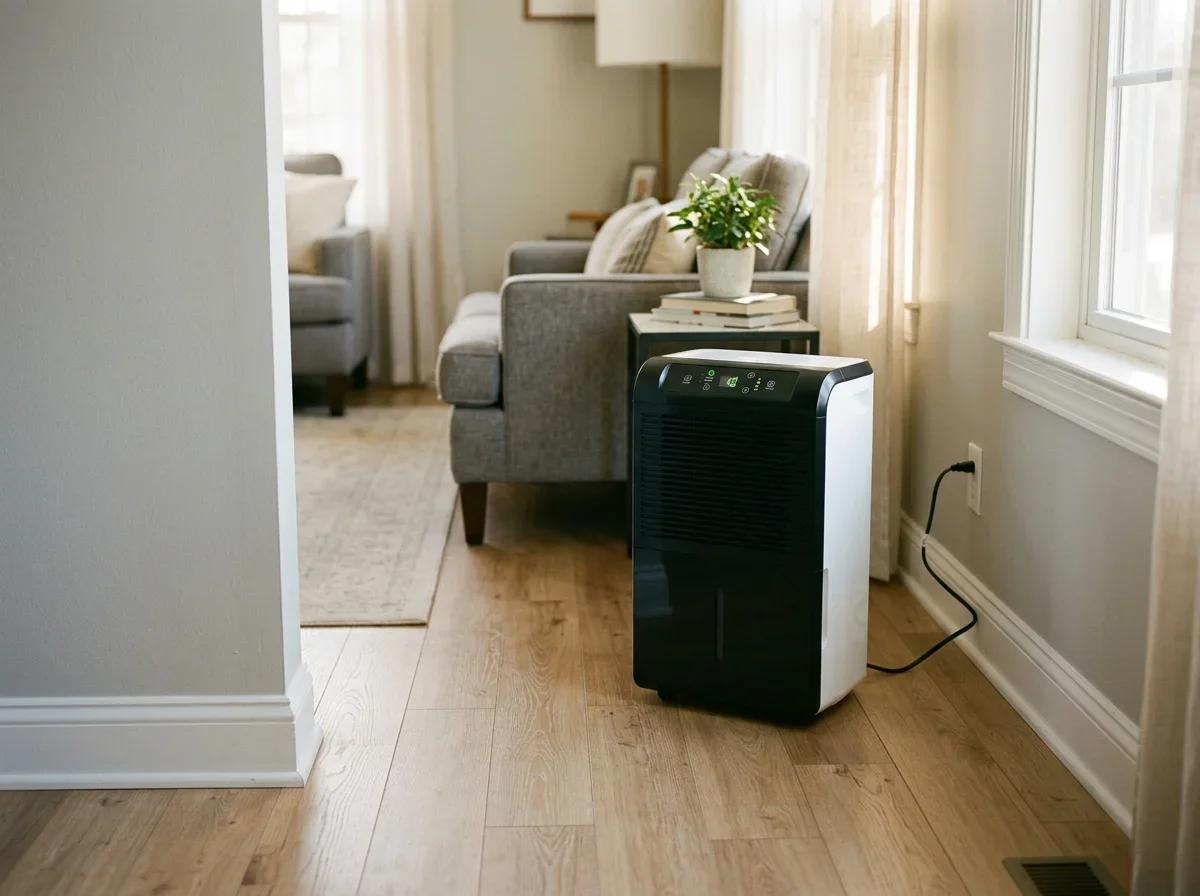
It Controls Moisture, Not Existing Colonies
When the air dries out, active growth slows and new colonies have a harder time starting. Mold that is already established doesn't disappear. It can go dormant and restart when moisture returns.
Why Drying the Air Does Not Clean Surfaces
Dormant mold and its residue stay on drywall, wood, and fabric. Those surfaces need cleaning, and porous materials that stay contaminated may need removal.
The steps a professional follows are laid out in how mold remediation works step by step.
Target Indoor Humidity for Texas Homes
EPA recommends keeping indoor relative humidity below 60%, ideally between 30% and 50%.[1] The lower half of that range gives you a cushion.
In Houston, the Gulf Coast, and East Texas, outdoor air is damp for much of the year, and your AC runs roughly eight months. When a mild, rainy stretch keeps the AC from cycling much, indoor humidity can creep upward even though the house feels cool.
The number matters most in closets, bathrooms, laundry rooms, and rooms with poor airflow.
Key takeaways
Keep indoor humidity below 60%
Aim for 30% to 50% for a cushion
Damp rooms and closets matter most
Mild, rainy stretches can raise humidity even with the AC on
West Texas is a different story. In the hot-dry climate around El Paso, general humidity rarely drives mold, and persistent dampness there is more likely a plumbing or roof leak.
Measuring Humidity with a Hygrometer
A basic hygrometer is inexpensive, and it tells you more than the display on the dehumidifier itself. Set it at breathing height, away from vents, windows, and the unit's exhaust.
Log a few places over several days, and write down the outdoor weather too:
| Location | Morning | Afternoon | Night | AC running? |
|---|---|---|---|---|
| Damp room | ||||
| Reference room far away | ||||
| Near the AC return |
A room that runs about 10 points higher than the reference room points to a local source. A whole-house rise while the AC is idle points toward the AC or the building envelope.
Pro tip
Compare the damp room against a reference room far away. A gap of about 10 points suggests a local moisture source rather than general humidity.
A unit that runs nonstop, fills its bucket daily, and still can't pull the room into range is telling you there's a moisture source feeding it.
Sizing a Dehumidifier for Your Space
Room Size, Dampness, and Capacity Ratings
DOE defines a dehumidifier's capacity as the water it removes from the air over 24 hours of continuous operation, reported in pints per day, using test conditions based on ANSI/AHAM DH-1.[5] Manufacturers must test under the DOE procedure.[4]
Compare that rating against the room's area and how damp it gets.
Slab homes have no basement to treat, so the problem rooms tend to be interior closets, utility rooms, bathrooms, and spaces along exterior walls.
Why Oversizing and Undersizing Both Cause Problems
An undersized unit runs constantly and never catches up. An oversized one may cool down the readout quickly in one corner while the far end of the house stays damp, since a single unit doesn't treat a whole home evenly.
Plan for drainage too. In a Texas summer a bucket fills fast, and standing water becomes its own mold source. A continuous drain hose to a suitable drain saves the daily chore.
How it works
How a dehumidifier removes moisture
Step 1: Damp room air is drawn in
Intake needs clearance
Step 2: Moisture is pulled out of the air
Step 3: Water collects in the bucket
Or runs out through a continuous drain hose
Step 4: Drier air returns to the room
Where to Place a Dehumidifier
Put the unit in the damp room itself, with clearance around the intake and exhaust. Keep the door closed so it isn't trying to dry the whole house.
Don't aim it at a wall that might have a leak behind it. Lowering the air humidity in the room can make the problem feel solved while the wall cavity stays wet.
Maintenance counts, because a dirty unit can grow mold of its own:
- Empty the bucket daily, or use continuous drainage
- Wipe the interior and pan regularly
- Clean the filter on the schedule in the manufacturer's manual
EPA also advises cleaning the appliance regularly.[3]
Checklist
Dehumidifier upkeep
0 of 3 ticked
Tick them off as you go. Nothing is saved or sent.
Portable vs Whole-House Dehumidification
When a Portable Unit Is Enough
A portable unit suits one damp room, a closet, or a bathroom. It can help dry the air after showers.
But a bathroom with visible mold needs cleaning, and a fan that vents outdoors does more for daily moisture.
When a Whole-House System Makes Sense
Whole-house systems tie into the HVAC and treat the entire home. They come up most in tight, newer Texas construction with spray foam and complex ducting, where the house holds moisture once the AC satisfies the thermostat.
An oversized AC can short-cycle, cooling the air without running long enough to pull out moisture. Have a qualified HVAC contractor evaluate it rather than buying a unit on a guess.
| Use case | What it treats | Who evaluates |
|---|---|---|
| One damp room or closet | Local air moisture | You, with a hygrometer |
| Whole home stays humid with AC on | Whole-house air moisture | HVAC contractor |
| One room damp, others fine | Likely a source, not air | Mold assessor or plumber |
Dehumidifier or Air Purifier for Mold
An air purifier filters spores out of the air, but it does nothing about the moisture that feeds growth. A dehumidifier controls moisture but doesn't filter spores. Neither removes mold from surfaces.
Side by side
Dehumidifier versus air purifier
Dehumidifier
- Controls the moisture that feeds growth
- Does not filter spores
- Does not clean surfaces
Air purifier
- Filters spores out of the air
- Does nothing about moisture
- Does not clean surfaces
When a Dehumidifier Is Not Enough
Humidity is sometimes the symptom, not the cause.
| Symptom | Likely cause | Dehumidifier appropriate? | Next step |
|---|---|---|---|
| High RH only in rainy or mild stretches | Ambient humidity, AC cycling off | Yes | Dehumidifier or whole-house unit |
| High RH even with AC running | Short-cycling, clogged condensate line, duct condensation | No | Check drain line and air handler; call HVAC |
| One room damp or musty, others normal | Hidden leak | No | Inspection |
| Damp slab-adjacent walls or floors | Under-slab plumbing leak | No | Leak detection |
Signs You Have Active Growth or a Hidden Leak
Visible growth, a persistent musty smell, or humidity that stays high after the AC is fixed suggests a source. TDLR lists pipe leaks, roof leaks, sewage backups, overflowing fixtures, and floodwater as common causes, and remediation requires fixing the source. Check signs of mold in your home and where hidden mold tends to hide.
Most Texas homes sit on slabs with plumbing underneath, and expansive clay in Houston, DFW, and San Antonio shifts foundations and cracks lines.
A warm spot on the floor or an unexplained jump in your water bill deserves a leak check before any purchase. Also look at the condensate drain and the area around the air handler, and read about mold in air ducts.
A dehumidifier treats room air, not the wall cavity. It may lower the reading while the leak keeps feeding the wall.
TDI says mold can begin within a day, and EPA advises drying affected areas within 24 to 48 hours.[1]
Texas Thresholds That Point to Professional Help
Visible mold over 25 contiguous square feet, roughly a 5 ft by 5 ft patch, is the point where Texas requires a licensed professional.
Under that, unlicensed people can handle visible mold, and owners have an exemption for property they own. Hidden growth behind a wall means the visible patch understates the problem.
Above the threshold, a TDLR-licensed assessor writes the protocol and a separate licensed remediator does the work. A legitimate pro gives you the Consumer Mold Information Sheet before starting. Read the Texas TDLR mold licensing rules or book a mold inspection from a licensed Texas assessor.
Professional work leaves a paper trail: a certificate of mold remediation, which sellers must pass on for the prior five years.
Many Texas policies cover sudden leaks but not gradual ones, and many cap mold. For ongoing moisture control, see mold prevention services. Questions about health effects are covered on the black mold health risks page.
FAQ
Does a dehumidifier help with mold?
Yes for prevention. It lowers moisture so new growth is less likely, but it doesn't cure existing mold.
Will a dehumidifier kill existing mold?
No. Dormant mold can restart when moisture returns, and the residue still needs cleaning.
What humidity level should I keep my Texas home at to prevent mold?
EPA recommends below 60%, ideally 30% to 50%.[1]
Is an air purifier or a dehumidifier better for mold?
They do different jobs. A purifier filters airborne spores, and a dehumidifier controls moisture. Moisture control comes first.
Can I run a dehumidifier if there is mold in my walls?
You can, but it won't fix the problem. Find and repair the source, and have a licensed assessor look at the wall.
Should I use a dehumidifier in a bathroom with mold?
It can help dry the air, but clean or remove the growth first and improve ventilation.
- U.S. Environmental Protection Agency. "Tribal IAQ Resource Directory: Mold and Moisture." https://www.epa.gov/indoor-air-quality-iaq/tribal-iaq-resource-directory-mold-and-moisture. Accessed October 17, 2026.
- U.S. Environmental Protection Agency. "Mold Course Chapter 9: Mold Prevention." https://www.epa.gov/mold/mold-course-chapter-9. Accessed October 17, 2026.
- U.S. Environmental Protection Agency. "Mold House Tour: Text Version." https://www.epa.gov/mold/text-version-mold-house-tour. Accessed October 17, 2026.
- U.S. Department of Energy. "Consumer Dehumidifiers." https://www.energy.gov/cmei/buildings/consumer-dehumidifiers. Accessed October 17, 2026.
- U.S. Department of Energy. "Test Procedures for Residential Dishwashers, Dehumidifiers, and Commercial Clothes Washers." https://www1.eere.energy.gov/buildings/appliance_standards/pdfs/aham-1_tp_final_rule.pdf. Accessed October 17, 2026.