What Texas Law Requires Sellers to Disclose About Mold
Texas sellers give the buyer a written Seller's Disclosure Notice, and the standard form asks about water damage, defects and repairs the seller knows of rather than about mold by name. A seller who has had licensed mold remediation must also hand the buyer every certificate of mold remediation issued in the five years before the sale.[4][6][7] Disclosure turns on what the seller actually knows.
The TREC Seller's Disclosure Notice Under Property Code 5.008
Texas Property Code § 5.008 requires the seller of residential property with no more than one dwelling unit to give the buyer a written notice, and the Texas Real Estate Commission publishes the standard form, TREC No. OP-H.[4][6] The seller completes it to the best of their belief and knowledge, and a seller who does not know an answer says so and is in compliance.[4] The form states that it reflects the seller's knowledge and is not a substitute for inspections or warranties.[6]
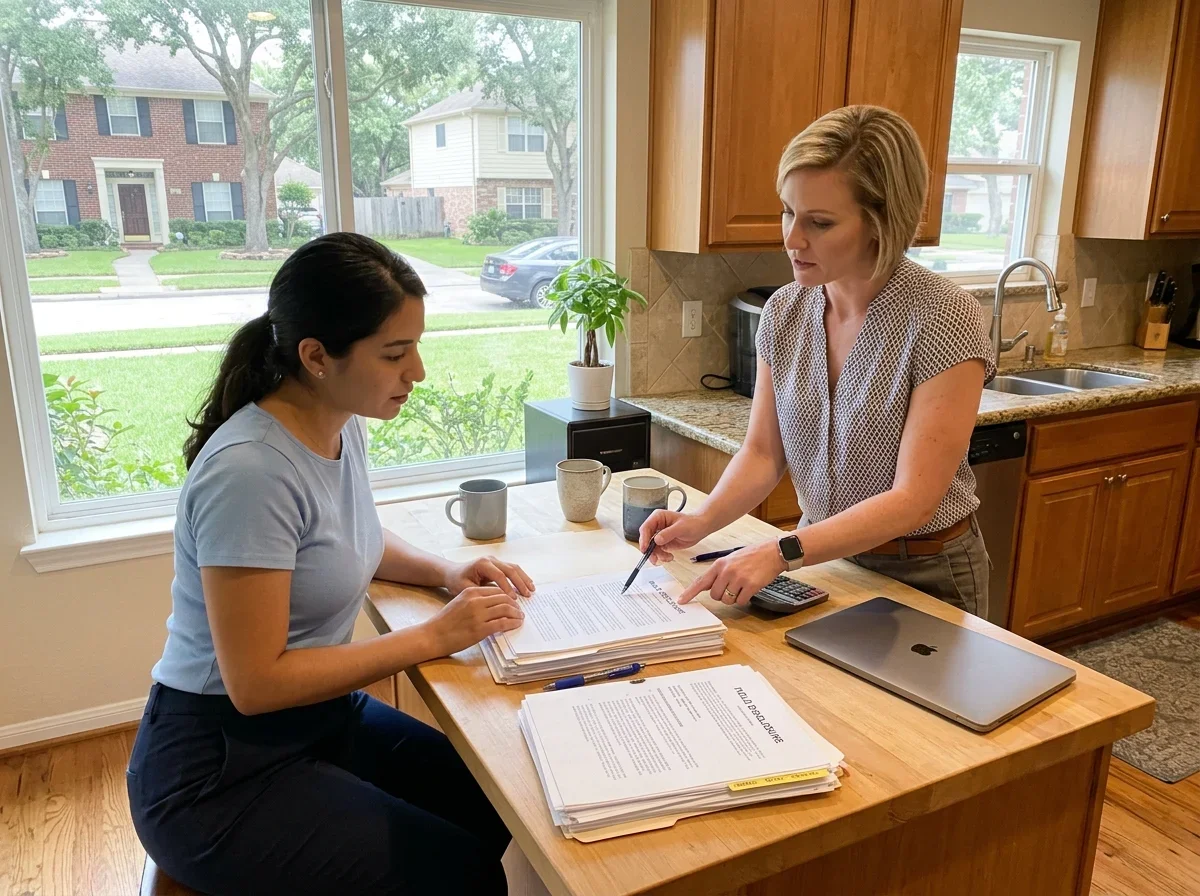
There is no standalone statewide mold disclosure form, and the TREC form has no line that says mold. Mold comes up through the questions on defects in interior walls, ceilings and floors, on "Water Damage Not Due to a Flood Event," and on any item or system in need of repair.[6]
The notice must reach the buyer on or before the effective date of the contract. If the contract was signed without it, the buyer may terminate for any reason within seven days after receiving the notice.[4] The statute does not apply to some transfers, including court-ordered and foreclosure sales and transfers by a fiduciary in a decedent's estate.[4]
Known Conditions Versus Suspected Ones
A seller reports what they know, not what they could guess. A slow under-slab leak in a 1990s slab home may truly be unknown to the owner, and "unknown" is a valid answer on the form.[4]
Answering "no" to a condition the seller did know about is what buyers later dispute. That is why the next sections focus on documents, not promises.
Certificates of Mold Remediation Travel With the House
When licensed remediation happens, a chain of documents follows. A licensed assessor writes a protocol before work starts, the remediator carries it out, and the assessor inspects afterward. No later than the 10th day after the project's stop date, the remediation contractor and the assessor who did the post-remediation assessment sign the Certificate of Mold Damage Remediation.[2]
Timeline
The remediation paper trail
Before work
Licensed assessor writes the protocol
During work
Remediator carries out the protocol
After work
Assessor performs the post-remediation inspection
By day 10
Contractor and assessor sign the certificate
At sale
Owner gives the buyer every certificate from the prior 5 years
The certificate states whether the identified mold was remediated and whether its underlying cause was corrected.[2] If the property is sold, the owner must give the buyer a copy of every certificate issued in the five years before the sale.[3][7]
That makes it the strongest proof that a past problem was handled to a protocol and cleared.
A buyer holding the protocol, clearance results and certificate can see a complete chain. A buyer holding only a seller's "it was fixed" cannot. To read what those reports say, see how to read a mold assessment report.
Why Small or Unlicensed Jobs Leave No Paper Trail
Most visible mold covering less than 25 contiguous square feet may be cleaned by people who are not licensed.[1] Owners may also do their own work on property they own. In either case, no certificate of mold remediation can be issued.
25 sq ft
contiguous area where unlicensed cleanup is generally allowed, and no certificate is issued
A clean file does not prove a clean history.
A missing certificate is not proof of a problem, but it is a reason to ask more questions: what was cleaned, how big the area was, who did it, whether the moisture source was fixed, and whether any photos or receipts exist.
The inverse matters too. If the affected area was 25 square feet or more, a licensed route should have produced a certificate, and a notification is required when that work is done.[5] A big job with no paperwork is a red flag. For license categories and exemptions, see TDLR mold licensing rules.
Decide
What paperwork to expect
Was the affected area 25 square feet or more?
If Yes
then: A licensed route should have produced a certificate
If No
then: No certificate is issued, so ask for photos, receipts and moisture readings
What Buyers Should Ask and Request
Ask early and in writing. Disclosures that arrive after inspections and negotiations are already underway leave you little leverage.
Documents to Ask For
Copy this list into an email to the listing agent:
- Seller's disclosure notice. It shows what the seller says they know.
- Certificates from the last five years. These prove cleared remediation.
- Assessor protocol and clearance results. These show the scope and whether the area passed.
- Repair invoices, photos and moisture readings. These cover small jobs that never produced a certificate.
- TDLR license number and type of whoever did past work. Verify it on the TDLR license search.
Questions for the Seller and the Listing Agent
Ask about past leaks, roof and plumbing repairs, flooding, storm damage and HVAC condensate problems. Ask about slab leak reroutes and foundation work.
Add drain pan overflows, clogged condensate lines and duct repairs, since air conditioning runs most of the year. For pre-1980 pier-and-beam homes, ask about crawl space drainage and vapor barriers.
Newer homes still need these questions, because "new" does not mean moisture-proof.
Most important: was the moisture source fixed? Remediation requires it.[2]
Pro tip
Ask for the moisture source repair in writing, with an invoice or photos, not just a verbal assurance that the leak was fixed.
Pair the Disclosure With an Independent Inspection
A disclosure only reflects what the seller knows. Mold inside walls, in attics or under flooring next to the slab can go unreported by an honest seller. A failed leak repair three years ago may never have shown a stain.
Hire a licensed assessor to evaluate moisture conditions, not just visible growth. Pay attention to HVAC closets, bathrooms, kitchens, roof penetrations and recently painted surfaces.
A real estate mold inspection gives you findings independent of the seller's account. In Texas, a license holder may not perform both assessment and remediation on the same project, and no one may own an interest in both companies on that project, which helps keep those findings unbiased.[8]
The process is covered in how to get a mold inspection before buying a Texas home. Remember that an inspector who finds nothing visible has not proven the seller disclosed everything. For where problems hide, see where hidden mold tends to be.
Seller Steps Before Listing a Home With a Mold History
A documented repair looks like diligence. An undocumented one can look like concealment, especially when fresh paint or new drywall covers the area.
- Gather every certificate and remediation record from the last five years and keep them with the closing file.
- Fix the moisture source first. Skip cosmetic cover-ups, which create the dispute risk buyers worry about.
- For jobs of 25 contiguous square feet or more, use a licensed assessor and a separate licensed remediator, then get post-remediation clearance through post-remediation verification.
- For small jobs, keep dated photos, receipts and moisture readings.
Do not count on insurance to pay for it. Standard HO-A policies in Texas generally cover only sudden and accidental leaks, and many do not cover mold remediation; those that do generally cap it.[9] The details are in whether Texas homeowners insurance covers mold.
The certificate itself comes from the licensed assessor under Occupations Code § 1958.154.[7] A small job you did yourself produces none, so keep your own records.
Disputes After Closing: Proof, Liability and Remedies
This is general information, not legal advice. A Texas real estate attorney can assess your facts.
Showing a Seller Knew About Mold
Finding mold after closing is not enough. A claim usually needs evidence that the seller knew and failed to disclose. Evidence tends to fall into three groups:
| Source | Examples |
|---|---|
| Seller-side | Repair invoices, prior assessment reports, insurance claims, listing-era messages |
| Physical | Fresh paint or new drywall over a damaged area, sealed access panels, odor masking |
| Third-party | Prior inspection reports, statements from neighbors or agents |
Preserve the disclosure notice, inspection report, listing photos, texts, emails and contractor records.
Legal Exposure for Sellers
What a buyer can recover after closing depends on the facts and the contract, and those are legal questions. A claim starts with what the seller knew when completing the notice.[4] A Texas real estate attorney can say which remedies apply.
Quick answers
Does mold need to be disclosed when selling a house in Texas?
The TREC notice asks about water damage, defects and repairs the seller knows of, not about mold by name. A seller completes it to the best of their belief and knowledge, and gives the buyer every certificate of mold remediation from the past five years.
Can you be sued for selling a house with mold?
A buyer's claim starts with what the seller knew and whether the notice reflected it. What a claim can recover depends on the facts and the contract, so ask a Texas real estate attorney.
How can a buyer show the seller knew about mold?
Through documents and physical signs: invoices, prior reports, insurance claims, messages, and fresh cover-ups over damaged areas.
What is a certificate of mold remediation and who gets it?
A statement from a licensed assessor that the identified mold was remediated and, where true, that its underlying cause was fixed. The license holder provides it to the owner within 10 days of completion, and a selling owner gives the buyer each one from the prior five years.
Where can I find a mold disclosure form for Texas?
There is no standalone mold form. Use the TREC Seller's Disclosure Notice, form OP-H, prepared under Property Code § 5.008.
What if the seller never gave me the notice?
If the contract was signed without it, the buyer may terminate for any reason within seven days after receiving the notice.
- Texas Department of Licensing and Regulation. "Mold Assessors and Remediators FAQs." https://www.tdlr.texas.gov/mld/mldfaq.htm. Accessed October 21, 2026.
- Texas Department of Licensing and Regulation. "Consumer Mold Information Sheet." https://www.tdlr.texas.gov/mld/pdf/cmis.pdf. Accessed October 21, 2026.
- Texas Department of Licensing and Regulation. "Mold Assessors & Remediators At A Glance." https://www.tdlr.texas.gov/media/pdf/mold-assessors-and-remediators-at-a-glance.pdf. Accessed October 21, 2026.
- Texas Legislature. "Seller’s Disclosure of Property Condition." https://statutes.capitol.texas.gov/Docs/PR/htm/PR.5.htm#5.008. Accessed October 21, 2026.
- Texas Department of Licensing and Regulation. "Mold Remediation Notification Requirements." https://www.tdlr.texas.gov/mld/mldnotifications.htm. Accessed October 21, 2026.
- Texas Real Estate Commission. "Seller's Disclosure Notice, TREC No. OP-H (09-01-2019)." https://www.trec.texas.gov/sites/default/files/pdf-forms/OP-H.pdf. Accessed October 21, 2026.
- Texas Legislature. "Occupations Code § 1958.154, Certificate of Mold Remediation; Duty of Property Owner." https://statutes.capitol.texas.gov/Docs/OC/htm/OC.1958.htm#1958.154. Accessed October 21, 2026.
- Texas Legislature. "Occupations Code § 1958.155, Conflict of Interest; Disclosure Required." https://statutes.capitol.texas.gov/Docs/OC/htm/OC.1958.htm#1958.155. Accessed October 21, 2026.
- Office of the Texas Attorney General. "Mold Remediation." https://www.texasattorneygeneral.gov/consumer-protection/home-real-estate-and-travel/mold-remediation. Accessed October 21, 2026.