Why Texas Regulates Mold Remediation
Texas created its mold licensing framework through Occupations Code Chapter 1958 and Administrative Code Chapter 78, establishing one of the most comprehensive regulatory systems in the country.[2] The state recognized that improper mold remediation can worsen indoor air quality, spread spores to unaffected areas, and leave underlying moisture problems unresolved.
The regulations serve two purposes: they set minimum competency standards for anyone working in the industry, and they protect homeowners from untrained contractors who treat mold like a cosmetic issue rather than a health and structural concern.
If you're comparing bids and one contractor isn't asking about TDLR compliance, that's your first red flag.
Texas's climate creates ideal mold conditions year-round — especially in the humid Gulf Coast corridor and in homes built on expansive clay soil where foundation movement creates hidden plumbing leaks. The state saw fit to regulate an industry that directly impacts public health and property values.
The Five TDLR Mold License Categories
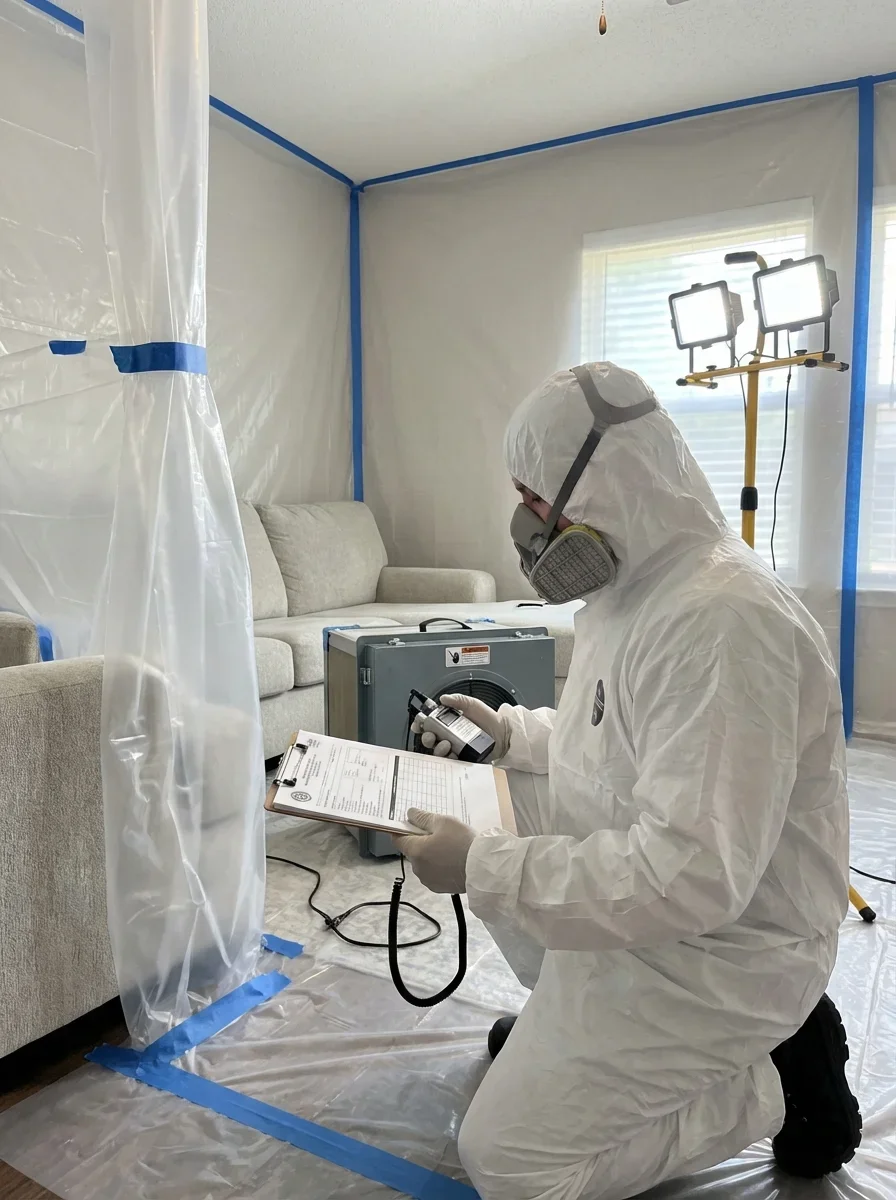
Texas doesn't issue a single "mold license." The state separates assessment from remediation and requires different credentials for workers versus companies.
Mold Assessment Technician: The individual who conducts on-site inspections, collects samples, and documents conditions. This person works under a licensed assessment company and must complete TDLR-approved training.
Mold Assessment Company: The business entity that employs assessment technicians and issues formal assessment reports. This license requires proof of liability insurance and bonding.
Mold Remediation Worker: The individual who performs hands-on remediation work — containment, removal, cleaning, disposal. Workers must complete 16 hours of TDLR-approved training.
Mold Remediation Contractor: The individual who supervises remediation projects and ensures compliance with state standards. This person must be at least 18 years old, pass a criminal background check, meet education and experience requirements, and carry required insurance coverage.[1]
Mold Remediation Company: The business entity that employs remediation workers and contractors. Like assessment companies, remediation companies must maintain liability insurance and meet bonding requirements.
Critical Rule: The same company cannot perform both assessment and remediation on the same project. Texas prohibits this conflict of interest to prevent companies from inflating problems during inspection to secure remediation work. Any company offering both services for the same job is operating outside the law.
One critical rule: the same company cannot perform both assessment and remediation on the same project.[2]
Texas prohibits this conflict of interest to prevent companies from inflating problems during inspection to secure remediation work. You'll need separate contractors for testing and cleanup. Any company offering both services for the same job is operating outside the law.
Small Project Exemptions and Owner Occupant Rules
Not every mold situation requires a licensed professional. Texas exempts projects affecting less than 25 contiguous square feet from licensing requirements.[3] That's roughly a 5x5 area — think a small section of bathroom tile or a corner of a bedroom wall.
If your project is smaller than that threshold, you can hire an unlicensed handyman or tackle it yourself. But measure carefully.
"Contiguous" means connected. If you have mold in three separate 10-square-foot areas, those don't combine to exceed the threshold. If you have a 30-square-foot patch behind your shower, you're over the limit and need a licensed contractor.
Property owners also get an exemption when remediating residential properties with fewer than 10 dwelling units that they own and occupy.[3] This means you can remediate your own single-family home without a license, but you cannot hire an unlicensed contractor to do it for you. The exemption applies to owner labor only.
These exemptions disappear entirely for rental properties, commercial buildings, and any project over 25 square feet where you're hiring outside labor. If you're a landlord dealing with mold in a duplex you don't live in, you must use licensed professionals regardless of project size.
How to Verify a Texas Mold License
TDLR maintains a public license lookup tool at tdlr.texas.gov/mol/mol.htm where you can search by company name, license number, or individual name. Before you sign any contract, verify three things:
Current license status: The license should show "current" or "active," not expired or suspended. Licenses must be renewed periodically, and contractors sometimes let them lapse between projects.
License category match: Make sure the license category aligns with the work you're hiring for. An assessment technician license doesn't authorize remediation work, and a remediation worker can't conduct formal inspections.
Insurance and bonding: While you can't verify coverage amounts through the public portal, TDLR requires proof of insurance at licensing. Ask your contractor for a certificate of insurance naming you as an additional insured, and confirm the policy includes pollution liability — standard general liability policies often exclude mold-related claims.
You should also verify that assessment and remediation companies are truly separate entities. Some contractors try to work around the conflict-of-interest rule by creating shell companies with shared ownership.
If the same person owns both the assessment and remediation company, that's a violation even if they hold separate licenses.
Education and Experience Requirements for Contractors
Becoming a licensed mold remediation contractor in Texas requires more than filling out paperwork. TDLR mandates specific training and experience thresholds designed to ensure competency.
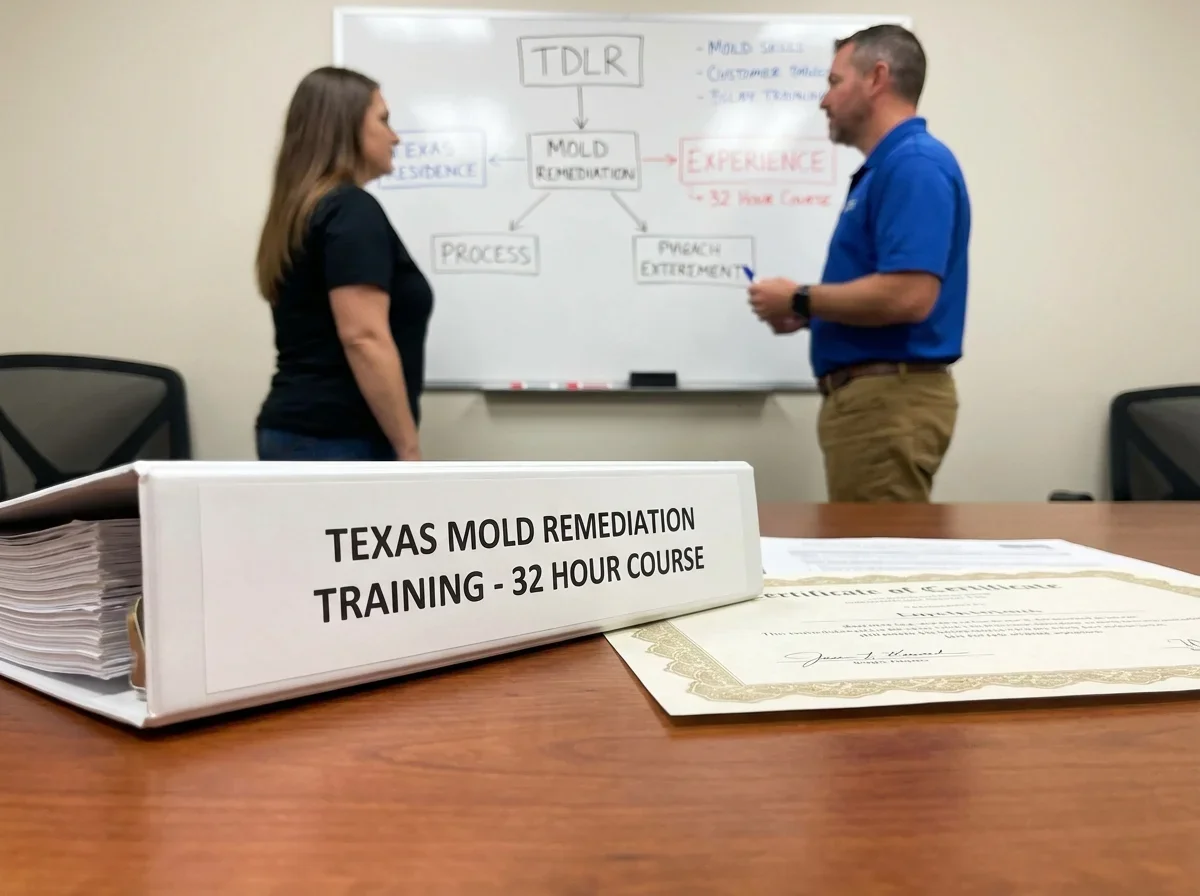
Contractors must complete a minimum of 32 hours of TDLR-approved initial training covering mold biology, health effects, assessment protocols, remediation techniques, containment procedures, and state regulations. Training providers must be approved by TDLR, and courses must follow standardized curricula.
Beyond initial training, contractors need documented experience. TDLR reviews work history to confirm applicants have supervised remediation projects and understand field conditions, not just classroom theory. The criminal background check requirement filters out candidates with recent felony convictions or certain misdemeanors related to fraud or dishonesty.
Insurance requirements include general liability coverage, pollution liability (sometimes called microbial or mold-specific coverage), and depending on the contractor's business structure, professional liability for errors and omissions.
These policies protect you if something goes wrong during remediation — a containment failure that spreads spores to unaffected rooms, damage to your HVAC system during duct cleaning, or incomplete work that allows regrowth.
| License Type | Training Required | Key Requirement | Who Needs It |
|---|---|---|---|
| Mold Remediation Worker | 16 hours TDLR-approved | Complete training course | Hands-on cleanup workers |
| Mold Remediation Contractor | 32 hours TDLR-approved | Training + experience + background check + insurance | Project supervisors |
| Mold Assessment Technician | TDLR-approved training | Complete training course | On-site inspectors |
| Remediation/Assessment Company | N/A (employs licensed individuals) | Insurance + bonding | Business entities |
Why TDLR Compliance Matters for Your Project
Hiring a licensed contractor isn't just about following the law. It's about ensuring the work meets minimum performance standards established in Administrative Code Chapter 78.[2]
Licensed contractors must follow specific protocols for containment (physical barriers and negative air pressure to prevent cross-contamination), removal (HEPA-filtered vacuuming and proper disposal of contaminated materials), and verification (post-remediation testing to confirm spore levels have returned to normal). They're required to document every step, provide written remediation plans before work begins, and issue final reports after completion.
Unlicensed contractors aren't bound by these standards.
They might spray bleach on visible mold and call it done, or tear out contaminated drywall without containment and spread spores throughout your home. Worse, they're not required to identify or address the underlying moisture source — the roof leak, plumbing issue, or condensation problem that caused the mold in the first place.
If you're selling your home and a buyer's inspector finds evidence of past mold remediation, they'll ask for documentation. A TDLR-licensed contractor provides a paper trail that satisfies disclosure requirements and gives buyers confidence the work was done properly.
An unlicensed contractor leaves you with no verifiable records and potential liability.
For homes built on Texas's expansive clay soil — the Blackland Prairie belt running through Dallas-Fort Worth, the Gulf Coast plain around Houston, and the Edwards Plateau near San Antonio — foundation movement creates chronic plumbing leaks under slab-on-grade construction. These slow leaks saturate the concrete and subfloor, creating persistent moisture that feeds mold growth in wall cavities and under flooring. Licensed contractors understand this regional pattern and know to investigate foundation settlement and under-slab plumbing as part of the remediation plan, not just treat surface symptoms.
What TDLR Standards Require During Remediation
The Texas Mold Assessment and Remediation Rules set specific minimum work standards that licensed contractors must follow. These aren't optional best practices — they're regulatory requirements.
Containment: For projects over 25 square feet, contractors must establish physical barriers (plastic sheeting sealed with tape) and negative air pressure using HEPA-filtered air scrubbers. The goal is to create a pressure differential that prevents contaminated air from migrating to clean areas. For projects over 100 square feet, double containment barriers are required.
Personal protective equipment: Workers must wear respirators (minimum N95, often full-face with P100 filters for heavy contamination), disposable coveralls, gloves, and eye protection. This isn't about protecting you — it's about preventing workers from tracking spores to unaffected areas on their clothing and gear.
HEPA filtration: All vacuuming and air scrubbing must use true HEPA filters (99.97% efficiency at 0.3 microns). Shop vacs and standard HVAC filters don't meet this standard.
Contractors must clean surfaces with HEPA vacuums before applying antimicrobial treatments, then vacuum again after treatment dries.
Moisture source correction: TDLR requires contractors to identify and document the moisture source, even if correcting it falls outside the remediation scope. If you have mold from a leaking roof, the contractor must note that the roof repair is a prerequisite to successful remediation. They can't just clean up mold and leave the leak active.
Disposal protocols: Contaminated materials must be double-bagged in 6-mil polyethylene, sealed, and disposed of according to local solid waste regulations. Contractors can't simply toss moldy drywall in your trash bin or leave debris piles in your yard.
Clearance testing: For projects over 25 square feet, TDLR recommends (but doesn't require) post-remediation verification by an independent licensed assessor. Many contracts and insurance policies make this mandatory regardless of state requirements.
These standards align closely with the IICRC S520 guidelines used nationally, but TDLR enforcement gives them teeth in Texas. Violations can result in license suspension, fines, and orders to redo substandard work at the contractor's expense.
How Licensing Affects Insurance Claims and Real Estate Transactions
If you're filing an insurance claim for mold remediation, your carrier will ask whether the work was performed by a licensed contractor. Many policies explicitly require TDLR compliance for coverage, and claims adjusters routinely verify licenses during the approval process.
Using an unlicensed contractor can void your claim entirely.
Even if your policy doesn't explicitly mention licensing, insurers can argue that unlicensed work doesn't meet professional standards and refuse to reimburse costs. Given that whole-house mold remediation in Texas often runs $8,000–$25,000+, that's not a risk worth taking to save a few hundred dollars on a low-ball bid.
Real estate transactions create similar documentation requirements. If you're buying a home and the seller discloses past mold remediation, your lender may require proof that a licensed contractor performed the work and that post-remediation verification confirmed successful cleanup. Without that documentation, the lender might require additional inspections, escrow holdbacks, or refuse to fund the loan entirely.
Sellers face parallel risks. If you remediate mold before listing your home and don't use a licensed contractor, buyers can argue during due diligence that the work doesn't count as proper disclosure.
You might be forced to credit the buyer for re-remediation by a licensed company, or in worst cases, face post-sale litigation if mold returns and the buyer discovers no licensed contractor was involved.
Enforcement and Penalties for Unlicensed Work
TDLR actively investigates complaints about unlicensed mold work. Homeowners, competitors, and even insurance companies can file reports, and penalties for operating without a license are substantial.
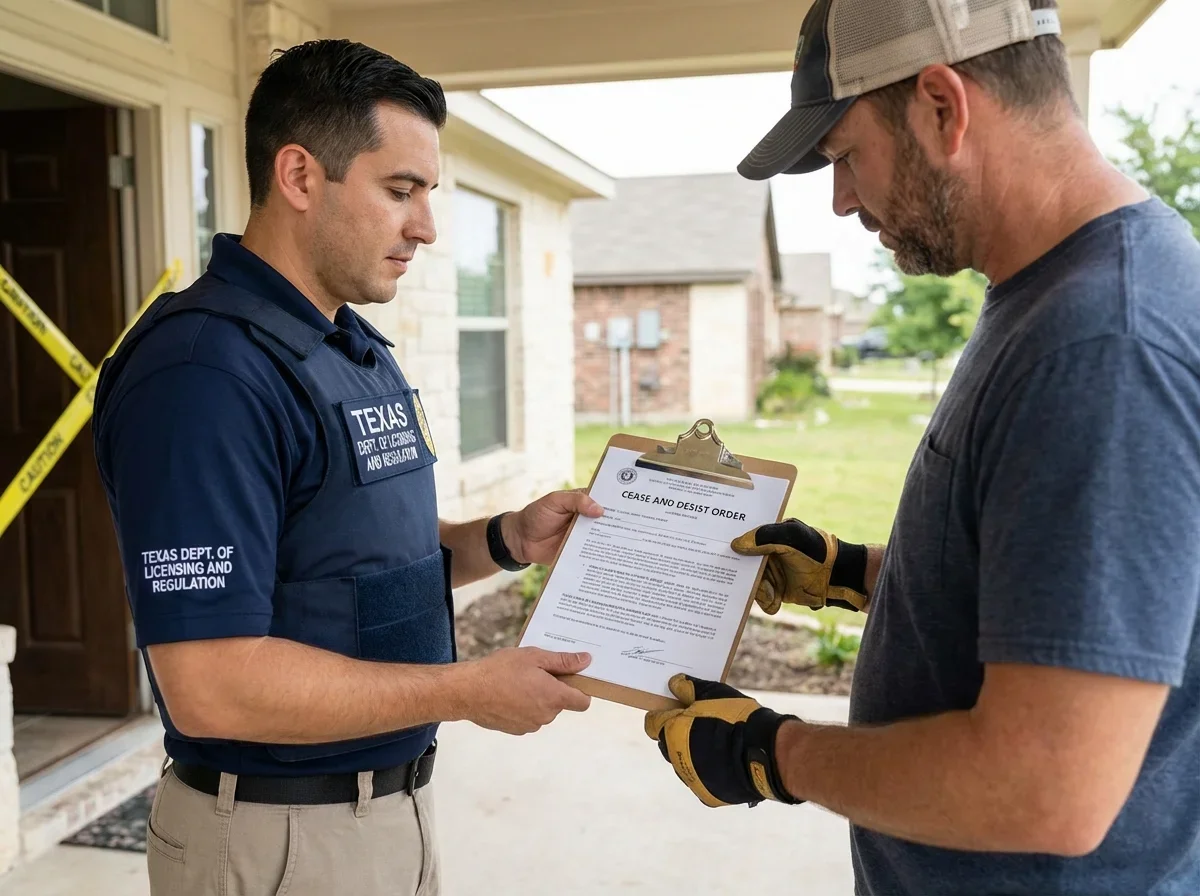
First-time violations can result in cease-and-desist orders requiring the contractor to stop all mold work immediately. Repeat offenses carry civil penalties up to $5,000 per violation per day.
For contractors who hold licenses in other trades (general contracting, plumbing, HVAC), a TDLR violation can trigger disciplinary action against those licenses as well.
For homeowners, hiring an unlicensed contractor creates liability exposure. If a worker is injured on your property and the contractor doesn't carry workers' compensation insurance (Texas is one of few states that doesn't require it for general contractors), you could be sued directly. If the contractor's work causes damage to neighboring properties — say, cross-contamination that forces your neighbor to remediate their home — you're potentially liable for those costs.
Beyond financial penalties, unlicensed work leaves you with no recourse if problems arise. Licensed contractors must maintain bonds that can be claimed against if they abandon projects or perform substandard work.
Unlicensed contractors offer no such protection, and small claims court is your only remedy — assuming you can even locate the contractor after the fact.
Penalties for Unlicensed Mold Work:
- Cease-and-desist orders for first-time violations
- Civil penalties up to $5,000 per violation per day
- Potential disciplinary action against other trade licenses
- Homeowner liability for worker injuries without workers' comp
- Homeowner liability for damage to neighboring properties
- No bond protection for abandoned or substandard work
- Limited legal recourse through small claims court only
Special Considerations for Hurricane and Flood Remediation
Texas's Gulf Coast experiences recurring flood events, and the licensing requirements don't change during disasters. After Hurricane Harvey in 2017, Houston saw a massive influx of out-of-state contractors, many operating without TDLR licenses. The same pattern repeats after every major storm.
If you're dealing with post-flood mold, verify that any contractor you hire holds a current Texas license, not just credentials from their home state.
Many states don't regulate mold work at all, and an "IICRC-certified" contractor from Louisiana or Florida isn't automatically qualified to work in Texas without TDLR licensing.
Emergency mold removal often begins with structural drying to prevent further growth while you arrange formal remediation. Some water damage restoration companies hold mold remediation licenses; others don't. If your restoration contractor starts removing wet drywall and discovers active mold, they must stop and call in a licensed remediator if they don't hold the appropriate TDLR license themselves.
Storm-damaged homes built on pier-and-beam foundations — common in older Houston neighborhoods like The Heights, Montrose, and Rice Military — face different mold risks than slab-on-grade construction. Standing water in crawl spaces can saturate floor joists and subfloors, creating widespread contamination that spreads through wall cavities via capillary action.
Licensed contractors familiar with Texas construction patterns recognize these risks and adjust remediation protocols accordingly, often requiring removal of subfloor sheathing and treatment of structural framing that unlicensed contractors might miss entirely.
When to Use a Licensed Assessor Before Remediation
Texas law doesn't require a formal mold assessment before remediation, but it's often worth the cost. Licensed assessors provide independent testing and documentation that protects you in three ways:
Scope verification: An assessor identifies all contaminated areas, including hidden mold in wall cavities, attic spaces, or under flooring. Contractors bidding without an assessment might miss affected areas, leading to incomplete work and regrowth.
Baseline documentation: Pre-remediation testing establishes spore counts and species identification that can be compared against post-remediation results. This objective data proves whether the work succeeded.
Conflict-of-interest protection: Because Texas prohibits assessors from remediating their own findings, you get an unbiased evaluation of what needs to be done. Contractors who offer "free inspections" with remediation services have an incentive to overstate problems.
Assessors typically charge $400–$800 for a residential inspection with laboratory analysis, and that cost often pays for itself by preventing over-scoped remediation projects.
If your contractor is recommending removal of all drywall in a room because of one visible patch of mold, an independent assessment might reveal the contamination is surface-level and doesn't require demolition.
For real estate transactions, many buyers require a licensed mold assessment as a contingency before closing. If you're buying a home in Houston's humid climate or anywhere with visible water damage history, an assessment identifies problems while you still have negotiating leverage.
How to Find a Licensed Mold Contractor in Texas
Beyond TDLR's license lookup, verify that contractors carry current insurance and check references from recent projects. Ask specific questions about their approach to containment, moisture source investigation, and post-remediation verification.
Reputable contractors will provide a detailed written scope of work before starting, including which areas they'll remediate, what materials they'll remove, how they'll contain the work area, and what verification testing they recommend.
If a contractor offers a verbal quote and wants to "get started right away," walk away.
Check whether the contractor holds additional certifications beyond TDLR licensing. Many carry IICRC (Institute of Inspection, Cleaning and Restoration Certification) credentials in Applied Microbial Remediation or Water Damage Restoration. While not required by Texas law, these industry certifications indicate ongoing education and commitment to national standards.
For complex projects — whole-house remediation, commercial buildings, or homes with structural issues — look for contractors who employ licensed contractors (plural), not just workers supervised by one licensed individual. Larger teams can complete projects faster and typically have more experience with diverse situations.
Most importantly, verify licensing before you sign anything or allow work to begin.
Once a contractor starts tearing out materials, you've lost negotiating leverage if you discover they're not properly licensed. A 10-minute license lookup at the start of your search prevents expensive mistakes later.
- Cornell Law School (Texas Administrative Code). "16 Tex. Admin. Code § 78.58 - Mold Remediation Contractor License." https://www.law.cornell.edu/regulations/texas/16-Tex-Admin-Code-SS-78-58. Accessed April 02, 2026.
- Texas Department of Licensing and Regulation (TDLR). "Mold Assessors and Remediators - Laws and Rules." https://www.tdlr.texas.gov/mld/laws-rules.htm. Accessed April 02, 2026.
- Texas Department of Licensing and Regulation. "Texas Mold Assessment and Remediation Rules." https://www.environmentaleducation.com/documents/Mold%20Agency%20Documents/MoldRules.pdf. Accessed April 02, 2026.