Where Mold Hides in Texas Homes
Mold doesn't announce itself. It colonizes surfaces where moisture lingers and airflow is restricted — conditions that exist in dozens of spaces throughout your home.
The EPA confirms that mold may be hidden "in places such as the back side of dry wall, wallpaper, or paneling, the top side of ceiling tiles, the underside of carpets and pads, inside walls around pipes, behind furniture, inside ductwork, and in roof materials above ceiling tiles due to water damage or leaks."[1]
In Texas, slab-on-grade construction is the dominant building method — which means no basement but also no easy access to plumbing once concrete is poured. When expansive clay soil swells during spring rains or contracts during summer drought, it shifts the slab just enough to stress plumbing joints. Copper and PVC lines running beneath the slab develop hairline cracks or failed fittings, leaking water into the subgrade or up through expansion joints where tile meets carpet.
You won't see pooling water, but the moisture wicks into drywall, insulation, and subflooring where mold takes hold within 24-48 hours.
Pier-and-beam homes in older neighborhoods (common in East Dallas, Houston Heights, Austin's Hyde Park) have crawl spaces that trap humidity. Without proper ventilation or vapor barriers, condensation collects on floor joists and subfloors. If you've got central AC, condensate drain lines often terminate in the crawl space — and when they clog or disconnect, they create standing water directly beneath your living room.
| Foundation Type | Common in | Primary Mold Risk | Detection Difficulty |
|---|---|---|---|
| Slab-on-grade | New construction, suburbs | Under-slab plumbing leaks, tile/carpet moisture wicking | High — no access without cutting |
| Pier-and-beam | Pre-1980 neighborhoods | Crawl space condensation, poor ventilation | Medium — crawl space accessible |
| Basement (rare) | Older East Texas homes | Standing water, poor drainage | Low — visible during inspection |
Behind Walls and Inside Cavities
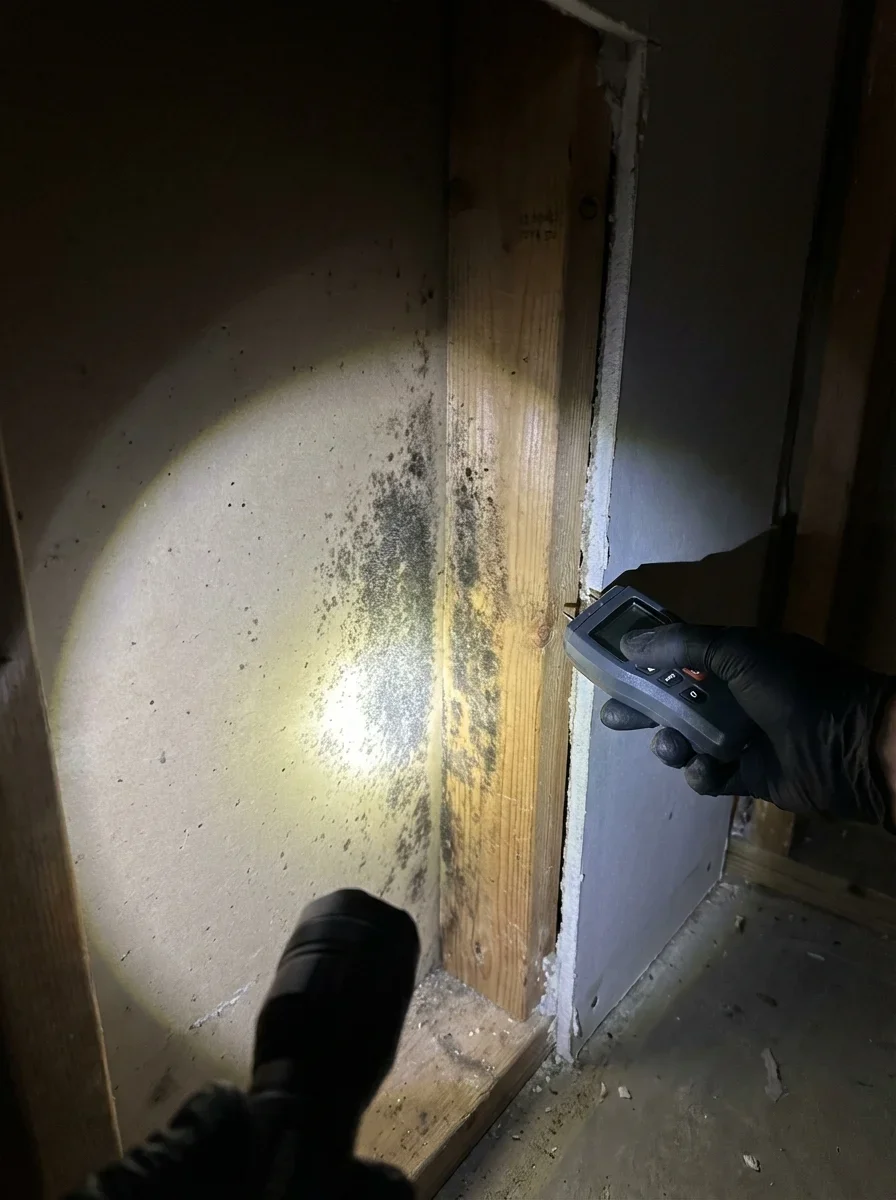
The HUD NSPIRE Standard identifies wall cavities as high-risk areas for "mold-like substance" because they create "captive moisture" conditions[2] — moisture gets in but can't easily evaporate. In Texas homes, this happens most often around plumbing penetrations (shower valves, toilet supply lines, washing machine hookups) and along exterior walls where brick veneer meets wood framing.
A slow leak from a second-floor bathroom shower pan can saturate the wall cavity and drip down to the first floor, colonizing drywall and insulation along the entire vertical run. You might notice a faint stain on a ceiling or a barely perceptible bulge in drywall, but the colony behind the surface can span 15-20 square feet.
Post-2000 tract homes with spray foam insulation in exterior walls are particularly vulnerable.
Once moisture gets trapped between foam and drywall, it can't dry out through normal evaporation, and mold spreads laterally across studs. Brick veneer is standard on Texas homes for curb appeal and thermal mass, but improper flashing around windows and weep holes clogged with mortar droppings allow water intrusion during heavy rains. Water runs down the air gap behind brick, collects on the foundation sill plate, and wicks up into wall framing. This is a known issue in rapid-build developments across Austin, Frisco, and Katy where quality control on moisture management details is inconsistent.
HVAC Systems and Ductwork
Your air conditioning system is one of the most common mold reservoirs in Texas homes, and it's also one of the hardest to inspect without specialized equipment. Mold in air ducts develops when condensation forms on cold supply ducts running through unconditioned attic spaces.
Summer attic temperatures in San Antonio or Corpus Christi regularly exceed 130°F, creating a massive temperature differential between 55°F supply air and surrounding air. Even with insulated flex duct, condensation collects at joints, seams, and anywhere the vapor barrier is torn or missing.
Evaporator coils inside air handlers accumulate mold because they're always wet during cooling season. Dust and organic debris settle on coil fins, moisture condenses, and colonies grow in the drain pan below. If the condensate drain line clogs — often with algae or mineral buildup from hard water — the pan overflows into the ductwork or into the ceiling cavity below the air handler.
Homeowners almost never check drain pans until water stains appear on drywall.
Return air plenums, especially those built with duct board or framed with drywall in older homes, pull humid air from the house and can develop surface mold if the system short-cycles or if the home has poor air sealing. If you've ever noticed a musty smell when the AC kicks on, there's a good chance the source is inside the return plenum or on dirty coils. HVAC mold removal often requires dismantling ductwork to reach colonies growing on interior surfaces.
Under Flooring and Carpet
Concrete slab floors in Texas homes often retain moisture for weeks after a plumbing leak or foundation intrusion, even after surface water is removed. Carpet and pad act as a sponge, wicking moisture up from the slab. If the leak is slow (a dripping supply line, a failed wax ring under a toilet), the carpet may feel dry to the touch while the pad and subfloor remain saturated.
Tile floors laid directly on slab can hide mold growth underneath if the slab cracked during foundation settlement. Water seeps through grout joints or through cracks in tile, pools beneath, and creates a moisture layer between tile and concrete.
You might notice grout discoloration or a persistent damp smell near the baseboards, but the actual colony is underneath where you can't see it.
Engineered hardwood and laminate flooring installed over slab without proper moisture barriers will delaminate and support mold growth when slab moisture vapor transmission exceeds the flooring's tolerance. This is especially common in Houston and Beaumont where ground moisture levels are high year-round. The California Department of Public Health notes that mold growth on building surfaces deems a residential building substandard under health codes,[3] and flooring materials are explicitly included in that definition.
Pro Tip: After any plumbing leak or water event, don't rely on how the carpet surface feels. Use a moisture meter to check the pad and subfloor — materials can stay saturated for 7-10 days even when the surface seems dry, giving mold plenty of time to establish colonies you won't see until you pull up the flooring.
Attics and Roof Assemblies
Texas attics are brutal environments — temperatures above 140°F in summer, high humidity when insulation doesn't include proper air sealing, and dozens of potential moisture entry points through roof penetrations. Attic mold removal is a major service category in the state because roof leaks, condensation on roof decking, and failed radiant barriers create ideal conditions for colony growth.
Roof leaks around chimneys, vent pipes, and skylights often go undetected because water runs down rafters or trusses before dripping onto insulation. By the time you see a ceiling stain in a bedroom, the roof sheathing above it has been wet for weeks.
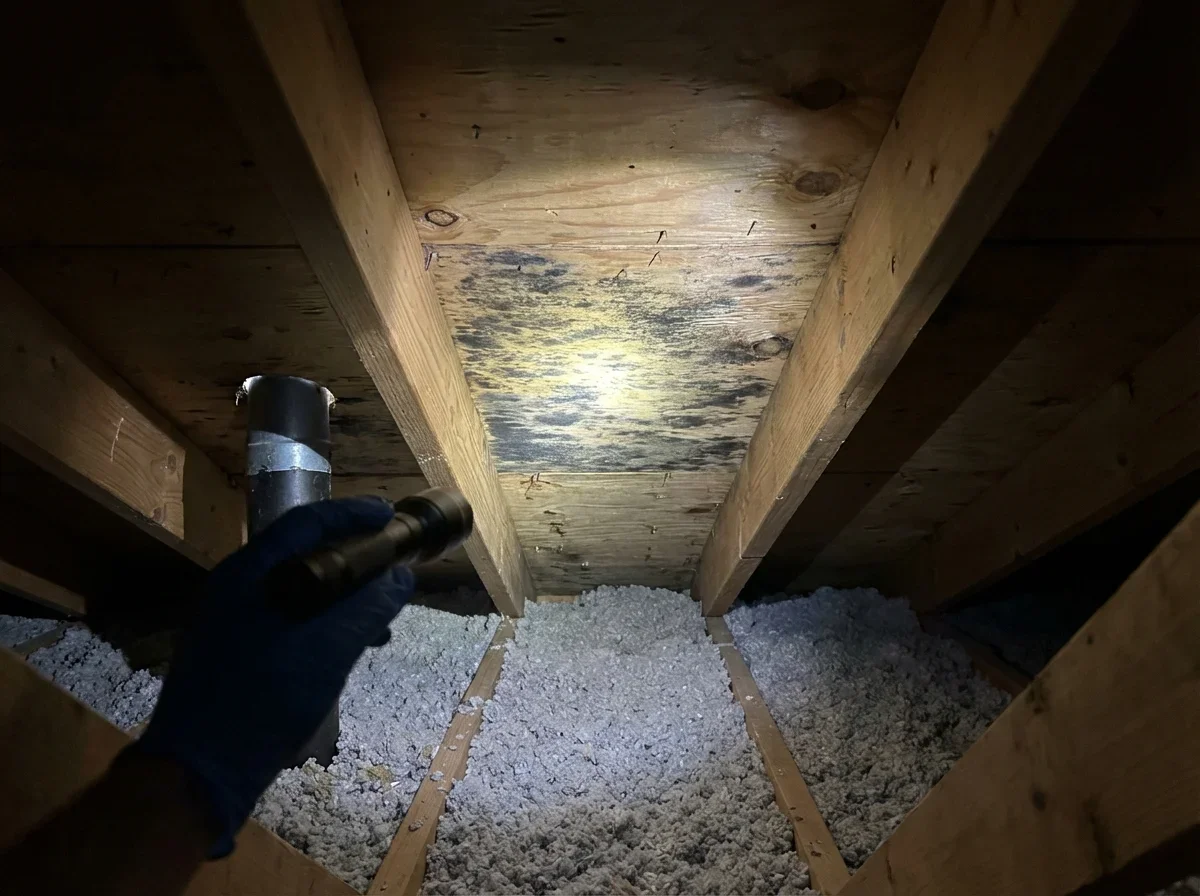
Mold grows on the underside of OSB or plywood sheathing, spreads across rafter surfaces, and colonizes blown-in insulation that can't dry out in the still air of an unventilated attic.
Ridge vents and soffit vents that are blocked by insulation (a common mistake in DIY insulation upgrades) eliminate airflow, trapping moisture vapor from the living space below. In winter, warm humid air from showers and cooking rises into the attic, condenses on cold roof decking, and creates a thin film of moisture that supports mold growth across hundreds of square feet. Spray foam insulation applied directly to the underside of roof decking (common in "hot roof" or conditioned attic designs) must be installed correctly — any gap or thermal bridge creates a condensation point that leads to hidden mold on sheathing or framing.
Behind Vinyl Wallpaper and Paneling
Vinyl wallpaper is vapor-impermeable, which means if moisture gets behind it — from a plumbing leak, exterior water intrusion, or condensation on an exterior wall — it can't escape. The drywall behind the wallpaper stays damp, mold colonizes the paper backing and drywall face, and you won't see it until the wallpaper starts peeling or bubbling.
This is a particular issue in older homes (pre-1980) with pier-and-beam construction and minimal insulation in exterior walls. During summer, cool conditioned air meets hot exterior wall surfaces, condensation forms on the back of drywall, and vinyl wallpaper traps it.
The same dynamic occurs with wood paneling in basements (rare in Texas but present in some older East Texas homes) and in bathrooms with poor exhaust ventilation.
Removing wallpaper in a home with a history of plumbing issues or exterior water intrusion often reveals extensive mold growth that was completely hidden — black staining on drywall, soft spots where paper has delaminated, and a musty odor that was muted by the vinyl barrier.
Inside Wall-Mounted Cabinets and Furniture
Kitchen and bathroom cabinets built against exterior walls can trap moisture between the cabinet back and the drywall. If the exterior brick veneer has failed weep holes or missing flashing, water intrudes during storms, runs down the wall cavity, and collects behind the cabinet.
You won't see it until you remove the cabinet or notice warping on cabinet backs.
Vanity cabinets under bathroom sinks are prime mold growth areas because they contain plumbing supply lines and drain traps. A slow drip from a P-trap or supply line soaks the cabinet bottom, wicks up the sides, and colonizes the interior surfaces. Homeowners often don't inspect under sinks unless they see active dripping — by then, the cabinet interior and the drywall behind it are already colonized.
Large furniture placed directly against exterior walls (bed headboards, bookshelves, media centers) restricts airflow and creates a microclimate. If the wall has a thermal bridge or air leak, condensation forms on the drywall surface behind the furniture, mold grows, and you don't discover it until you rearrange the room. This is common in Houston and East Texas homes where humidity is high year-round and exterior walls aren't well-insulated.
How to Detect Hidden Mold
You can't rely on visible growth to identify every mold problem in your home. Detection requires a combination of sensory cues, moisture measurement, and sometimes invasive investigation or air testing.
A persistent musty odor is the most reliable early indicator. Mold produces microbial volatile organic compounds (MVOCs) as it metabolizes building materials — these create the characteristic damp, earthy smell even when the colony is hidden behind drywall or above a ceiling.
If you smell mold in a room but can't see growth, the source is almost always in a wall cavity, under flooring, or in ductwork. Mold odor removal can't succeed until the hidden colony is located and remediated — masking the smell with air fresheners or ozone treatment just delays the inevitable.
Thermal imaging cameras detect temperature differentials that indicate moisture. A wet wall cavity will show cooler than the surrounding drywall because water retains heat differently than dry material. TDLR-licensed mold assessors in Texas use infrared cameras during mold inspections to map potential moisture intrusion without cutting into walls.
This is particularly useful in post-storm investigations and real estate transactions where non-invasive methods are preferred.
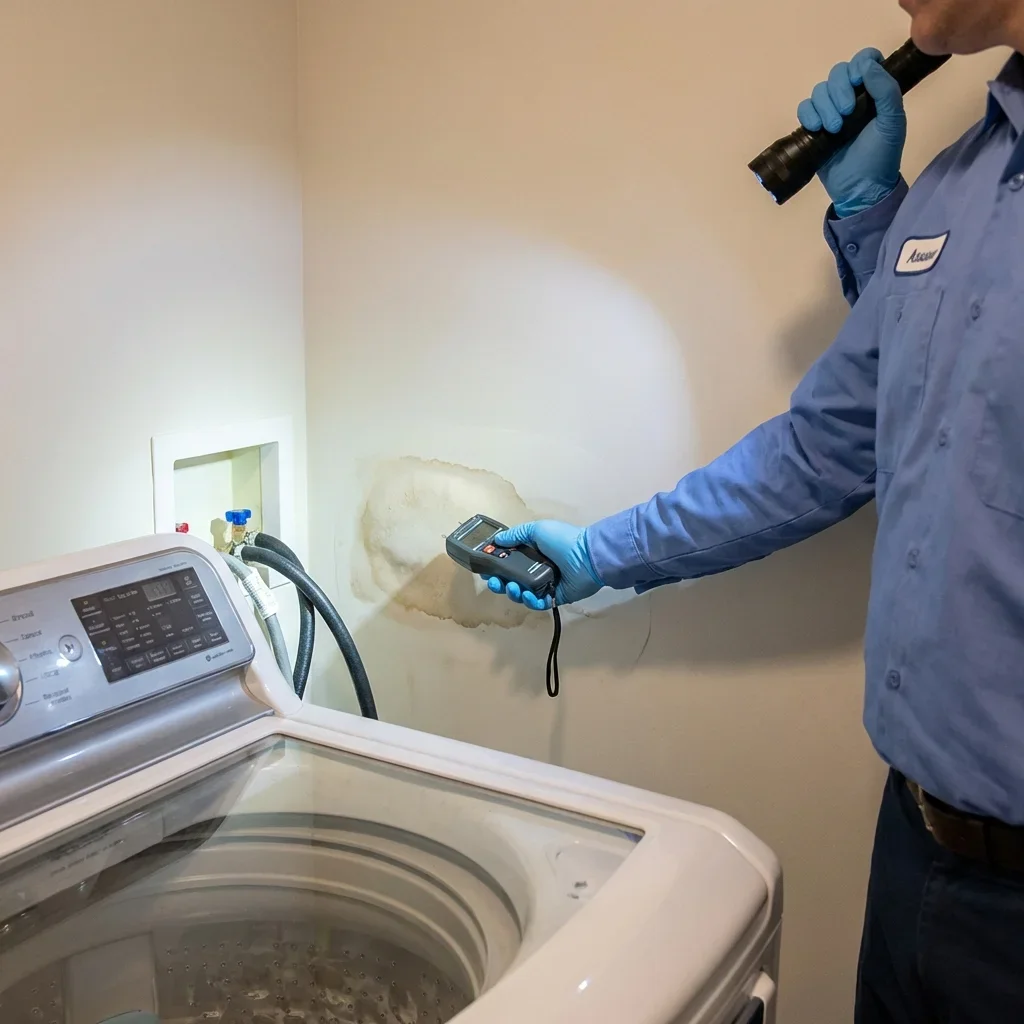
Moisture meters measure the water content in drywall, wood framing, and concrete slabs. Readings above 16% in wood or above 2% in drywall indicate conditions that support mold growth. Inspectors probe around windows, along baseboards, near plumbing penetrations, and in attic framing to identify elevated moisture before mold becomes visible.
If your home has a history of foundation movement or plumbing issues, periodic moisture mapping can catch problems before they become whole house mold remediation projects.
Air sampling captures airborne mold spores and can indicate hidden growth even when no visible colony is present. Elevated spore counts in a specific room compared to outdoor baseline levels suggest an active source in that space. Indoor air quality testing is especially useful after you've addressed a known leak but still smell mold — it confirms whether spores are elevated and helps narrow down the search area.
Signs You Have Hidden Mold in Your Home:
- Persistent musty odor with no visible source
- Unexplained allergic symptoms that improve when you leave the house
- Water stains on ceilings or walls (even old, dried stains)
- Warping or bubbling of wallpaper, paint, or flooring
- Condensation on windows or walls during AC operation
- Recent plumbing leak, roof leak, or flooding event (even if "dried out")
- HVAC system producing musty smell when starting
- Increased humidity in specific rooms (above 60% RH)
When to Call a TDLR-Licensed Assessor
Texas is one of the few states with specific mold licensing requirements under the Texas Mold Assessment and Remediation Rules (TMARR). If you suspect hidden mold but can't locate the source, a licensed Mold Assessment Technician has the training and equipment to perform a thorough investigation.
TDLR requires that assessment and remediation be performed by separate companies — the assessor identifies the problem and writes a remediation protocol, and a licensed Mold Remediation Contractor performs the work.
This separation prevents conflicts of interest and ensures you get an unbiased evaluation. Verify any assessor's license at the Texas Department of Licensing and Regulation's online lookup at https://www.tdlr.texas.gov/mol/mol.htm before hiring.
Licensed assessors understand Texas-specific moisture dynamics — how expansive clay soil affects foundation integrity, how slab-on-grade plumbing leaks manifest, and how HVAC systems in hot-humid climates create condensation problems. They know to check crawl spaces in pier-and-beam homes for ventilation defects, to inspect attic sheathing for condensation staining, and to measure moisture in wall cavities around brick veneer.
If you're buying a home in Houston, Austin, Dallas, or San Antonio, consider adding a mold assessment to your inspection contingency, especially if the home is more than 20 years old or in an area with known foundation issues. Real estate mold inspection can reveal hidden problems that a general home inspection misses — and give you negotiating leverage or an exit from the contract if the issue is severe.
Common Hiding Spots by Home Age
Pre-1980 homes in Texas often have cast iron drain lines that corrode from the inside, especially where they run under slab or in wall cavities. Pinhole leaks and joint failures release wastewater into wall framing and subfloors, creating persistent moisture that supports mold growth.
These homes also tend to have minimal insulation and no vapor barriers in exterior walls, so condensation on interior drywall surfaces during cooling season is common.
Homes built between 1980-2000 transitioned to copper and PVC plumbing, but they still have slab-on-grade foundations vulnerable to shifting from expansive clay soil. Fiberglass batt insulation in walls can settle or get compressed, leaving gaps where condensation forms on drywall. This era also saw widespread use of polybutylene ("poly B") plumbing in some markets, which is prone to brittle failure and sudden leaks.
Post-2000 construction uses PEX plumbing, which is more flexible and less prone to corrosion, but rapid build schedules in major metro areas have led to moisture management defects. Missing or improperly installed flashing around windows, gaps in vapor barriers, and undersized HVAC systems that short-cycle and fail to dehumidify properly all create conditions for hidden mold.
Two-story homes with complex HVAC duct runs through attics are especially prone to condensation issues on supply ducts.
What to Do If You Find Hidden Mold
If you locate hidden mold during an inspection or renovation, don't attempt to remediate it yourself if the affected area exceeds 10 square feet or if the mold is in HVAC systems, wall cavities, or other areas that require specialized containment. The EPA and IICRC S520 standards both recommend professional remediation for anything beyond small surface colonies on non-porous materials.
Texas law requires that anyone performing mold remediation for compensation hold a TDLR license. Unlicensed contractors can't legally perform remediation work, and hiring one puts you at risk if the work is done improperly or if you need to file an insurance claim later.
Mold remediation must follow a written protocol prepared by a licensed assessor, include proper containment and air filtration, and be verified with post-remediation testing.
If the hidden mold resulted from a covered peril (sudden plumbing failure, roof leak from storm damage), your homeowners insurance may cover remediation costs. Document everything with photos, preserve the failed component that caused the leak (burst pipe, torn roof shingle), and contact your insurer before starting work. Insurance claim mold services can help you navigate the claims process and ensure you meet documentation requirements.
The source of moisture must be corrected before remediation begins.
If expansive clay soil caused a foundation crack that's allowing water intrusion, the crack must be sealed and drainage improved. If a plumbing leak under the slab is the source, the line must be repaired or rerouted. Remediating mold without fixing the underlying moisture problem guarantees it will return — often within weeks.
Preventing Hidden Mold Growth
You can't eliminate every moisture risk in a Texas home, but you can reduce the most common triggers. Have your plumbing inspected every 3-5 years, especially if you're in an area with expansive clay soil or if your home is over 30 years old.
Look for signs of foundation movement (cracks in slab, doors that stick, gaps between baseboards and floors) and address them before they stress plumbing.
Clean AC condensate drain lines twice a year with a wet-dry vacuum and a bleach or vinegar flush. Check the drain pan under your air handler for standing water or rust — if water is present, the drain line is partially clogged. Ensure attic vents aren't blocked by insulation and that bathroom exhaust fans vent to the exterior, not into the attic.
If you've had a plumbing leak, roof leak, or flooding event, act within 24-48 hours to dry affected materials. Structural drying using commercial dehumidifiers and air movers can prevent mold colonization if started immediately.
Don't assume that surface drying means everything is fine — wall cavities, insulation, and subflooring can remain wet for days after the surface feels dry.
Use a hygrometer to monitor indoor humidity levels. The EPA recommends keeping relative humidity below 60% to inhibit mold growth. In humid regions like Houston and East Texas, this often requires supplemental dehumidification beyond what your AC system provides, especially during spring and fall when outdoor humidity is high but cooling loads are low.
Verify any contractor you hire for plumbing, roofing, or HVAC work is properly licensed and insured. Shoddy repairs create moisture problems that lead to hidden mold — saving money upfront by hiring the cheapest bidder often costs far more when you discover mold months later.
- U.S. Environmental Protection Agency. "A Brief Guide to Mold, Moisture and Your Home." https://www.epa.gov/mold/brief-guide-mold-moisture-and-your-home. Accessed April 02, 2026.
- U.S. Department of Housing and Urban Development. "NSPIRE Standard - Mold-like Substance." https://www.hud.gov/sites/dfiles/PIH/documents/NSPIRE-Standard-Mold-like-Substance_20230811.pdf. Accessed April 02, 2026.
- California Department of Public Health. "Frequently Asked Questions about Mold." https://www.cdph.ca.gov/Programs/cls/dehl/ehl/Pages/AQS/Frequently-Asked-Questions-about-Mold.aspx. Accessed April 02, 2026.