Attic mold is fungal growth on wood sheathing, rafters, insulation or dust, driven by repeated moisture. In Texas, the usual sources are bath fans, slow roof leaks, weak ventilation and leaky AC ducts.
Growth under 25 contiguous square feet may be handled without a license. Larger areas call for a TDLR-licensed pro.[1]
Why Attics in Texas Grow Mold
Mold needs three things: moisture, an organic surface and time. Plywood, OSB, framing and settled dust supply the food. Moisture is the only variable you can control.
Air conditioning runs roughly eight months of the year, so warm, humid air keeps meeting cool surfaces such as ducts and the underside of roof decking. Condensation forms wherever that happens.
How it works
How attic mold develops
Step 1: Warm, humid air meets cool surfaces
Ducts and the underside of roof decking
Step 2: Condensation forms
Step 3: Wood and dust stay damp
Step 4: Mold grows over time
In the humid Gulf Coast, East Texas and Central Texas, this is the main mechanism. In drier West Texas, such as El Paso, roof leaks and duct leaks matter more than humidity.
Attics are also rarely visited, so growth can go on for years. TDLR lists roof leaks among the common moisture problems behind mold, and fixing the source is part of any real remediation.[1][3]
Common Causes of Attic Mold
Bath Fans and Dryer Vents Ending in the Attic
A fan that exhausts into the attic dumps a shower's worth of humid air onto the sheathing every day. EPA guidance says bathroom exhaust should be discharged directly outdoors, not into an attic.[4][5]
Look for disconnected duct, flex duct that simply ends in open attic space, or a duct that stops at a soffit.
Roof Leaks
Slow leaks at flashing, plumbing vents and damaged shingles wet the decking again and again. After hail in North Texas or a hurricane on the Gulf Coast, a leak may not show for weeks.
Check the attic after any major storm, and document what you find.
Poor Ventilation and Blocked Soffits
Attics breathe in at the soffits and out at the ridge or roof vents. When that balance fails, moist air sits.
The parts of the system
How an attic should breathe
Soffit vents
Air intake; keep insulation off them
Attic space
Air moves across the sheathing
Ridge or roof vents
Air exhaust
In many 1980s and 1990s homes, insulation has been pushed over the soffit vents, blocking intake. A powered fan without adequate intake doesn't fix this.
Leaky Ducts and Air Leaks from the Living Space
Gaps around ceiling fixtures, attic hatches and cracked ducts push conditioned, humid air upward. Cool duct surfaces and sheathing can then sweat. The AC condensate drain line and overflow pan are also worth checking.
What Attic Mold Looks Like
Color and Texture on Sheathing and Framing
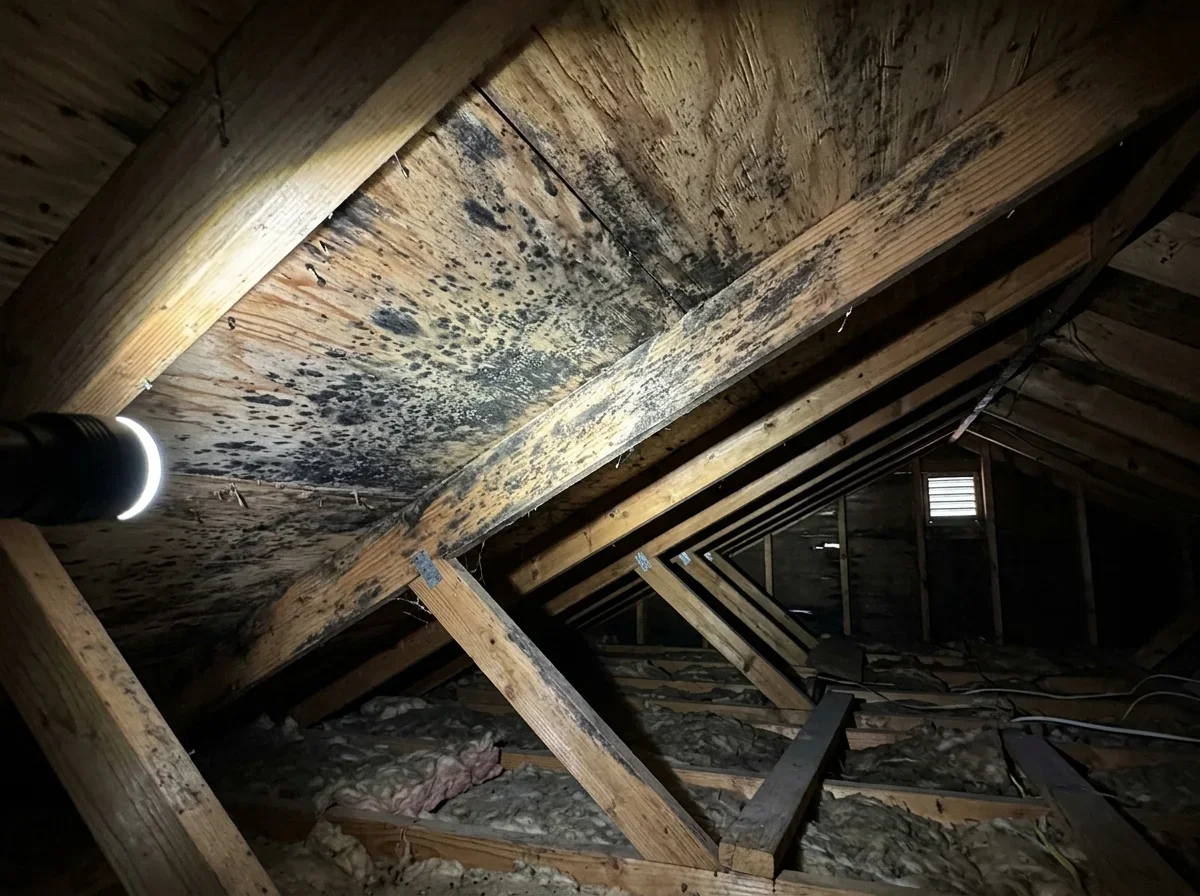
Mold appears as fuzzy or speckled patches in white, gray, green, brown or black. EPA notes that you can't tell what kind of mold you have by looking at it.[6]
Only lab sampling identifies species, and in Texas, sampling is itself licensed assessment work.
On plywood or OSB, look for dark staining or spotting, sometimes concentrated along nail tips, where cool metal draws condensation.
Signs Beyond Visible Growth
Not every sign is on the wood. Watch for:
- A musty smell at the attic hatch or in upstairs rooms
- Damp, matted or compressed insulation
- Rusty nails or fasteners
- Stains or discoloration on ceilings below
Mold in other parts of the house can look similar, so signs of mold elsewhere in your home are worth checking too.
A little historic discoloration on old sheathing can be harmless. Active, widespread or recurring growth means there's a moisture problem.
Roof Problem or Ventilation Problem
The pattern on the sheathing is your best first clue. Treat it as a clue, not a diagnosis, since a roof leak and an air leak can look alike.
| Roof leak | Ventilation or humidity | |
|---|---|---|
| Pattern | Localized under a penetration, valley or damaged area | Widespread across cooler decking, near fan outlets or along the ridge |
| Rain link | Worse after rain | Present regardless of rain |
| Other clues | Water-stained rafters, wet insulation | Damp insulation near soffits, rusty nails, musty air |
| First check | Flashing, vents, shingles, daylight | Fan duct, soffits and baffles, duct joints |
Safe checks from the attic hatch or floor edge include looking for duct disconnections, blocked soffits, and stains or daylight near flashing. Don't walk across joists you can't see.
Checklist
Safe checks from the attic hatch
0 of 4 ticked
Tick them off as you go. Nothing is saved or sent.
Cleaning without fixing the source is why mold returns. If that's already happened to you, see why mold keeps coming back after remediation.
Pro tip
Find and stop the moisture source before any cleaning, or the mold will likely come back.
TDLR is direct on this point: prevention begins with finding and stopping the moisture source.[3]
Is Attic Mold Dangerous
It can be, but reactions vary widely by person. EPA says mold exposure can cause symptoms such as nasal stuffiness, throat irritation, coughing or wheezing, and skin irritation in some people. People with allergies or asthma may react more strongly.[6]
An attic isn't sealed off from the house. Air leaks around hatches, fixtures and ducts can carry spores into living space.
Until it's been checked, avoid disturbing the growth and stop using the attic for storage. For the fuller picture, see the black mold health risks page.
DIY Limits and the 25 Square Foot Rule
What Texas Law Allows Homeowners to Do
Texas is one of the few states with its own mold licensing program. Under the Occupations Code, remediation generally requires a TDLR license. Unlicensed people may clean visible mold covering less than 25 contiguous square feet, and owners may work on property they own or lease.[1]
The details are on the Texas TDLR mold licensing page.
A small unlicensed job can't produce a certificate of mold remediation. That matters later if you sell or file an insurance claim.
Why Attic Work Is Harder Than It Looks
Houston and Dallas summer highs average about 96°F, and attic temperatures run far higher. Heat illness is a real risk. Add limited footing, hidden wiring, loose insulation and poor access.
Sanding or dry-brushing sheathing throws spores into the air, and those can reach living areas through air leaks. Spraying a surface doesn't address the moisture feeding it.
The DIY versus professional mold removal page covers the trade-offs in depth.
When to Hire a TDLR-Licensed Professional
Call a pro when any of these apply:
- Growth covers 25 or more contiguous square feet, or much of the sheathing
- Insulation is wet or a leak is ongoing
- You're selling the home or filing a claim
- You can't identify the moisture source
What a Licensed Job Includes
A licensed project follows a set order, and the assessor and remediator must be separate companies.
- A licensed mold assessor writes a protocol for the project.[2]
- A licensed remediation company follows it with a written work plan.[2]
- The remediator contains the area, removes or cleans affected material and addresses the source.
- The assessor checks the work against the protocol's criteria.
- You receive a Certificate of Mold Damage Remediation no later than the 10th day after the project stop date.[2]
Ask for the license number and type, then check it in TDLR's license search. Companies should be able to show proof of insurance.
If you need a protocol first, a mold inspection and assessment is the starting point. Attic mold removal by licensed Texas professionals handles the work itself.
Insurance and Cost Expectations
Most Texas homeowners policies (HO-A) cover sudden and accidental leaks, not gradual ones, and many exclude or cap mold. Hail or hurricane damage that leads to attic mold is the scenario where a claim is most plausible, so document it promptly.
The homeowners insurance and mold in Texas page covers the details.
Compare itemized estimates. For ranges, see what attic mold removal costs in Texas.
Frequently Asked Questions
How can I remove mold from attic plywood?
Fix the moisture source first. Sanding or dry-brushing spreads spores, and surface treatment alone won't stop regrowth.
Small areas under 25 contiguous square feet may be handled by an owner with protective gear. Larger areas require a licensed remediator.[1]
Is attic mold covered by homeowners insurance?
Sometimes. Most Texas HO-A policies cover sudden, accidental leaks but not gradual or repeated ones, and many exclude or cap mold.
Is it normal to have mold in a loft or attic?
Some spores are always present, and light staining on old sheathing can be historical. Active, widespread or recurring growth points to a moisture problem that needs attention.
How can I tell if I have mold in my attic?
Look for fuzzy or speckled patches, dark staining on sheathing or nail tips, a musty smell, damp insulation and ceiling stains below.[6]
Can I remove attic mold myself in Texas?
Under 25 contiguous square feet, yes, and owners may work on their own property.[1] You won't get a certificate, and attic heat and spore spread are real hazards.
Should I test attic mold before removal?
Testing doesn't replace finding the moisture source. In Texas, sampling is licensed assessment work, so hire a licensed assessor if you want it done.
- Texas Department of Licensing and Regulation. "Mold Assessors and Remediators FAQs." https://www.tdlr.texas.gov/mld/mldfaq.htm. Accessed October 17, 2026.
- Texas Department of Licensing and Regulation. "Consumer Mold Information Sheet." https://www.tdlr.texas.gov/mld/pdf/cmis.pdf. Accessed October 17, 2026.
- Texas Department of Licensing and Regulation. "Consumer Protection: Mold." https://www.tdlr.texas.gov/media/pdf/consumer-protection-mld-2025.pdf. Accessed October 17, 2026.
- U.S. Environmental Protection Agency. "Building a Home Addition." https://www.epa.gov/indoor-air-quality-iaq/remodeling-your-home-and-indoor-air-quality. Accessed October 17, 2026.
- U.S. Environmental Protection Agency. "Building Codes and Indoor Air Quality Note." https://www.epa.gov/sites/default/files/2014-08/documents/building_codes_and_iaq.pdf. Accessed October 17, 2026.
- U.S. Environmental Protection Agency. "A Brief Guide to Mold, Moisture and Your Home." https://www.epa.gov/mold/brief-guide-mold-moisture-and-your-home. Accessed October 17, 2026.