Why Carpet and Padding Grow Mold So Easily
Carpet fibers trap dust, skin cells and soil, all of which mold can feed on. Underneath sits a foam or fiber pad that soaks up water like a sponge and dries far more slowly than the pile above it.
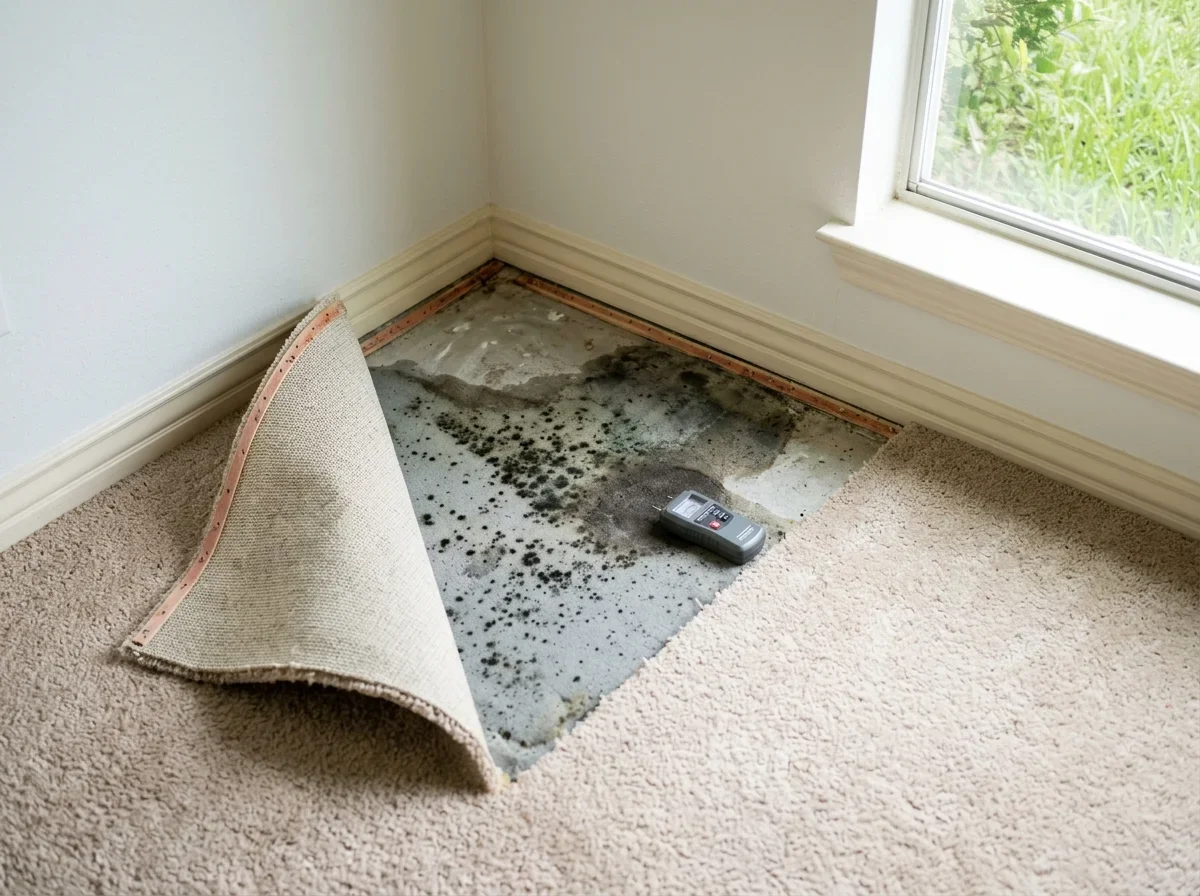
EPA says mold can grow on carpet that stays wet for more than 24 hours.[1] That makes the first day or two the window that matters.
24 hours
how long wet carpet can sit before mold can grow
Texas stacks the odds against you. Slab-on-grade foundations are common in Texas, so carpet over concrete is common. A clogged condensate line or overflowing drain pan can wet the carpet near a closet air handler with no flood at all.
Signs of Mold in Carpet You Can Check Yourself
Smell, Staining and Texture
A musty odor is usually the first clue. It often gets stronger in humid weather or when the AC is off. Look for dark, fuzzy or discolored patches, and press a hand on the carpet to feel for cool or damp spots.
Spots can be dirt, dye, mildew or mold. Our guides on general signs of mold in a Texas home help with identification.
Nobody can name a species by color alone, so "black mold" is not something you can confirm by looking.
Looking Under the Carpet and at the Pad
Surface checks miss the real problem. A carpet face can look clean while the pad underneath is fuzzy and wet. Check in this order:
- Baseboard bottoms and the lower edge of the drywall behind them
- The tack strip, looking for staining or rusted nails
- The underside of the carpet along the wall
- The top and bottom faces of the pad
- The slab or subfloor surface
Wear gloves, eye protection and an N-95 respirator while you do this, and keep the HVAC off so you don't push particles through the house.[4] More on hiding places is in our hidden mold guide.
Checklist
Inspection order
0 of 5 ticked
Tick them off as you go. Nothing is saved or sent.
When Carpet and Pad Must Be Removed Instead of Cleaned
Treat the carpet and the pad as two separate decisions. The carpet may be salvageable. The pad rarely is.
Water Source and Time Wet
Sewage and floodwater change the answer completely. EPA advises that absorbent flood-damaged materials such as carpets and padding generally cannot be cleaned and should be discarded.[4]
Clean-water leaks caught quickly give you more options, but the clock still applies. EPA's guidance says materials wet more than 48 hours or showing mold need further remediation guidance.[6]
Pad Almost Always Goes
Wet pad that has molded is a replacement item. Mold grows into porous material in spaces that are difficult or impossible to clean completely.[3]
The parts of the system
Layers of a carpeted floor
Carpet pile
Traps dust and soil
Carpet backing
Foam or fiber pad
Soaks up water, dries slowly
Tack strip
Check for staining or rusted nails
Slab or subfloor
Where Cleaning Can Be Enough
Carpet may be worth saving when the water was clean, the carpet was pulled up and dried fast, and growth is limited to a light surface patch. Cleaning here means extraction and HEPA vacuuming, not a spritz of spray.
Wet over 48 hours, growth on the underside, odor that lingers after drying, or growth beyond a small patch all point toward tear-out.
Drying Timeline and What Slows It Down in Texas
Speed matters more than product choice. The sequence is: stop the water, remove standing water with a wet vacuum, pull the carpet and pad off the floor, then run fans and a dehumidifier.
EPA says this approach can dry carpet and backing within 48 hours, and the pad must be dried too.[2] EPA's broader target is 24 to 48 hours for water-damaged areas and items.[3]
Timeline
Drying sequence
Step 1
Stop the water
Step 2
Remove standing water with a wet vacuum
Step 3
Pull carpet and pad off the floor
Step 4
Run fans and a dehumidifier
Within 48 hours
Carpet, backing and pad dry
Moisture meters help you verify drying instead of assuming it.[5]
Texas conditions can stall all of this. In summer, after storms, or in a closed-up vacant house, outdoor air can be as wet as indoor air, so opening windows may not help. For help, see professional structural drying and our post-flood mold prevention guide.
Subfloor and Slab Issues Under Wet Carpet
Replacing wet carpet fixes nothing if the water is still arriving. The source has to be found and repaired first, and the plumber or HVAC contractor handles that, not the remediator.
Slab Leaks and Moisture Through Concrete
Under a slab, a leaking supply line can wet carpet with no visible source. Clues include warm spots on the floor, an unexplained jump in the water bill, and a musty smell that returns after cleaning.
A rough field test: tape a 2x2 foot sheet of plastic to the bare slab edge for 24 to 48 hours and check for condensation or darkening. It is an indicator, not a diagnosis. If mold keeps coming back, read our guide on recurring mold and call an assessor.
Plywood or Wood Subfloors in Pier-and-Beam Homes
Older pier-and-beam houses can get wet from below through the crawl space. Check the subfloor underside where you can reach it.
Wood that is stained, warped or soft needs drying, cleaning or replacement, and EPA says the subfloor must be cleaned and dried as well.[6]
DIY Cleanup Limits and the 25-Square-Foot Rule
Texas Occupations Code Chapter 1958 requires a TDLR license for mold remediation, but in most instances visible mold covering less than 25 contiguous square feet can be cleaned up by people who are not licensed.[7] "Contiguous" means one connected area, not a total across rooms.
Measure after you lift the carpet. A patch that looks small on the surface can exceed 25 square feet once the pad underside is exposed. Unlicensed work cannot earn a certificate of mold remediation, which matters later at sale. Full details are in our TDLR licensing explainer.
Pro tip
Measure the affected area only after the carpet is lifted, since the pad underside can show growth well beyond the visible patch.
If you do it yourself, contain dust, skip dry brushing, bag removed material securely, and wear gloves, goggles and an N-95.[4] Compare the trade-offs in DIY versus professional removal.
When to Call a Licensed Assessor or Remediator
Call a pro for large areas, sewage or floodwater, repeat growth, anyone with respiratory sensitivity, hidden wall damage, or a suspected slab leak. Our water damage mold removal page covers the service.
What a Professional Job Looks Like
Texas bars a license holder from doing both assessment and remediation on the same project.[9] The assessor writes the protocol, and the remediator follows a work plan built on it.
The license holder provides a certificate of mold remediation to the owner within 10 days of completion.[10] A mold remediation notification to TDLR is required when the contamination covers 25 contiguous square feet or more.[8]
Before hiring, confirm:
- The TDLR license number and type, verified on the TDLR license search
- That the assessor and remediator are separate companies
- That you received the Consumer Mold Information Sheet before work began
Insurance and Paperwork
Standard HO-A policies in Texas generally cover only sudden and accidental leaks, and many do not cover mold remediation; those that do generally cap it.[11] Check your own policy and read our mold insurance guide.
Take dated photos of the carpet, pad and source before tear-out, and keep the plumber's or HVAC tech's report.
FAQ
How can I remove mold from my carpet?
For a small, light surface patch on carpet that dried fast, extraction and HEPA vacuuming come first. If the pad is wet or moldy, remove it.
How do you clean mold from carpet padding?
Generally, you don't. Pad is porous and hard to clean effectively, so it is typically discarded and replaced once it has been wet and moldy.[3]
How do you use Concrobium on carpet?
Follow the directions on the product label exactly, including any dwell time. It may help on light surface growth but will not dry a wet pad or fix the moisture source.
How long does vinegar take to kill mold in carpet?
Vinegar does not reach a wet pad or slab, so removal and drying matter more than any spray.
Does baking soda kill mold in carpet?
Baking soda may help with odor on surface growth, but it is not a substitute for drying, removing porous materials and fixing the leak.
Is mold in carpet dangerous?
It can be a concern, especially for people with allergies, asthma or weakened immune systems. Wear protective gear when disturbing it, and have a professional assess larger areas.[4]
See our signs of mold overview for what to look for.
- U.S. Environmental Protection Agency. "Flood Cleanup to Protect Indoor Air and Your Health." https://www.epa.gov/emergencies-iaq/flood-cleanup-protect-indoor-air-and-your-health. Accessed October 21, 2026.
- U.S. Environmental Protection Agency. "Mold Course Chapter 4." https://www.epa.gov/mold/mold-course-chapter-4. Accessed October 21, 2026.
- U.S. Environmental Protection Agency. "A Brief Guide to Mold, Moisture and Your Home." https://www.epa.gov/mold/brief-guide-mold-moisture-and-your-home. Accessed October 21, 2026.
- U.S. Environmental Protection Agency. "Protecting Children in Aftermath of Hurricanes and Floods." https://www.epa.gov/children/protecting-children-aftermath-hurricanes-and-floods. Accessed October 21, 2026.
- U.S. Environmental Protection Agency. "Mold: Worker and Employer Guide to Hazards and Recommended Practices." https://www.epa.gov/sites/default/files/2017-08/documents/mold_worker_and_employer_guide._disaster-flood_cleanup.pdf. Accessed October 21, 2026.
- U.S. Environmental Protection Agency. "Chapter 4: Mold Remediation in Schools and Commercial Buildings." https://www.epa.gov/mold/mold-remediation-schools-and-commercial-buildings-guide-chapter-4. Accessed October 21, 2026.
- Texas Department of Licensing and Regulation. "Mold Assessors and Remediators FAQs." https://www.tdlr.texas.gov/mld/mldfaq.htm. Accessed October 21, 2026.
- Texas Department of Licensing and Regulation. "Mold Remediation Notification Requirements." https://www.tdlr.texas.gov/mld/mldnotifications.htm. Accessed October 21, 2026.
- Texas Legislature. "Occupations Code § 1958.155, Conflict of Interest; Disclosure Required." https://statutes.capitol.texas.gov/Docs/OC/htm/OC.1958.htm#1958.155. Accessed October 21, 2026.
- Texas Legislature. "Occupations Code § 1958.154, Certificate of Mold Remediation; Duty of Property Owner." https://statutes.capitol.texas.gov/Docs/OC/htm/OC.1958.htm#1958.154. Accessed October 21, 2026.
- Office of the Texas Attorney General. "Mold Remediation." https://www.texasattorneygeneral.gov/consumer-protection/home-real-estate-and-travel/mold-remediation. Accessed October 21, 2026.