Why Mold Grows Inside Wall Cavities
Mold needs moisture, a food source and time. A wall cavity supplies the last two for free. Drywall paper and lumber are both organic, and the space stays dark and still.
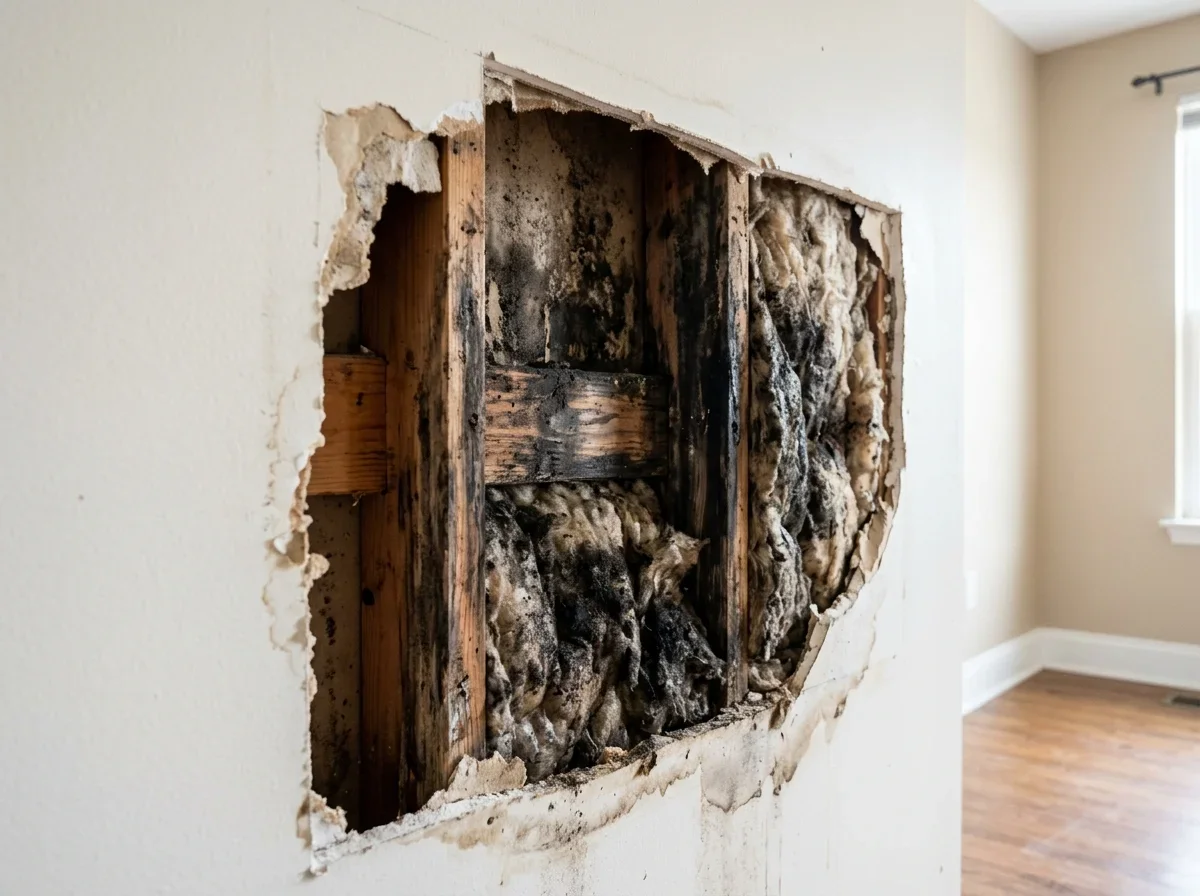
Add water and the clock starts. Mold can begin growing within a day after a leak, according to the Texas Department of Insurance.[3]
The Texas Department of Licensing and Regulation (TDLR) lists pipe leaks, roof leaks, overflowing fixtures, sewage backups and floodwater as common moisture sources. The source must be fixed for remediation to work.[1]
Signs of Mold in Walls You Can See, Smell and Feel
No single sign proves mold, and color cannot tell you what type it is. Each sign points to moisture, which is the real thing to chase. For whole-house symptoms, see our guide to general signs of mold in a Texas home.
Stains, bubbling paint and warped drywall
Brown or gray stains, bubbling or peeling paint and drywall that bows or ripples all suggest water has been present. A stain can be old and dry, so it tells you where to look, not what you have.
Mold may also hide on the back side of drywall, wallpaper or paneling.[4]
Musty odor with no visible source
A musty or earthy smell is often the first clue. It tends to be strongest when the AC is off or the room has been closed up.
If the wall looks clean, treat the smell as a reason to check moisture, not to repaint.
Soft spots, peeling wallpaper and baseboard swelling
Press gently on drywall near the floor. A soft spot, swollen baseboard or wallpaper lifting at the seams means the material has been wet for a while.
Using a Moisture Meter and Other Checks Before Opening the Wall
Many people assume a wet reading means mold, or that a dry reading rules it out. Neither is true.
What a moisture meter does and does not show
A moisture meter shows moisture, not mold. Take readings on the suspect wall and on a dry reference wall in the same home, since the comparison matters more than any single number.
Here is a simple decision path:
- Read the suspect wall and a dry reference wall.
- Trace and stop the water source.
- If the wall dried quickly, keep monitoring it.
- If porous material stayed wet or shows growth, plan to open the wall under containment.
- If visible growth may reach 25 contiguous square feet, hire a licensed assessor before a remediator.
Photograph the wall and log every reading with the date. That record helps with any insurance claim.
How it works
Checking a suspect wall
Step 1: Read suspect and dry reference walls
Step 2: Trace and stop the water source
Step 3: Dried quickly: keep monitoring
Porous material still wet: open the wall under containment
Step 4: Growth may reach 25 contiguous square feet: hire a licensed assessor
Thermal imaging, borescope and sampling
Thermal cameras can point to cool, wet areas, and a borescope lets you look inside through a small hole. Neither proves mold on its own.
A licensed assessor can combine tools and sampling to confirm a problem and define its extent. See what to expect in our mold inspection overview.
Common Texas Sources: Plumbing, Slab Leaks and Brick Veneer Wicking
Where the wall is wet usually points to the cause. The table maps common Texas sources to symptom location.
| Source | Where it shows | What to check |
|---|---|---|
| Supply or drain line leak | Wall near fixtures, ceilings below | Cabinet bases, shutoffs, water meter movement |
| Slab leak | Bottom of walls, flooring | Baseboards, warm floor spots, flooring edges |
| Brick veneer water entry | Exterior walls, lower sections | Flashing, weep holes, sealant, window corners |
| AC condensation | Near ducts, window frames, cold walls | Drain line, drain pan, duct insulation |
Supply line and drain leaks
Small defects can leak for years before anyone notices. Hard water, which runs 150 to 300+ ppm across much of Texas, can speed pipe corrosion and slow leaks.
Check under sinks, behind toilets and around appliance connections first.
Slab leaks and walls with plumbing
Under-slab leaks are a leading mold trigger in Texas homes. The wet bottom plate and baseboards are where it appears first.
Moisture behind brick veneer and exterior walls
Brick veneer sits off the wall with a gap behind it. Water that gets past flashing, weep holes or failed sealant can reach the sheathing and the cavity.
AC condensation and cold interior walls
Texas runs air conditioning eight months or more a year. Condensation can form where cool air meets humid air, around ducts and window frames. A clogged drain line or overflowing pan can soak a wall quietly.
The parts of the system
Common moisture sources behind a wall
Supply or drain line leak
Wall near fixtures
Slab leak
Bottom of walls
Brick veneer water entry
Lower exterior walls
AC condensation
Near ducts and window frames
When Drywall Must Come Out and When It Can Stay
Whether drywall comes out depends on how wet it got, for how long, and what it looks like now. EPA guidance says drywall may be dried in place when it has no obvious swelling and its seams remain intact. Otherwise removal is necessary, and wall cavities are among the hardest places to dry.[5]
EPA also notes that porous materials such as drywall may need to be discarded because mold can reach spaces that are hard to clean completely.[4]
A wall dried fast with intact surfaces may stay. A wall that stayed wet or shows growth usually opens up.
Why surface cleaning does not fix mold inside a cavity
Wiping, spraying or painting over a wall treats the surface. It leaves the insulation, paper backing and framing behind it untouched.
Mold that returns after cleaning usually means the water problem was never solved. EPA also provides separate guidance by material.[6]
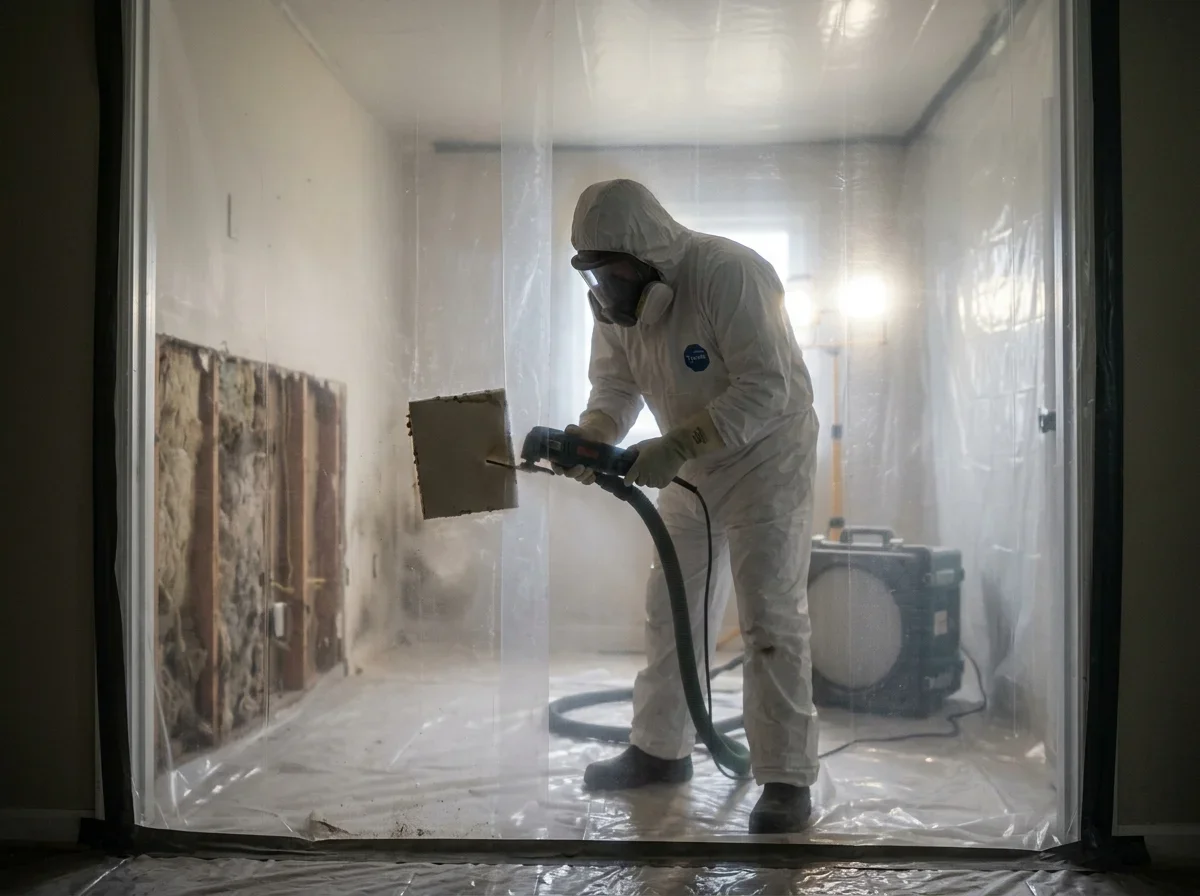
What removal usually involves
Cutting in without containment can spread spores through the house. Larger jobs use plastic containment, HVAC isolation, HEPA filtration and a written protocol. Typical steps are:
- Opening the wall back past visible damage
- Inspecting and drying the framing
- Cleaning salvageable lumber and bagging waste
- Rebuilding only after the source is repaired
See how the remediation process works and our wall cavity mold removal page for the full sequence.
Permits, Licensing and Who Can Do the Work in Texas
Two different rules get confused here: the state license line for mold, and the city permit line for replacing drywall.
The 25 contiguous sq ft rule
TDLR generally requires licensed remediation for projects involving 25 contiguous square feet or more of visible mold in covered residential properties.[1] Under that size, or when an owner does the work on property they own, a license is not required, but no certificate of mold remediation can be issued.
When a licensed remediator is hired, a licensed assessment consultant writes the protocol. It identifies materials and locations to remediate, methods and cleanup criteria.[2] One company may not do both jobs on the same project.
Ask for the license number and type, and read the Texas TDLR mold licensing rules.
City permit lines for drywall replacement
Mold remediation itself needs no building permit, but the plumbing, roof or HVAC repair behind it often does.
| City | Drywall replacement rule |
|---|---|
| Houston | Up to 100 sq ft exempt; inspection before replacement drywall where a permit applies |
| Austin | Up to 128 sq ft exempt for 1-2 family homes, with fire-rated, shear-wall and tub-surround exceptions |
| Fort Worth | Permit at 16 sq ft or more |
| Dallas | Nonstructural interior remodeling of 1-2 family homes exempt |
Rules change, so confirm with your city's building department before you start.
Older homes and lead-safe rules
In a home built before 1978, the EPA's Renovation, Repair and Painting rule may apply when paint is disturbed. Ask any contractor whether they hold the required EPA certification.
Health Concerns and Safe Steps Before Help Arrives
Mold can irritate the eyes, nose, throat and lungs, and people with asthma or allergies tend to react more. How harmful a given wall is depends on the amount, the person and the exposure.
If anyone has symptoms, talk to a doctor. For a deeper look, read about black mold health risks.
What to do and not do in the meantime
Do:
- Stop the water at its source
- Run dehumidification and keep the area closed off
- Photograph and log everything
Don't:
- Cut open large sections of wall
- Bleach or paint over the area
- Run fans that blow air from the wall through the house
EPA recommends fixing plumbing leaks and other moisture problems promptly.[4]
Checklist
Before help arrives
0 of 4 ticked
Tick them off as you go. Nothing is saved or sent.
Costs, Insurance and Hiring for Wall Cavity Work
Wall jobs span several scopes: leak repair, assessment, remediation, drying and rebuild. Ask for a written scope that covers source repair, containment, removal limits, drying, cleaning, disposal and rebuild.
Pro tip
Ask every contractor to quote the same written scope, covering source repair, containment, removal limits, drying, cleaning, disposal and rebuild, so quotes compare fairly.
Most Texas policies are HO-A forms. They commonly cover sudden damage such as a burst pipe but generally exclude gradual leaks or seepage, and many exclude or cap mold.[3]
Our page on whether Texas homeowners insurance covers mold goes further.
Browse our directory for TDLR-licensed assessors and remediators, and verify each license through TDLR's Mold Assessors and Remediators program.
Key takeaways
Mold in walls points to a moisture problem that must be fixed first
A moisture meter shows moisture, not mold
Porous material that stayed wet or shows growth usually comes out
At 25 contiguous square feet or more, licensed professionals are required
Most Texas policies exclude gradual leaks and many exclude or cap mold
FAQ
Is mold inside walls harmful?
It can be. Mold in a wall signals a moisture problem, and spores can irritate airways, particularly for people with asthma or allergies.
Is it okay to sleep in a room with mold?
If odor is strong or anyone has symptoms, move sleeping areas away from the affected room until it is addressed. Talk to a doctor about symptoms.
What are the first signs of mold sickness?
Mold is not diagnosed as "mold sickness," but exposure can bring coughing, wheezing, stuffy nose and eye or throat irritation.
How do I get rid of mold in my walls?
Stop the water, dry the area, and remove porous materials that stayed wet or show growth, under containment. Then repair the source, dry the cavity and rebuild.
At 25 contiguous square feet or more, hire a licensed assessor and remediator.
What does mold in walls smell like?
Usually musty or earthy, strongest in closed rooms or with the AC off. A smell alone does not confirm mold, so check moisture next.
- Texas Department of Licensing and Regulation. "Mold Assessors and Remediators FAQs." https://www.tdlr.texas.gov/mld/mldfaq.htm. Accessed October 17, 2026.
- Texas Department of Licensing and Regulation. "Consumer Protection — Mold." https://www.tdlr.texas.gov/media/pdf/consumer-protection-mld-2025.pdf. Accessed October 17, 2026.
- Texas Department of Insurance. "When are water damage and mold covered by insurance?." https://www.tdi.texas.gov/tips/when-are-water-damage-and-mold-covered-by-insurance.html. Accessed October 17, 2026.
- U.S. Environmental Protection Agency. "A Brief Guide to Mold, Moisture and Your Home." https://www.epa.gov/mold/brief-guide-mold-moisture-and-your-home. Accessed October 17, 2026.
- U.S. Environmental Protection Agency. "Mold Course Chapter 4." https://www.epa.gov/mold/mold-course-chapter-4. Accessed October 17, 2026.
- U.S. Environmental Protection Agency. "Table 2: Guidelines for Remediating Building Materials with Mold." https://www.epa.gov/sites/default/files/2014-08/documents/table2.pdf. Accessed October 17, 2026.