Why Air Conditioners Grow Mold in Texas
Condensation forms when warm, humid air meets a cold surface, and that is exactly what happens on a cooling coil.[4] Over a Texas cooling season that stretches about eight months, the coil, drain pan and condensate line stay wet almost continuously. Dust, pollen and household debris collect on those damp surfaces and give mold something to feed on.
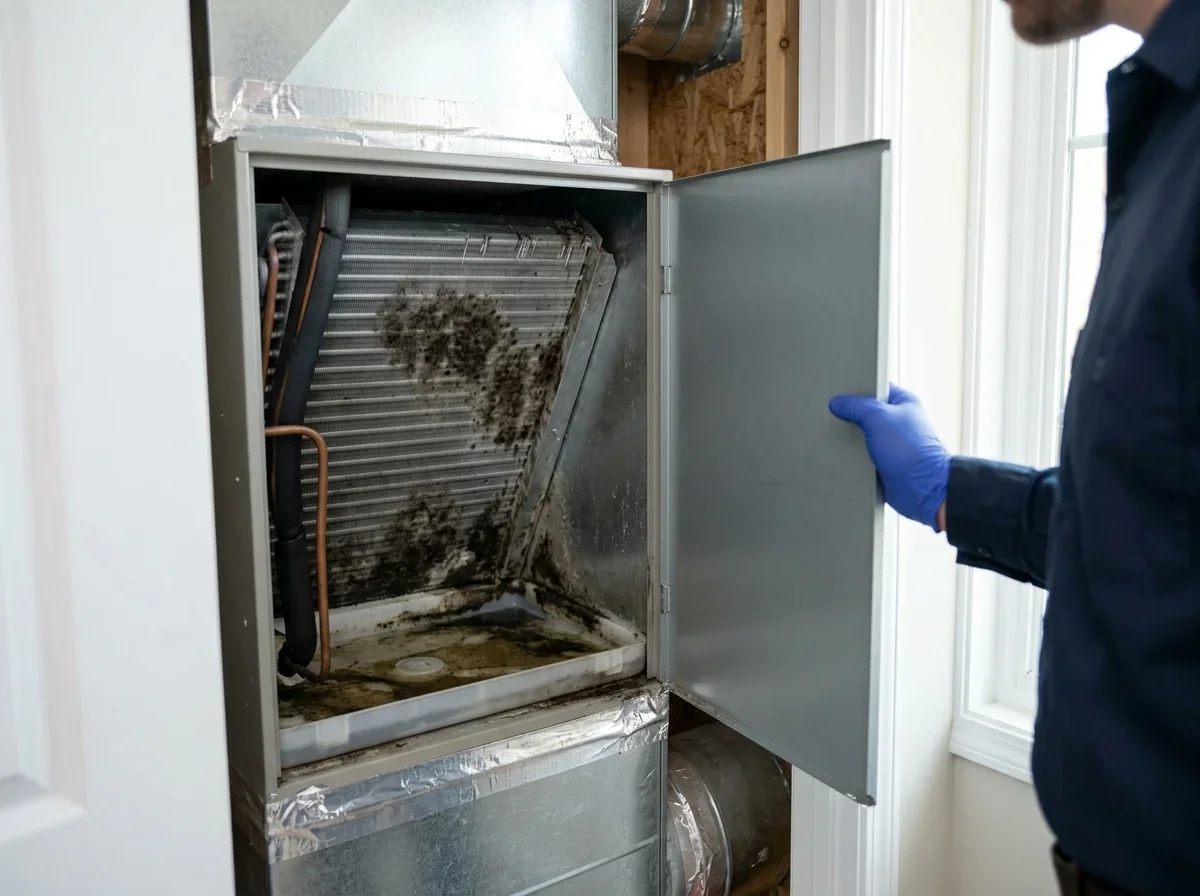
In hot-humid Houston, the Gulf Coast and East Texas, components stay damp even between cycles. West Texas has drier ambient air, but the coil still produces condensation.
Oversized systems make it worse. A unit that is too big cools the house quickly and shuts off before it has removed much moisture, leaving the coil wet and indoor humidity high.
Mold can begin growing within a day after a leak or wetting. EPA advises drying damp materials within 24 to 48 hours.[6]
Where Mold Grows in Each Type of AC
Cleaning a window unit and cleaning a central air handler are very different jobs. Know which kind you have before you pick up a sponge.
Central Air Handler, Evaporator Coil and Drain Pan
Central systems grow mold on the evaporator coil, in the drain pan, along the condensate line and inside the blower housing. Many Texas slab-on-grade homes put the air handler in an interior closet or attic, so a clogged drain or overflowing pan can leak for weeks without anyone seeing it.
The parts of the system
Where mold grows in a central system
Evaporator coil
Stays wet while cooling
Drain pan
Can overflow unseen
Condensate line
Clogs and backs up
Blower housing
Hard to see inside
Before you blame the AC alone, rule out a plumbing leak near the closet.
Mold in the ductwork is its own issue, covered on our page about mold in air ducts.
Window Units
Window units are the easiest to inspect. Look at the drip tray, the coil fins and the back of the front panel, where moisture and dust gather. Everything is within reach, which makes these units the best candidates for homeowner cleaning.
Mini Splits and Ductless Systems
Mini splits tend to hide their problems. Humid air condenses inside the indoor cassette and on the louvers, and the blower wheel sits behind the front panel where you can't see it.
You can clean the accessible filters and louvers. A mold-covered blower wheel usually needs a technician or a manufacturer-approved cleaning method.
Signs of Mold in an Air Conditioner
The most common sign is a musty or earthy smell when the system starts, especially after it has sat idle. You may also see spots on vents, the drip tray or the indoor unit. Water around the air handler or a slow, clogged drain points to the moisture source behind it.
White, green and black growth can all be mold, but color tells you nothing about the species or how risky it is. Treat color as a reason to look closer, not as a diagnosis.
Smell works the same way. A musty odor is a cue to hunt for moisture, not proof of dangerous mold.
Our guide to the signs of mold in your Texas home can help you confirm what you are seeing. A professional mold inspection is more reliable than guessing.
What a Homeowner Can Clean Safely
Visible mold under 25 contiguous square feet falls under a Texas exemption that lets owners or maintenance staff clean it themselves.[1] For a window unit or a vent cover, that is usually plenty of room. Our comparison of DIY versus professional mold removal covers the decision in more depth.
Start with moisture, not the mold. If the drain is clogged or the pan doesn't empty, the growth will return no matter how well you scrub.
Window Units
- Unplug the unit and remove it from the window if practical.
- Take off the cover and pull out the filter.
- Wash the drip tray, coil fins and accessible surfaces with a mild detergent solution, wearing gloves and a mask.
- Rinse without soaking electrical parts, then let everything dry completely.
- Reinstall with a slight tilt toward the outside so condensate drains instead of pooling.
Never mix cleaners, and never spray liquid into controls or a running unit. No source here shows that vinegar kills mold on AC parts, so detergent and thorough drying are the safer starting point.
How it works
Cleaning a window unit
Step 1: Unplug and remove the unit
Take it out of the window if practical
Step 2: Take off the cover and filter
Step 3: Wash tray and fins with mild detergent
Wear gloves and a mask
Step 4: Rinse lightly and dry completely
Step 5: Reinstall with a slight tilt outside
Condensate drains instead of pooling
EPA's cleaning guidance focuses on removing growth and fixing the moisture problem.[3]
Filters, Vents and Accessible Parts
Replace the filter, clear any visible blockage at the drain line and wipe accessible vent covers. Don't spray cleaners into a central air handler or mini split. A new filter won't fix buildup on the coil, pan or blower.
When to Call an HVAC Technician or a Mold Professional
One handles the equipment, the other handles mold that has spread beyond it.
Jobs for an HVAC Technician
Call a licensed HVAC technician for coil cleaning inside the cabinet, drain pan or line repair, blower wheel cleaning, and any refrigerant or airflow trouble. A technician can also look at system sizing and humidity control if the coil never dries out.
Aggressive DIY disassembly can damage the unit or spread debris. For mold in the air handler itself, see our HVAC mold removal service.
Jobs for a Licensed Mold Assessor and Remediator
Bring in a mold professional when growth reaches closet drywall, insulation or the duct system, when it returns after cleaning, or when visible mold exceeds 25 contiguous square feet. Texas generally requires a TDLR license for mold assessment and remediation unless an exemption applies.[2]
The assessor and remediator must be separate companies. Ask each firm for its TDLR license number and type, and expect to receive the Consumer Mold Information Sheet before work begins.[2]
Pro tip
Ask each firm for its TDLR license number and type before signing, and confirm the assessor and remediator are separate companies.
Our page on Texas TDLR mold licensing rules explains each license type, and the TDLR mold program lists the details.
If you suspect mold in the HVAC system, EPA advises against running it, since it could spread mold through the building.[3]
Is Mold in an AC Dangerous
Mold exposure can cause a stuffy nose, sore throat, coughing, wheezing, burning eyes or a skin rash in some people.[5] People with asthma or allergies tend to react more strongly.
Serious harm is uncommon in healthy people. If you have asthma, a weakened immune system or another chronic condition, talk to your doctor about your exposure.
An air conditioner moves air through the entire house, so spores and odor travel with it.
Preventing Mold in Your AC Through a Texas Cooling Season
Timing your maintenance to the Texas calendar works better than generic tips. December through February is the slow season for HVAC companies, which makes it a good window for pre-season service.
Checklist
Seasonal AC mold prevention
0 of 7 ticked
Tick them off as you go. Nothing is saved or sent.
- Before the season starts (spring): book a tune-up, flush or inspect the condensate line and test the float switch.
- During the season: change filters on schedule and watch for water near the air handler.
- Humidity: EPA recommends keeping indoor relative humidity below 60%, ideally between 30% and 50%.[3] In humid regions, a dehumidifier can help, as we explain in our guide to using a dehumidifier to control mold.
- Insulation: insulate cold lines and ducts to limit sweating, and keep drain pans flowing freely.[4]
- Shutdown: before storing a window unit or turning off a mini split for a stretch, let the fan run a while so residual moisture can dry.
Cost and Insurance Considerations
Prices for AC cleaning, inspection and remediation vary with the scope, so get written quotes that spell out the coil, blower, pan, drain and cabinet work.
Most Texas homeowner policies cover sudden and accidental water damage but usually exclude gradual or repeated leakage. Mold from a slow condensate-line problem is therefore often an out-of-pocket expense.
Our page on whether homeowners insurance covers mold in Texas goes through the details.
Key takeaways
Mold in an AC comes from constant moisture on the coil, pan and drain
Owners can clean visible mold under 25 contiguous square feet
Central air handlers and mini splits usually need an HVAC technician
Keep indoor humidity below 60%
Get written quotes that spell out the scope
FAQ
What is the $5,000 rule for air conditioners?
It is an HVAC repair-versus-replace rule of thumb, not a mold rule. Treat it as a rough guide and ask a technician for a real assessment.
What are the signs you are sick from mold?
Mold can cause a stuffy nose, sore throat, coughing, wheezing, burning eyes or a skin rash in some people.[5] These symptoms overlap with colds and allergies, so a doctor is the right person to sort them out.
Why does my split system smell?
A musty smell often points to moisture on the indoor coil, blower wheel or drain. Clean the accessible filters and louvers and check the drain line. If the odor continues, have a technician inspect the blower and coil.
How do I clean a window air conditioner with mold?
Unplug it, remove the cover, wash the tray and fins with mild detergent, rinse lightly and dry fully. Wear gloves and a mask, and reinstall with a slight tilt so water drains outward.
Does vinegar kill mold in an air conditioner?
No source here shows that it does. Detergent, careful cleaning and complete drying are the safer approach.
Is white mold in an air conditioner dangerous?
Color cannot tell you the type of mold or how risky it is. Treat any growth as a sign of moisture to fix, and talk to a doctor if you have breathing problems.
- Texas Department of Licensing and Regulation. "Mold Assessors and Remediators FAQs." https://www.tdlr.texas.gov/mld/mldfaq.htm. Accessed October 17, 2026.
- Texas Department of Licensing and Regulation. "Consumer Mold Information Sheet." https://www.tdlr.texas.gov/mld/pdf/cmis.pdf. Accessed October 17, 2026.
- U.S. Environmental Protection Agency. "A Brief Guide to Mold, Moisture and Your Home." https://www.epa.gov/mold/brief-guide-mold-moisture-and-your-home. Accessed October 17, 2026.
- U.S. Environmental Protection Agency. "Mold Course Chapter 2: Moisture Control." https://www.epa.gov/mold/mold-course-chapter-2. Accessed October 17, 2026.
- Centers for Disease Control and Prevention. "Mold." https://www.cdc.gov/mold-health/about/index.html. Accessed October 17, 2026.
- U.S. Environmental Protection Agency. "What are ten things I need to know about mold?." https://www.epa.gov/mold/what-are-ten-things-i-need-know-about-mold. Accessed October 17, 2026.