What Mold on a Bathroom Ceiling Looks Like
Most ceiling growth shows up as small dark speckles, fuzzy patches, or a stain that fades after scrubbing and then returns.
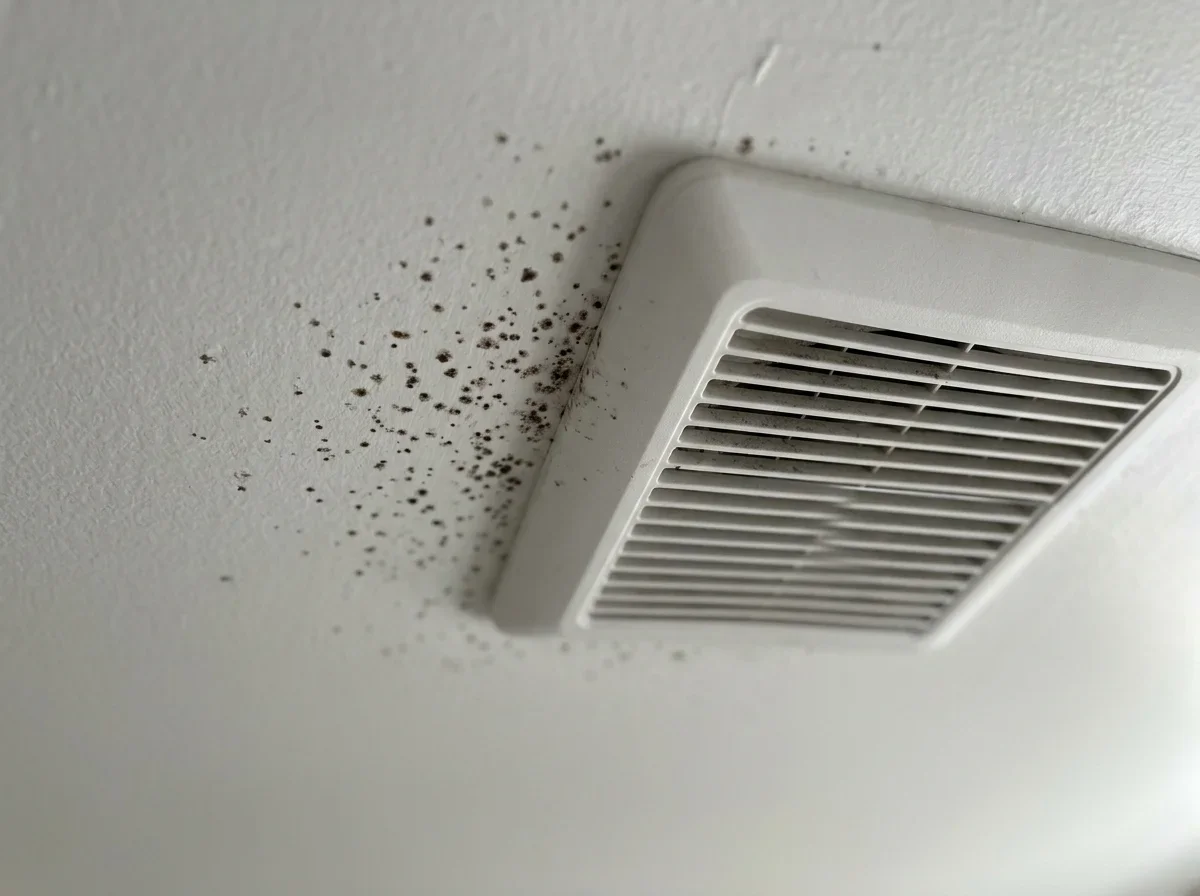
Staining that comes through from above tends to have a defined shape, such as a ring with a darker edge. It doesn't wipe away.
Black, Green, White and Pink Growth
Color alone doesn't tell you how risky a growth is. You can't judge health effects by looking.
For more on that question, see the health risks of black mold.
Mold or Mildew and Why the Difference Matters Less Than the Cause
Mildew is usually a flat, powdery surface growth, while mold often looks fuzzier or more deeply rooted. In practice the fix starts the same way: find the moisture.
Soft or sagging drywall, bubbling paint, or a musty smell when the fan is off mean moisture is inside the ceiling, not just on it.
Why Bathroom Ceilings Grow Mold
Shower steam condenses on the coolest surface in the room, and that's often the ceiling. In Texas, where air conditioning runs 8 months or more a year, a chilled ceiling meets hot shower steam and collects moisture quickly.
EPA notes that poorly ventilated bathrooms encourage mold growth.[6]
Undersized or Weak Exhaust Fans
HVI generally recommends about eight air changes per hour, which commonly works out to 1 CFM per square foot, with at least a 50-CFM fan for bathrooms of 50 square feet or less.[4] A fan can hum along and still move very little air if it's undersized, clogged, or has a split duct.
Fans That Vent Into the Attic
A fan that ends in the attic dumps warm, wet air onto the cooler roof deck and insulation. That can grow mold in the attic and on the bathroom ceiling below. EPA advises venting bathrooms outdoors.[3]
The parts of the system
Where bathroom moisture can go
Shower steam
Condenses on the cooler ceiling
Exhaust fan
Should move air out
Duct
Check for disconnected or crushed sections
Attic
Wet air here grows mold on insulation and roof deck
Outdoors
Where the duct should end
If you find growth in both places, the mold in the attic above the bathroom page explains what to look for.
Long Showers and Closed Doors
Long, hot showers with the door shut and the fan off load the room with moisture.
HVI recommends leaving the fan on for 20 minutes after use.[5]
Leaks From Above
Roof leaks, pipe leaks and overflowing fixtures are among the common moisture sources the Texas Department of Licensing and Regulation (TDLR) lists.[1] If the bathroom sits under an upstairs tub or shower, a slow supply-line or shower-pan leak is a real possibility.
Work Out the Source Before You Clean
Scrubbing before diagnosing is how mold comes back. Read the pattern first, then check what it points to.
| Where the growth is | What it suggests | What to check next |
|---|---|---|
| Centered over the shower or toilet | Condensation | Fan airflow, run time, door habits |
| In a line along the fan housing or duct run | Fan leaking or dumping humid air | Duct connections, where the duct ends |
| Ring-shaped stain with a darker edge, or a patch that grows after rain or the upstairs shower | Leak from above | Attic, roof, upstairs plumbing |
| Spreading stain that returns after cleaning | Moisture still behind the drywall | Moisture meter, attic inspection |
Next, test the fan. Hold a tissue at the grille: it should cling firmly.
Pro tip
A fan that hums but can't hold a tissue at the grille is moving very little air. Check for a clog, an undersized unit or a split duct before blaming the paint.
If the attic is safe to enter, follow the duct to see where it ends. Texas summer attics get dangerously hot, so go in the morning and wear a mask. Look for disconnected or crushed sections and damp or dark insulation.
Safe Cleaning for Small Areas
Cleaning suits small, surface-level growth on a dry, solid surface. It does not fix soft, stained or crumbling material.
What to Wear and How to Set Up
Wear gloves and eye protection, and use a mask or respirator suited to the task. Open a window or run the fan, and never mix cleaning products.
How it works
How to clean a small area
Step 1: Set up ventilation and wear protective gear
Step 2: Lightly dampen with detergent and water
Step 3: Wipe gently with a soft cloth or sponge
Step 4: Dry the surface completely
Step 5: Photograph it and mark the edges
Tracks any return
- Set up ventilation and put on protective gear.
- Lightly dampen the area with detergent and water.
- Wipe gently with a soft cloth or sponge.
- Dry the surface completely.
- Photograph it and mark the edges to track any return.
Baking Soda, Vinegar and Detergent Compared
EPA's guidance for hard surfaces is to clean with water and detergent and dry completely.[3] That's the best-supported method for painted drywall.
| Option | On painted drywall | Limits |
|---|---|---|
| Detergent and water | Removes surface growth | Needs full drying |
| Baking soda | Mild abrasive for gentle scrubbing | No EPA-backed claim that it treats the cause |
| Vinegar | Popular household choice | Claims that it kills a wide range of mold species are marketing unless sourced; the EPA cleanup guidance above does not rely on it |
What Not to Do
Don't soak drywall, and never mix bleach with ammonia or vinegar, since that can release toxic fumes. Bleach is also a poor fit for porous ceiling material because it doesn't reach growth beneath the surface.
The Texas 25 Square Foot Line
Texas requires a TDLR license for mold remediation, but jobs under 25 contiguous square feet and certain owner work are exempt.[1] That's a licensing line, not a safety line.
Only licensed work produces a certificate of mold remediation. For the full rules, see Texas TDLR mold licensing.
Fixing the Cause So Mold Stays Gone
Cleaning treats the symptom. These changes treat the cause.
Key takeaways
Size the fan to the room and vent it outdoors, not into the attic
Run the fan during showers and for about 20 minutes afterward
Keep indoor humidity between 30% and 60%
Repair leaks and dry everything before repainting
Ventilation Upgrades
Size the fan to the room using the HVI guideline above, and have it vent outdoors through a short, sealed duct, not into the attic.[4]
Moisture and Humidity Habits
Run the fan during showers and for about 20 minutes afterward.[5] EPA recommends keeping indoor humidity between 30% and 60% and using air conditioners or dehumidifiers.[3]
Paint and Surface Finishes
Mold-resistant paint is a supporting measure only. Repair leaks first, let everything dry fully, then repaint.
Check Whether the Fix Worked
Use a simple timeline:
- Day 0: Photograph the cleaned area.
- Give it some time: Check again after normal use.
- After the next rain: Look for new staining.
Any return in the same spot points to a hidden source.
When to Call a Professional
Larger or recurring cases need more than a wipe-down. If you're weighing the choice, see DIY versus professional mold removal, or go straight to bathroom mold removal services.
Signs the Job Is Bigger Than a Cleaning
Call a pro when:
- Growth approaches 25 contiguous square feet
- It returns after cleaning
- It sits over a suspected leak
- The drywall is soft, bubbling or sagging
- You find growth in the attic too (see attic mold removal)
If drywall must come out, permit rules vary by city. Houston exempts repairs up to 100 square feet, Austin exempts up to 128, and Fort Worth requires a permit at 16 square feet or more.
Checklist
Signs to call a professional
0 of 5 ticked
Tick them off as you go. Nothing is saved or sent.
What a Licensed Process Looks Like
In Texas, assessment and remediation must be done by separate licensed parties. The assessor writes a protocol, the remediator follows a work plan, and licensed jobs end with a certificate of mold remediation within 10 days of completion.[2]
Ask for the TDLR license number and type, then verify it with TDLR at tdlr.texas.gov/mld or by calling 800-803-9202.
Health Concerns and Insurance Questions
Reactions to mold vary by person. People with asthma, allergies or weakened immune systems should skip DIY cleaning and let someone else handle it.
On insurance, most Texas homeowner policies cover sudden and accidental leaks but usually not gradual ones, and many exclude or cap mold remediation. Photograph the damage and get a written scope of work.
Coverage isn't guaranteed, so read whether Texas homeowners insurance covers mold before you file.
Frequently Asked Questions
Is it mold or mildew on the bathroom ceiling?
Mildew tends to look flat and powdery, mold fuzzy or raised, but the two are hard to tell apart by eye. Either one means the ceiling stays damp.
Can I clean mold with baking soda?
Baking soda works as a gentle abrasive, but EPA's hard-surface guidance centers on detergent and water, then drying completely.[3]
Does vinegar kill mold on ceilings?
Vinegar is popular, but claims that it kills many mold species are marketing unless sourced. EPA guidance emphasizes removing growth with detergent and water, drying, and fixing moisture.[3]
What are the health risks of mold exposure?
Symptoms vary by person, and people with asthma, allergies or weakened immunity are generally more sensitive.
Is black mold on a bathroom ceiling dangerous?
Color doesn't show how harmful a growth is. Treat any growth as a moisture warning, and see the black mold health page for more.
Why does mold keep coming back on my bathroom ceiling?
Usually the moisture source is still there: a weak fan, a duct venting into the attic, or a hidden leak. See why mold keeps coming back.
- Texas Department of Licensing and Regulation. "Mold Assessors and Remediators FAQs." https://www.tdlr.texas.gov/mld/mldfaq.htm. Accessed October 17, 2026.
- Texas Department of Licensing and Regulation. "Mold Assessors & Remediators At A Glance." https://www.tdlr.texas.gov/media/pdf/mold-assessors-and-remediators-at-a-glance.pdf. Accessed October 17, 2026.
- U.S. Environmental Protection Agency. "What are ten things I need to know about mold?." https://www.epa.gov/mold/what-are-ten-things-i-need-know-about-mold. Accessed October 17, 2026.
- Home Ventilating Institute. "Bathroom Exhaust Fans." https://www.hvi.org/resources/publications/bathroom-exhaust-fans/. Accessed October 17, 2026.
- Home Ventilating Institute. "Bathroom Ventilation." https://www.hvi.org/resources/publications/bathroom-ventilation/. Accessed October 17, 2026.
- U.S. Environmental Protection Agency. "Biological Contaminants and Indoor Air Quality." https://www.epa.gov/indoor-air-quality-iaq/biological-contaminants-and-indoor-air-quality. Accessed October 17, 2026.